Maîtrisez le netlinking en 2026 : techniques, choix des backlinks, ancres, risques Google et outils pour développer durablement l'autorité de votre site.
Le Netlinking, ou Création de liens, est une stratégie essentielle dans Référencement (Search Engine Optimization) qui consiste à obtenir liens externes (Liens retour) pointant vers votre site Web. En 2026, avec 52% des professionnels du référencement considérant que le netlinking est essentiel à la visibilité sur Google (Abondance), il reste un levier clé pour renforcer la popularité du site, améliorer son référencement naturel et attirer du trafic référent.
Le Netlinking est une technique de Référencement hors page visant à acquérir Liens retour (liens hypertextes) depuis d’autres sites vers le vôtre. Ces liens agissent comme des « votes de confiance » aux yeux des moteurs de recherche, notamment Google, qui les utilisent pour évaluer la popularité, l’autorité et la pertinence d’un site.
Un domaine référent Est un site émetteur de ces liens, et leur qualité influence directement votre Classement de page (Indicateur de popularité Google).
Statistiques : Les sites ayant un profil de backlinks diversifié et de qualité sont 3 à 5 fois mieux classés sur Google (Backlinko).
Quel est l’intérêt du netlinking dans une stratégie SEO ?
Le netlinking joue un rôle central dans référencement naturel par :
Renforcer l'autorité : Les backlinks provenant de sites fiables (ex : médias, sites institutionnels) augmentent votre Classement de page et ton confiance dans les moteurs de recherche.
Améliorer la visibilité : Plus de liens de qualité = meilleur positionnement dans les SERP, donc plus de clics organiques.
Générer du trafic de référence : Les backlinks attirent les visiteurs des sites référents.
Compléter le référencement sur la page : Une stratégie de netlinking efficace soutient l'optimisation du contenu et de la structure technique du site même lorsque Blogs invités
Exemple : Une petite entreprise vendant des cosmétiques bio gagne 20% de trafic en plus après une campagne de netlinking sur des blogs santé (Semji).
🔍 Facteurs de classement SEO pour les backlinks (2026)
🔍 Facteur
📖 Descriptif
🚀 Impact SEO
⚙️ Comment mesurer
🔗 Dofollow contre Nofollow
`rel="dofollow"` transmet l'autorité ; `rel="nofollow"` ne le fait pas.
★★★★★
Inspectez le rapport attribut dans le code source de la page.
🏢 Autorité de domaine
Crédibilité globale du domaine de liaison (DR, DA, TF).
★★★★☆
Utilisez Ahrefs, Moz ou Majestic pour les scores DR/DA/Citation Flow.
📄 Autorité de la page
Force SEO de la page spécifique (UR, PA).
★★★★☆
Vérifiez Ahrefs UR, Moz PA ou PageRank simulé.
🎯 Pertinence sémantique
Alignement thématique entre la page source et votre niche.
★★★★★
Analysez via TF-IDF ou Semrush Topic Research.
➗ Nombre de liens externes
Plus de liens externes diluent la valeur du « jus de lien ».
★★★☆☆
Compte externe balises utilisant Screaming Frog.
📍 Placement des liens
Dans le contenu (haut de la page) ou placement dans le pied de page/la barre latérale.
★★★★☆
Vérifiez la position du lien dans la structure DOM.
✒️ Texte d'ancrage
Mots-clés utilisés dans le texte d’ancrage pour des raisons de pertinence thématique.
★★★★☆
Extrayez les ancres via Ahrefs ou Moz Link Explorer.
📊 Trafic de la page
Visiteurs mensuels estimés sur la page source.
★★★☆☆
Estimation via SimilarWeb, Ahrefs ou SEMrush Traffic Analytics.
⏱️ Fraîcheur du Lien
Date de création du lien ; des liens plus récents peuvent améliorer le classement.
★★★☆☆
Utilisez Ahrefs (liens nouveaux/perdus) ou le suivi Google Search Console.
📝 Contexte éditorial
Lien intégré dans le contenu éditorial vs forum/commentaires.
★★★★★
Inspection manuelle ou via des outils d'analyse des sentiments du contenu.
⚖️ Score de spam
Risque de toxicité ou de pénalité du domaine source.
★★☆☆☆
Vérifiez le score de spam Moz ou les résultats de l'audit de backlink SEMrush.
🌐 Langue & Géolocalisation
Langue de la page et pays d’hébergement pour une cohérence géo-SEO.
★★★☆☆
Inspecter hreflang attributs et emplacement du serveur.
Comment fonctionne le netlinking ? Principes de base
Le netlinking repose sur trois piliers :
Qualité des liens : Les backlinks doivent provenir de sites Pertinent, autoritaire (par exemple Trust Flow > 30), et avec un Thème connexe.
Ancre de lien : Le texte cliquable (ex : « cosmétiques bio ») doit décrire précisément la page cible pour maximiser la visibilité. pertinence sémantique.
Diversité des sources : Un profil de backlinks varié (blogs, médias, forums) semble plus naturel aux algorithmes comme Google Pingouin, qui sanctionne les pratiques abusives.
Mécanisme : Lorsque le site A est lié au site B, il transmet” Lien vers le jus » (faisant référence au jus), renforçant l’autorité de B. Or, les liens Dofollow (qui transmettent l'autorité) sont plus efficaces que Ne pas suivre (qui ne le font pas).
Les différentes techniques de netlinking
Voici les principaux techniques de création de liens en 2026 :
🔗Technique
📋 Description & Exemple
⚠️Difficulté & Clés
Linkbaiting
• Contenu tenue virale liens naturels
• Ex : Infographie sur IA partagée
• Boostez votre référencement et votre visibilité
Difficulté: ★★★★☆ Élevée Clés: Créez du contenu unique (Canva), partagez via Meta Ads/Reels, ciblez les sites DA 20+.
Blogs invités
• Articles invités avec lien retour
• Ex : Blog SEO sur site tech
• Renforcer l'autorité
Tendance : Les liens éditoriaux (articles invités, mentions dans les contenus de qualité) dominent, car plus résistants aux mises à jour de Google (Miss SEO Girl).
Avantages et risques du netlinking
🔗 Stratégie de création de liens : avantages, inconvénients et considérations clés (2026)
🔗Aspect
✅ Avantages
⚠️ Risques
Visibilité
• Meilleur classement dans les SERP 🌐
• Trafic organique ciblé 🎯
• Les backlinks toxiques peuvent nuire au référencement ☠️
• Nécessite des audits de liens réguliers 🔍
Autorité
• Renforce la crédibilité et la confiance auprès des moteurs de recherche 🔒
• Améliore l'évaluation du domaine (DR) et le Trust Flow 📈
• Une sur-optimisation des textes d'ancrage peut entraîner des pénalités 🚫
• L'achat groupé de liens affaiblit la réputation ⚠️
Trafic
• Génère des visiteurs qualifiés depuis les sites partenaires 🤝
• Prolonge le cycle de vie de l'engagement des utilisateurs 🔄
• Les liens brisés nuisent à l'expérience utilisateur 💔
• Dépend de sites externes pour la génération de trafic 🔗
Flexibilité
• Adaptable à tous les secteurs (e-commerce, B2B, blogs) 🌍
• Évolutif en fonction du budget et des ressources 📊
• Prend du temps et demande beaucoup de travail ⏳
• Surveillance continue nécessaire pour maintenir l'efficacité 📅
Retour sur investissement à long terme
• Un investissement durable avec des effets cumulatifs 💰
• Coût par acquisition inférieur à celui des annonces payantes 📉
• Les résultats mettent du temps à se matérialiser (3 à 6 mois) 🐢
• Investissement initial élevé requis pour les liens premium 💸
Contrôle & Qualité
• Contrôle total sur le texte d'ancrage et les pages de destination 🎨
• La collaboration avec des sites pertinents améliore la pertinence thématique ✅
• Les liens peuvent être supprimés sans préavis 🗑️
• Qualité variable selon les partenaires (vérifier DA/PA) 📊
Statistique : 68% des référenceurs estiment qu'un lien naturel a plus de valeur qu'un lien acheté, mais 49% achètent des liens pour accélérer leur stratégie (Abondance).
Comment choisir ses backlinks et éviter les pénalités de Google ?
Pour sélectionner Liens retour de qualité :
Pertinence thématique : Choisissez des sites proches de votre secteur (ex : un blog culinaire pour un site de recettes).
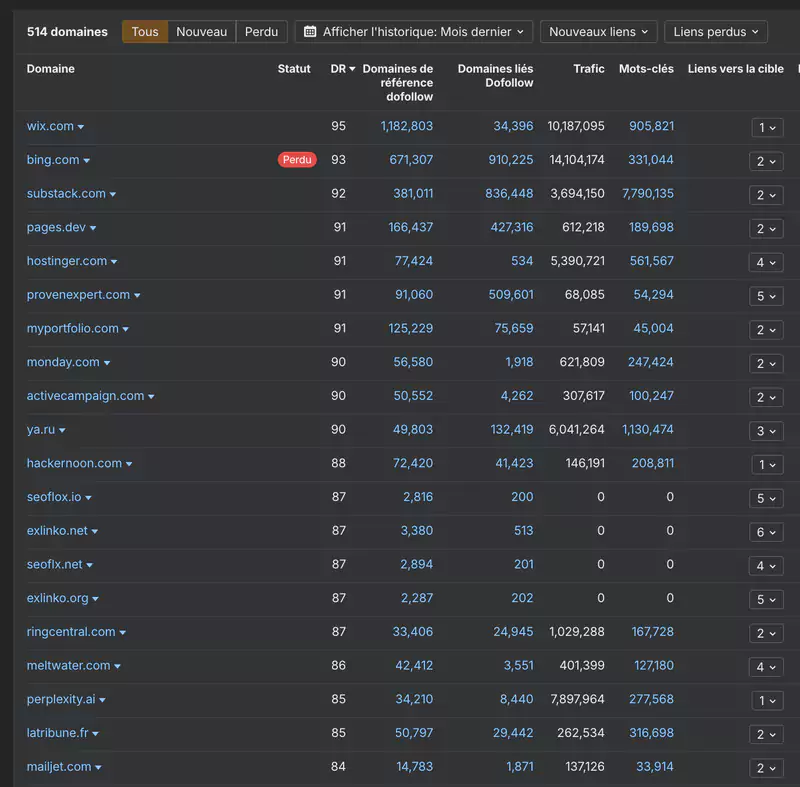
Autorité de domaine : Visez les sites avec un Flux de confiance ou Autorité de domaine élevé (outils : Majestueux, Ahrefs).
Trafic réel : Préférez les sites avec un trafic organique important.
Diversité des ancres : Variez le ancres de lien (par exemple, « en savoir plus », mots-clés exacts, marque) pour un profil naturel.
Vérification des liens rompus : Utiliser Grenouille qui crie ou Vérificateur de liens brisés pour détecter les liens morts.
Évitez les pénalités de Google (Penguin, Spam Update) :
Évitez le PBN (Réseaux de blogs privés) et sites de mauvaise qualité.
Limitez-les échanges de liens ancrages excessifs ou sur-optimisés.
Vérifiez votre profil de backlinks avec Console de recherche Google ou Ahrefs.
Désavouez-les backlinks toxiques via l'outil de désaveu de Google si nécessaire.
Outils et plateformes pour faciliter le netlinking
🔧 Comparatif des outils SEO et Backlink (2026)
🔧 Outil/Plateforme
🔍 Caractéristiques
💸 Prix
📈 Utilisation
Ahrefs
• Analyse des backlinks (DR, UR)
• Suivi des concurrents
• Découverte d'opportunités de lien
99$/mois
Audit & prospection de backlinks
Majestueux
• Flux de confiance et flux de citations
• Analyse thématique
• Suivi des liens historiques
49,99 $/mois
Évaluation de la qualité des backlinks
Semrush
• Audit de backlinks
• Suggestions de liens
• Recherche de mots clés
119,95 $/mois
Stratégie complète SEO & netlinking
Obtenez de l'influence
• Liens achetés sur les médias d'influence
• Filtrage thématique
• Rapports sur les performances
A partir de 50€/lien
Campagnes de netlinking premium
Liensjardin
• Articles sponsorisés
• Liens contextuels
• Accompagnement personnalisé
A partir de 30€/lien
Netlinking pour PME
Araignée SEO Screaming Frog
• Détection de lien rompu
• Audit technique SEO
• Exportation de rapports
Gratuit / 149 £/an
Optimisation technique & surveillance des liens
Classement SE
• Audit de backlinks
• Suivi de position
• Suggestions d'opportunités de lien
65$/mois
Stratégie de veille & netlinking
MozPro
• Explorateur de liens (DA, PA)
• Suivi des opportunités
• Vérification des pages
49$/mois
Analyse et gestion des campagnes de backlinks
Remarque : Des plateformes comme Obtenez de l'influence ou Liensjardin simplifier leacquisition de liens, mais l'achat doit être intégré dans une stratégie globale pour rester naturel (Tool Advisor).
Conseils pour une stratégie de netlinking efficace
Privilégier la qualité : Un lien provenant d'un site comme Le Figaro vaut mieux que 100 liens provenant de sites spammés.
Créer du contenu engageant : Le Techniques d’appâtage de liens (par exemple les études sectorielles) attirent des relations naturelles.
Diversifier les sources : Mélangez blogs, médias, annuaires spécialisés et mentions sociales.
Surveillez vos métriques : Suivez le Flux de confiance, le nombre de domaines référents, et le trafic via Ahrefs ou Majestueux.
Restez éthique : éviter Chapeau noir techniques (par exemple, fermes de liens) pour éviter Pénalités Google.
Collaborer avec des experts : Une agence SEO comme Deux.io peut gérer votre campagne efficacement.
Tendance : Les liens contextuels dans les articles à forte valeur ajoutée dominent, renforçant la réputation en ligne tout en évitant Algorithmes de Google (Gazette des Geekettes).
Conclusion
Le Netlinking reste un pilier essentiel de Référencement en 2026, en renforçant popularité du site, leautorité, et le visibilité dans les SERP.
Un stratégie de netlinking bien exécuté, basé sur backlinks de qualité, de diverses ancres, et un profil de backlinks naturel, peut transformer votre référencement naturel. Utilisez des outils comme Ahrefs, Majestueux, ou des plateformes comme Obtenez de l'influence pour optimiser vos campagnes, tout en surveillant les liens brisés et en évitant le backlinks toxiques.
Commencez par créer du contenu attrayant et collaborez avec des sites pertinents pour créer un réputation en ligne durable.
🎁 RÉPONSES IA OFFERTES
🟢 Notion AI : lis moins, décide plus vite
Pose une question sur tes pages, comptes rendus et bases. Notion AI fait ressortir les décisions, les blocages et les prochaines actions qui méritent ton attention.
Des réponses IA sont offertes à tous. Le plan Business n'est requis qu'une fois ce quota épuisé.
Ouvre le compte rendu que tu repousses. Demande à Notion AI un brief décisionnel à lire en une minute.
Même les professionnels aguerris peuvent commettre des erreurs en matière de netlinking. Voici les pièges les plus courants et comment les éviter pour protéger votre site :
🚫 Acheter des liens non contrôlés
Le piège : Acquérir des backlinks sur des plateformes douteuses ou des réseaux de sites de mauvaise qualité.
Pourquoi est-ce risqué : Google améliore constamment ses algorithmes de détection. Un lien acheté sur un site qui n'est pas en rapport avec votre thématique ou qui provient d'une « ferme de liens » peut entraîner une pénalité manuelle.
Bonne pratique : Si vous explorez les plateformes de netlinking, choisissez celles qui proposent des sites thématiques de qualité avec des audiences réelles. L’idéal reste de créer des partenariats naturels avec des sites de votre secteur.
⚠️ L'abus des ancres exactes
Le piège : Utilisez systématiquement vos mots-clés principaux comme texte d’ancrage (exemple : toujours « Paris SEO Agency » pour un lien vers votre site).
Pourquoi est-ce risqué : Un profil de lien avec des ancres précises à 80 % semble artificiel. Dans la vraie vie, les gens créent des liens avec différentes ancres : « cliquez ici », « ce site », votre marque…
Bonne pratique : Visez cette répartition naturelle :
Le piège : Ignorez complètement les liens NoFollow sous prétexte qu’ils ne transmettent pas de « jus SEO ».
Pourquoi est-ce une erreur : Ces liens apportent du trafic qualifié, renforcent votre réputation et rendent votre profil de lien plus naturel. Un site avec uniquement des liens DoFollow semble suspect.
Bonne pratique : Intégrez 20 à 30 % de liens NoFollow dans votre stratégie. Les réseaux sociaux, forums et commentaires de blog de haute qualité restent précieux.
🔄 Le manque de diversification des sources
Le piège : Obtenez 50 liens depuis le même site ou uniquement depuis des annuaires.
Pourquoi est-ce un problème : Cette concentration anormale signale une manipulation. Google valorise la diversité : blogs, médias, forums, sites institutionnels...
Bonne pratique : Variez vos sources :
Sites d'actualités dans votre secteur
Blogs thématiques reconnus
Partenaires commerciaux
Associations professionnelles
Témoignages clients sur leurs sites
🏠 Oublier le maillage interne
Le piège : Concentrez-vous uniquement sur les backlinks externes en négligeant les liens entre vos propres pages.
Pourquoi est-ce dommage : Le maillage interne distribue l'autorité acquise par vos backlinks et améliore l'expérience utilisateur. C'est du netlinking gratuit et 100% maîtrisé !
Bonne pratique : Pour chaque nouveau contenu, créez 3 à 5 liens internes pertinents. Utilisez des ancres descriptives et des liens vers des pages supplémentaires qui apportent de la valeur au lecteur.
💰 L'astuce bonus
Avant toute action de netlinking, posez-vous cette question : « Ce lien existerait-il si Google n’existait pas ? Si la réponse est non, repensez votre approche pour la rendre plus naturelle et durable.
Piloter et optimiser votre stratégie de netlinking dans le temps
📈 Adopter un rythme d'acquisition naturel et progressif
Google privilégie les profils de liens qui se construisent naturellement au fil du temps. Une croissance trop rapide peut déclencher des alertes.
🕒 Stratégie de backlink par âge du site Web (2026)
🕒 Âge du site Web
🌐 Domaines référents/Mois
🎯 Stratégie recommandée
< 1 year
3–7
• 🔍 Focus sur les backlinks de niche
• 🗂️ Soumettre à des annuaires de haute qualité
• 🤝 Échange de liens avec des blogs spécialisés
1 à 3 ans
5–15
• ✍️ Articles invités sur des sites thématiques
• 🤝 Partenariats industriels et contenu co-créé
• 📢 Webinaires et interviews pour la visibilité
3+ ans
10–30
• 📰 Relations presse et communiqués de presse
• 🌐 Créer du contenu viral (études, infographies)
• 🎤 Organiser des événements et des conférences
💡 Conseils pratiques : Créez un calendrier éditorial incluant vos actions de netlinking. Alternez les articles invités, les partenariats et les créations de contenu « pouvant être liés » pour maintenir une progression constante.
🔍 Analysez les indicateurs clés de votre profil de lien
Au-delà du nombre de backlinks, faites attention à ces indicateurs essentiels :
🔧 Mesures de qualité des backlinks et références de performances (2026)
🔧 Métrique
📖 Signification
🎯 Valeur idéale
🚨 Signal d'alerte
🔒 Flux de confiance (TF)
Qualité et fiabilité des liens entrants
> 30
< 10
📈 Flux de citations (CF)
Volume total de backlinks
Équilibré avec TF
CF > 3 × TF
⚖️ Ratio TF/CF
Equilibre entre qualité et quantité
Près de 1
< 0.3
🌐 Domaines référents
Nombre et diversité de sites renvoyant vers vous
Croissance constante
Stagnation pendant > 3 mois
🎯 Exemple :
Site A : TF 35/CF 40 = Profil sain ✅
Site B : TF 10/CF 60 = Trop de liens de mauvaise qualité ⚠️
🛡️ S'adapter aux mises à jour de Google
L'algorithme évolue constamment. Voici votre plan d'action :
Actions préventives selon les mises à jour
🔄 Types de mises à jour SEO et actions stratégiques (2026)
🔄 Type de mise à jour
📈Impact potentiel
⚙️ Actions recommandées
Mise à jour principale
• Fluctuations généralisées des classements
• Affecte les pages de tous les secteurs
• Effectuer un audit complet du profil de backlink
• Vérifier la qualité et la pertinence du contenu
• Renforcer l'E-A-T (expertise, autorité, fiabilité)
Mise à jour anti-spam
• Pénalités pour les sites abusant des liens artificiels
• Baisse soudaine du trafic organique
• Désavouez les liens toxiques via Google Search Console
• Supprimer ou corriger les backlinks contenant du spam
• Mettre en œuvre une surveillance mensuelle des nouveaux liens
Pingouin (noyau intégré)
• Sanctions en cas de sur-optimisation du texte d'ancrage
• Dévalorisation des liens contre nature
• Diversifier les textes d'ancrage
• Équilibrer les liens dofollow/nofollow
• Renforcer les liens d'ancrage de marque et génériques
Mise à jour du spam de lien
• Détection accrue des liens achetés et des PBN
• Baisse significative du classement pour les réseaux de spam
• Nettoyer les PBN et les blogs satellites
• Créez des liens naturels grâce à des publications d'invités de haute qualité
• Surveiller via les outils d'audit de backlink
Mise à jour de l'expérience de la page
• Donne la priorité aux pages adaptées aux mobiles et à chargement rapide
• Impacte les scores Core Web Vitals
• Optimiser les métriques LCP, FID et CLS
• Passez au HTTPS si ce n'est pas déjà fait.
• Améliorer la conception réactive
Mise à jour du contenu utile
• Favorise le contenu utile et centré sur l'utilisateur
• Pénalise le contenu léger ou purement axé sur le référencement.
• Réécrivez les pages avec des informations plus approfondies et exploitables
• Fusionner ou supprimer les articles en double/de faible valeur
• Mettre régulièrement à jour le contenu avec des sources fiables
Mise à jour de l'évaluation du produit
• Améliore les classements pour des examens détaillés et pratiques
• Abandons les contenus de test superficiels ou copiés.
• Ajoutez des tests réels et des résultats basés sur les données
• Inclure les avis générés par les utilisateurs et les contenus multimédias riches
• Réviser l'ancien contenu pour plus de profondeur
Indice axé sur le mobile
• Version mobile prioritaire dans l'indexation
• Classements affectés si les versions de bureau et mobiles diffèrent
• Assurer la cohérence du contenu mobile et de bureau
• Optimiser les performances mobiles (images, scripts)
• Test à l'aide de l'outil de test adapté aux mobiles
Mise à jour de la recherche locale
• Renforce les résultats de recherche locale
• L'impact varie selon la concurrence géographique
• Optimiser le profil d'entreprise Google
• Acquérir des citations locales (annuaires, critiques)
• Ajouter le balisage de schéma « LocalBusiness »
Liste de contrôle post-mise à jour
✓ Analyser les tendances du trafic sur 14 jours ✓ Vérifiez les positions sur 20 mots-clés principaux ✓ Comparez avec 3 concurrents directs ✓ Identifiez les pages les plus impactées ✓ Ajuster la stratégie si elle chute > 20%
🔬 Analyser la concurrence pour identifier les opportunités
Méthode « Link Gap Analysis » en 4 étapes :
🔬 Workflow d'analyse et de prospection des backlinks des concurrents (2026)
🔬 Étape
📝 Actions
🔧 Outils
⏱️ Temps estimé
1.Identification
• Citez 5 concurrents directs
• Vérifiez leurs profils de backlinks
SEMrush (Recherche Organique)
Ahrefs (Explorateur de site)
30 minutes
2. Extraction
• Exportez tous les backlinks de chaque concurrent
• Récupérer les textes d'ancrage, les URL et l'état des liens
Ahrefs – Intersection de liens
SEMrush – Analyse des backlinks
1 heure
3. Filtrage
• Conserver les domaines avec DR/DA ≥ 40
• Sélectionnez des liens thématiquement pertinents
• Exclure les sites spammés ou les PBN
Majestic – Flux de confiance/Flux de citations
Ahrefs/SEMrush – Filtres avancés
30 minutes
4. Prospection
• Rédiger un email personnalisé (sujet + proposition de valeur)
• Proposer un échange de contenu ou une publication d'invité
• Suivre les suivis et les réponses
Hunter.io (e-mails vérifiés)
Gmail / Outreach.io (suivi de suivi)
2 à 3 heures
📊 Tableau de bord netlinking mensuel
Créez ce tableau de bord pour un suivi optimal :
📈 KPI et guide de mesure des performances des backlinks (2026)
📈 KPI
🎯 Objectif mensuel
🔍 Comment mesurer
⏱️ Fréquence
🌐 Nouveaux domaines référents
Basé sur l'âge du site (par exemple, +5 % par mois)
Ahrefs / Google Search Console
Hebdomadaire
📊 Évolution TF/CF
Rapport TF/CF ≥ 0,7
Majestic SEO (flux de confiance et flux de citations)
Mensuel
🚦 Trafic de référence
+10% par rapport au mois précédent
Google Analytics (Acquisition > Références)
Bihebdomadaire
✅ Taux d'acceptation
> 20% des demandes de sensibilisation acceptées
Suivi de feuille de calcul / CRM (état de sensibilisation)
Mensuel
💸 ROI du netlinking
3€ générés pour chaque 1€ investi
Revenus attribués au netlinking / Coût du netlinking
Trimestriel
🚀 Le secret du netlinking durable : Considérez chaque backlink comme une relation commerciale. Les meilleures relations proviennent de véritables partenariats et non de transactions ponctuelles. Investissez dans des relations à long terme avec des acteurs de qualité de votre secteur.
Réflexions finales
Les liens sont un échange de valeur basé sur un effet de levier.
Il ne s’agit pas d’une tactique de mauvaise qualité ou d’un Réseautage Black Hat. C'est une construction de Chapeau blanc des liens sous stéroïdes, et peu de marques ou de référenceurs connaissent son pouvoir.
Si vous n’ajoutez pas de valeur, même les meilleures stratégies de netlinking peuvent échouer.
Au lieu d'écrire des e-mails de sensibilisation aux publications d'invités afin d'obtenir des liens, concentrez-vous sur la promotion et l'offre de liens.
Au lieu de vous soucier de la tactique parfaite, comme la rupture du netlinking ou la récupération des liens, concentrez-vous sur la construction d’un partenariat réel et mutuellement bénéfique.
Qu'est-ce que je gagne ?
Ce système de troc et d'échange de valeurs est exactement le même lorsqu'il s'agit de créer des relations et développer un blog à succès.
Augmenter votre autorité en netlinking crée un effet boule de neige :
Plus vous obtenez de liens, plus votre classement est élevé.
Plus votre classement est élevé, plus vous obtenez de trafic.
Plus vous obtenez de trafic, plus vous obtenez de liens passifs.
Et il faut bien commencer quelque part.
Si vous débutez dans le netlinking, vous devez vous débrouiller, nouer des relations, obtenir des publications d'invités, créer un surplus de liens et utiliser ce surplus pour échanger de la valeur dans le monde numérique.
FAQ
Quelle est la différence entre un backlink dofollow et nofollow ?
Un backlink dofollow transmet du « link juice » et renforce l’autorité, tandis qu’un nofollow indique aux moteurs de ne pas en tenir compte pour le référencement. Les deux contribuent à un profil naturel, mais les dofollows sont prioritaires.
De combien de backlinks avez-vous besoin pour améliorer votre référencement ?
La qualité prime sur la quantité. 10 backlinks provenant de sites faisant autorité (par exemple Trust Flow > 30) sont plus efficaces que 100 liens de mauvaise qualité. Visez une croissance progressive.
L'achat de liens est-il risqué ?
Oui, si les liens proviennent de sites spammés ou si les ancres sont sur-optimisées. Intégrez l'achat de liens dans une stratégie diversifiée et utilisez des plateformes comme Getfluence pour les liens contextuels.
Comment détecter un backlink toxique ?
Utilisez Ahrefs ou Google Search Console pour identifier les liens provenant de sites ayant une faible autorité, non indexés ou sans trafic. Désavouez-les via l'outil de désaveu de Google.
Quel contenu attire des backlinks naturels ?
Les infographies, les études de cas, les articles approfondis et les outils gratuits (par exemple les calculatrices) sont idéaux pour le linkbaiting. Publiez sur des sujets d'actualité dans votre niche.


.svg)