Sakana Fugu: Features, API, Performance, and Reviews of the Multi-Agent Orchestrator
Découvrez Sakana Fugu, son orchestration multi-agents, ses versions Fugu et Fugu Ultra, ses performances, son API et ses différences avec Claude, GPT et Gemini.
Sakana Fugu is a multi-agent artificial intelligence system developed by the Japanese laboratory Sakana AI. Rather than relying on a single large language model, it selects and coordinates several specialized models to solve a task behind a single interface.
Publicly unveiled on June 22, 2026, Fugu specifically targets programming, complex reasoning, scientific research, and issues requiring multiple verification steps. It distinguishes itself from Claude, GPT, or Gemini by its primary function: it is not just an additional model, but an orchestration layer capable of utilizing different agents.¹
What is Sakana Fugu?
Sakana Fugu is a family of orchestrator models offered by Sakana AI, an artificial intelligence research laboratory based in Tokyo.
The word fugu also refers to the famous Japanese pufferfish. In the context of this article, however, it is not about the fish, but a multi-agent AI system marketed as an API.
Fugu receives a request like a traditional model. In the background, however, it can:
analyze the type of problem posed;
select one or more suitable models;
assign them roles or sub-tasks;
organize their interactions;
verify and synthesize the results.
For the user, this orchestration remains largely invisible. They send a single request and receive a final response, without having to manage multiple providers, API keys, or agent chains themselves.
Architecture de Sakana Fugu en 2026 : rôle de chaque composant
Élément 🧩
Fonction dans Sakana Fugu ⚙️
Apport au workflow 🎯
🧠 Modèle orchestrateur
Analyse la demande et choisit une stratégie de résolution
Détermine les agents, rôles et étapes nécessaires
🧩 Agents spécialisés
Résolvent différentes parties du problème
Mobilisent des compétences complémentaires 🤝 Multi-agents
🔀 Routage dynamique
Sélectionne les modèles selon la tâche et son évolution
Adapte les ressources à chaque étape du raisonnement
💬 Communication inter-agents
Organise le partage des résultats et du contexte
Évite les analyses isolées et facilite la collaboration
✅ Vérification
Contrôle, critique ou complète les solutions intermédiaires
Réduit certains angles morts 🔍 Contrôle
📝 Synthèse finale
Consolide les contributions dans une réponse unique
Fournit un résultat lisible sans exposer tous les échanges
This approach is sometimes presented as a mixture-of-agents framework, by analogy with so-called mixture of experts. The difference is that Fugu coordinates complete models accessible as agents, instead of only activating internal sub-networks within a single model.
How does Sakana Fugu work?
Fugu itself is a language model trained to understand a request and build an agent organization tailored to that request.
It therefore does not rely solely on a list of manually written rules. The system learns to decide which model to engage, in what order, and with what instructions.
An adaptive orchestration process
In a simplified use case, the process can be summarized in five steps:
Fugu interprets the request and its level of difficulty.
It selects the agents likely to be the most competent.
It builds a suitable collaboration process.
The agents execute, critique, or complete the work.
Fugu aggregates the contributions into a final response.
For a simple question, this organization can remain lightweight. For a complex problem, Fugu Ultra can coordinate up to three agents and produce a longer process.
This adaptive task delegation It avoids systematically using the most expensive mechanism. The number of agents and the level of reasoning can vary depending on the detected difficulty.
Trinity and Conductor: The Technologies Behind Fugu
Sakana Fugu leverages two research papers presented at ICLR 2026: TRINITY and Conductor. The commercial product goes further than these prototypes, but they help understand the fundamental principles.²
TRINITY: Select a Model and Assign a Role
TRINITY uses a small coordinator model associated with a very lightweight selection head.
At each step, the coordinator selects a model and assigns it one of the following three roles:
Sakana Fugu en 2026 : missions des agents Thinker, Worker et Verifier
Rôle 🤖
Mission 🎯
Apport au workflow ⚙️
💭 Thinker
Décomposer le problème et proposer une stratégie de résolution
Structure les étapes avant l’exécution 🧭 Plan
🛠️ Worker
Exécuter concrètement une partie du travail attribué
Produit le code, l’analyse ou le résultat intermédiaire attendu
🔍 Verifier
Contrôler l’exactitude et la complétude du résultat
Repère les erreurs et demande les corrections nécessaires ✅ Contrôle
The process can span multiple rounds. A first agent develops a plan, a second performs the calculations or writes the code, then a third verifies the solution.
TRINITY's coordinator has been optimized, in particular, with an evolutionary strategy called sep-CMA-ES. This method tests different coordination policies, evaluates their results, then retains and combines the most effective strategies.
It is thus a form ofevolutionary optimization applied not directly to the content of the responses, but to the way models are organized.
Conductor: Build a Natural Language Workflow
Conductor adopts a more open approach.
Instead of merely selecting a model and a role at each turn, it generates a genuine multi-agent workflow in natural language. It can define:
the sub-tasks to be completed;
the responsible agents;
the instructions given to each;
the structure of their interactions;
the method for synthesizing the results.
Conductor is trained by reinforcement learning to discover effective collaboration strategies.
This architecture is an important part of Fugu Ultra, which must be able to handle longer workflows, use tools, and maintain a shared memory among multiple agents.
Fugu and Fugu Ultra: what are the differences?
At the time of its public launch, Sakana AI offers two models: Fugu and Fugu Ultra.
During the beta phase, the first version was called Fugu Mini. It was simply renamed Fugu upon commercialization.
Fugu face à Fugu Ultra en 2026 : différences de performance et d’usage
Critère 🧭
Fugu 🐟
Fugu Ultra 🐡
Objectif
Équilibre entre qualité et rapidité
Qualité maximale et raisonnement approfondi
Nombre d’agents
Routage adaptatif, généralement plus léger
Un à trois agents selon la complexité du problème
Latence
Réponse généralement plus rapide ⚡ Faible
Latence potentiellement plus élevée
Coût
Variable selon les modèles utilisés dans le pool
Tarification fixe selon le volume de jetons
Cas d’usage
– Programmation quotidienne et chatbots
– Analyse et tâches courantes
– Recherche et cybersécurité
– Problèmes complexes nécessitant plus de profondeur
Pool personnalisable
Oui, certains fournisseurs peuvent être exclus
Non, utilisation du pool complet imposée
Effort de raisonnement
🧠 high/xhigh
high ou xhigh
Choix par défaut
Oui, adapté à la majorité des usages
À privilégier lorsque la profondeur est prioritaire
Fugu is designed as the default model for interactive uses.
It is suitable for programming, code review, conversational assistants, and analyses where response time is crucial.
Fugu Ultra prioritizes depth and quality, at the cost of potentially higher latency and expense.
Sakana AI notably cites:
the reproduction of scientific articles;
data science competitions;
cybersecurity analyses;
documentary or patent research;
complex problems involving multiple steps.
Fugu Ultra is therefore not necessary for every query. Its value becomes apparent primarily when the cost of a mediocre answer outweighs that of a longer reasoning process.
Is Sakana Fugu a model like Claude, GPT, or Gemini?
Fugu can be queried like a traditional model, but its nature is different.
Claude, GPT models, and Gemini are primarily foundation models developed by a provider. Fugu acts as an orchestrator model above a set of models and agents.
Sakana Fugu face à Claude, GPT et Gemini utilisés seuls en 2026
Critère 🧭
Sakana Fugu 🐟
Modèles utilisés seuls 🤖
Lecture rapide 🔎
Architecture
Orchestrateur combinant plusieurs agents et modèles
Modèle de fondation principal appelé directement
Fugu ajoute une couche d’orchestration au-dessus des modèles
Sélection dynamique
Oui, le routage s’adapte à la requête 🔀 Dynamique
Non, le modèle est sélectionné avant l’appel
Fugu choisit les ressources selon la nature du problème
Collaboration
Plusieurs agents peuvent contribuer à une même réponse
Un seul modèle intervient par appel standard
L’approche multi-agents favorise la confrontation des analyses
Résultat produit
Synthèse consolidée des réponses générées par les agents
Réponse directe produite par le modèle choisi
Fugu privilégie la synthèse ; le modèle seul reste plus direct
Intégration
API compatible avec le format OpenAI
API propre à OpenAI, Anthropic ou Google
L’intégration Fugu peut limiter les adaptations applicatives
Transparence du routage
Visibilité limitée sur les modèles réellement mobilisés
Le fournisseur et le modèle appelés sont connus
Le modèle seul facilite davantage l’audit et la traçabilité
Latence
Variable et parfois élevée selon le nombre d’agents
Généralement plus stable ⏱️ Prévisible
L’orchestration ajoute des étapes avant la réponse finale
Coût
Dépend du routage, des agents et des modèles sollicités
Dépend directement du tarif du modèle sélectionné
Le modèle seul offre une estimation plus simple par appel
Fugu therefore doesn't necessarily replace Claude, GPT, or Gemini. It can use them as components within its own system.
The most accurate comparison isn't "Fugu versus Claude," but rather:
Should one select a model oneself, or entrust this selection and coordination to Fugu?
Is Sakana Fugu merely a model router?
A traditional router analyzes a query, selects a model, then transmits the task to it.
Fugu aims to go further. It can organize multiple interventions, assign different roles, and adapt the workflow based on intermediate responses.
Sakana Fugu en 2025 : du routage simple à la collaboration multi-agents dynamique
Approche 🧩
Fonctionnement ⚙️
Adaptation du workflow 🔀
Lecture rapide 🔎
➡️ Routeur simple
Choisit un seul modèle pour traiter toute la requête
Parcours fixe après la sélection initiale
– ✅ Rapide et prévisible
– ⚠️ Aucun ajustement selon les résultats
🗳️ Vote majoritaire
Interroge plusieurs modèles puis retient la réponse majoritaire
Comparaison collective, mais processus prédéfini
– ✅ Renforce le consensus
– ⚠️ La majorité n’assure pas toujours la précision
🧪 Mixture of Agents classique
Génère plusieurs réponses puis les combine dans une synthèse
Collaboration structurée selon un schéma généralement fixe
– ✅ Analyse plus riche 🤝 Multi-agents
– ⚠️ Agrégation parfois coûteuse
🐡 Sakana Fugu
– Attribue différents rôles aux agents
– Adapte les étapes aux réponses intermédiaires
Processus de collaboration construit dynamiquement
– ✅ Profondeur adaptée au problème 🔀 Adaptatif
– ⚠️ Latence et coût moins prévisibles
In certain situations, the system can call upon one agent to develop a strategy, another to implement it, and a third to identify errors.
This multi-step reasoning synthesis represents Fugu's key differentiator.
Our review of Sakana Fugu
Sakana Fugu offers a particularly interesting approach to multi-agent orchestration.
Instead of requiring developers to manually select Claude, GPT, or Gemini and then build their own workflows, Fugu encapsulates this complexity behind a familiar API.
Its combination of dynamic routing, reinforcement learning, and evolutionary optimization is its main advantage. Its published results on code, scientific reasoning, and agentic tasks indicate that coordination can sometimes surpass the performance of each model used separately.
Nevertheless, several limitations prevent us from hastily concluding it's a revolution.
The routing remains proprietary, costs and latency are less predictable, independent evaluations are still rare, and the service is not available in the European Union at the time of its launch.
Therefore, Fugu seems particularly relevant for teams that already use multiple models and want to outsource their selection and coordination. An organization requiring full traceability or strict control over each provider might prefer to maintain its own orchestration layer.
Nevertheless, Sakana Fugu illustrates an important evolution: the improvement of AI performance no longer solely depends on ever-larger models. It can also come from better organization of existing intelligences.
🎁 TRY AI REVOLUTION FOR FREE
Notion AI: read less and decide faster
Ask one question across your pages, meeting notes, and databases. Notion AI surfaces the decisions, blockers, and next steps worth your attention.
Everyone gets complimentary AI responses. Upgrade to Business only after you use them up.
Open the meeting notes you have been avoiding and ask Notion AI for a one-minute decision brief.
As of June 26, 2026, Sakana AI offers subscriptions and usage-based billing.
Formules et tarifs indicatifs en 2026 selon l’intensité d’utilisation
Formule 🧩
Prix affiché 💳
Usage indicatif 🎯
🟢 Standard
💳 20 $/mois
Essais, découverte et utilisation ponctuelle
🔵 Pro
💳 100 $/mois
Sessions régulières de programmation, recherche et analyse
🟣 Max
💳 200 $/mois
Tâches longues, workflows complexes et utilisation intensive
⚙️ Paiement à l’usage
Tarification variable selon la consommation
Production, volumes fluctuants et besoins évolutifs
For Fugu, usage-based billing depends on the most expensive model in the active pool. The rates for different agents are not cumulative.
For fugu-ultra-20260615, the prices displayed per million tokens are:
Tarification des jetons en 2026 selon la longueur du contexte
Type de jetons 🧾
Contexte standard 📦
Contexte supérieur à 272 000 jetons 🚀
📥 Entrée
💳 5 $
10 $
📤 Sortie
30 $
💳 45 $
♻️ Entrée en cache
0,50 $
1 $
Tokens consumed by orchestration are billed, even when not directly visible in the final response.
These prices are subject to rapid change after launch.
Key Use Cases for Sakana Fugu
Fugu is primarily intended for problems where models exhibit complementary strengths.
Programming and Software Engineering
Fugu can be integrated with Codex or another OpenAI API-compatible environment.
Its uses include:
code generation and correction;
software repository analysis;
bug fixing;
reviewing changes;
executing tasks in a terminal.
The system was trained on trajectories from environments such as Claude Code, Codex, and OpenCode. These trajectories include tool usage, execution feedback, and successive file modifications.
Scientific Reasoning
Fugu can deploy different models depending on whether the problem requires scientific knowledge, calculations, graphical understanding, or logical verification.
This dynamic specialization is particularly valuable for multidisciplinary questions that a single model might address unevenly.
Research and Document Analysis
Fugu Ultra is designed for tasks involving multiple phases:
define a research plan;
collect information;
compare sources;
check for contradictions;
produce a synthesis.
The Responses API also enables an integrated web search tool.
Data Science and Automated Research
Sakana AI showcases several experiments in which Fugu Ultra drives optimization processes over an extended period.
The model can propose a modification, run an experiment, analyze its result, and decide whether to keep or abandon the approach.
Specialized Tasks
The technical report also evaluates Fugu on problems of CAD model generation, competitive programming, interpretation of ancient documents, and reasoning over long contexts.
These examples primarily demonstrate its ability to adapt the composition of its agents to very different domains.
Advantages of Sakana Fugu
Avantages de Sakana Fugu en 2026 : orchestration multi-agents et routage dynamique
Avantage clé ✨
Fonctionnement ⚙️
Bénéfice concret 🎯
Point de vigilance ⚠️
API unique
– Regroupe plusieurs fournisseurs de modèles
– Masque le routage et la synthèse
Évite de construire une infrastructure multi-modèles complète 🔌 1 API
Le fonctionnement interne du routage reste peu visible
Sélection adaptée
Choisit un agent différent selon chaque étape du problème
Mobilise les modèles selon leurs forces spécifiques 🔀 Adaptatif
Le meilleur choix peut varier selon la requête et le contexte
Diversification des fournisseurs
Combine plusieurs éditeurs et fait évoluer le pool de modèles
– Réduit la dépendance à un seul fournisseur
– Renforce la résilience de l’infrastructure
Les données peuvent toujours transiter vers des services externes
Vérification croisée
Plusieurs agents proposent, critiquent et vérifient la solution
Réduit certains angles morts d’un modèle isolé 🤝 Multi-agents
Le consensus ne garantit ni exactitude ni absence de biais
Orchestration apprise
– Apprentissage supervisé et stratégies évolutionnaires
– Amélioration par apprentissage par renforcement
Adapte les rôles et le workflow plutôt qu’utiliser un schéma fixe
Cette sophistication peut augmenter la latence et la complexité
Limitations of Sakana Fugu
Sakana Fugu en 2026 : principaux avantages et limites à connaître
Critère 🧭
Points forts ✅
Limites ⚠️
Accès aux modèles
Accès à plusieurs modèles depuis une seule API
Le routage précis entre modèles reste peu transparent
Orchestration
Coordination dynamique des agents selon la tâche
Latence variable selon le workflow construit
Performances
Bons résultats sur de nombreux benchmarks 📊 Multi-domaines
Évaluations principalement publiées par Sakana AI
Intégration
API compatible avec le format OpenAI
Certains paramètres OpenAI ne sont que partiellement compatibles
Personnalisation
Fugu permet d’exclure certains fournisseurs du pool
Le pool complet de Fugu Ultra n’est pas personnalisable
Dépendance technologique
Réduit la dépendance à un modèle unique
Dépend toujours de fournisseurs de modèles externes
Adaptation et accès
Workflow ajusté dynamiquement à chaque problème 🔀 Adaptatif
Disponibilité géographique encore limitée
How to access this technology?
In supported regions, the user must:
create an account on the Sakana AI console;
set up a payment method or subscription;
generate an API key;
store this key securely;
call one of the models from a compatible client.
The API key is displayed only once during its creation.
Sakana AI currently offers the following model identifiers:
IdentifierUsagefuguBalanced version for everyday usefugu-ultraVersion focused on maximum qualityfugu-ultra-20260615Dated and fixed version of Fugu Ultra
The dated identifier is useful when an application needs to maintain more stable behavior despite future service updates.
How to integrate Sakana Fugu via its API?
The Sakana Fugu API is compatible with the OpenAI SDK.
It supports:
the Responses API;
the Chat Completions API;
the Models API;
streaming responses;
tool calls;
structured JSON output;
integrated web search.
Sakana AI recommends the Responses API for new integrations.
Python Integration Example
import os from openai import OpenAI
api_key = os.environ.get("SAKANA_API_KEY")
if not api_key: raise RuntimeError( "The SAKANA_API_KEY environment variable is missing." )
response = client.responses.create( model="fugu", input=( "Analyze this Python function, identify the risks " "and suggest a corrected version." ), reasoning={"effort": "high"}, timeout=120.0, )
print(response.output_text)
Switching from Fugu to Fugu Ultra only requires changing the ID:
model="fugu-ultra"
For complex processing, the timeout may need to be increased beyond 120 seconds.
Performance
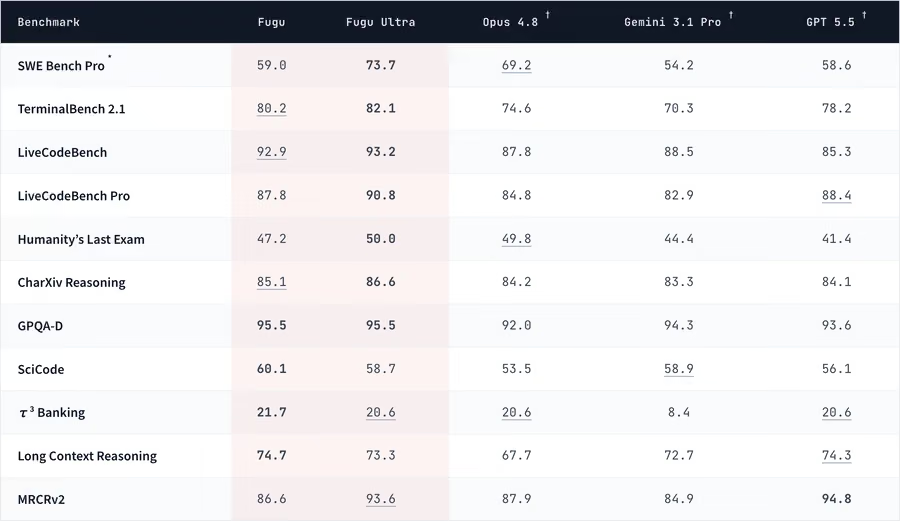
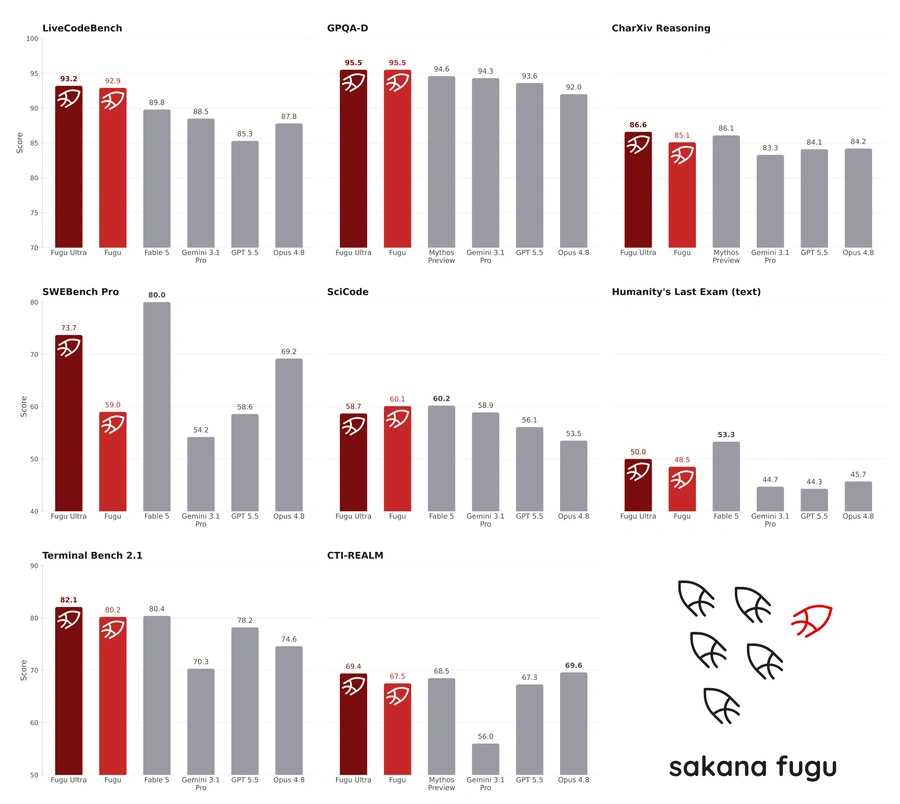
Sakana AI reports strong results on several programming, science, and reasoning benchmarks.
Performances de Sakana Fugu et Fugu Ultra sur les benchmarks en 2026
Benchmark 🧪
Fugu 🐟
Fugu Ultra 🐡
Meilleur résultat 🏆
SWE-Bench Pro
59,0
🏆 73,7
Fugu Ultra, avec un avantage marqué
Terminal-Bench 2.1
80,2
82,1
Fugu Ultra, avec un écart limité
LiveCodeBench Pro
87,8
90,8
Fugu Ultra sur les tâches de programmation
Humanity’s Last Exam
47,2
50,0
Fugu Ultra sur le raisonnement général avancé
GPQA Diamond
🧠 95,5
95,5
Égalité entre les deux configurations
SciCode
60,1
58,7
Fugu, légèrement meilleur en code scientifique
Long Context Reasoning
📚 74,7
73,3
Fugu, plus performant sur le contexte long
These results indicate that Fugu Ultra is not consistently superior. Fugu, for example, scores better on certain scientific or long-context tests.
They also show that the most complex orchestration is not always the optimal solution.
FAQ
Can Fugu be used in Codex?
Sakana AI provides a configuration to set Fugu as the model provider in Codex CLI.
This integration allows you to use Codex's interface and tools while having requests processed by Fugu or Fugu Ultra.
An automated installer is available for macOS and Ubuntu. Manual configuration is still required in some environments, particularly on Windows.
In this architecture:
Codex provides the agentic environment and tools;
Fugu provides the orchestrator model;
the agents selected by Fugu process the different steps.
Therefore, the programming agent should not be confused with the model that powers its reasoning.
Can the models used by Fugu be chosen?
With the standard version of Fugu, users can exclude certain providers when creating or modifying their API key.
This option addresses constraints related to:
confidentiality;
compliance;
internal policies;
authorized providers;
data processing location.
However, the exact list of models selected for a request is not disclosed.
Fugu Ultra necessarily uses the complete pool provided by Sakana AI. Its composition cannot be customized, as its performance relies on this set of agents.
Is Sakana Fugu suitable for high-stakes decisions?
Fugu Ultra is designed for complex problems where response quality is a priority.
This does not mean it can independently make medical, legal, financial, industrial, or security decisions.
For high-stakes applications, an organization must implement:
qualified human validation;
source traceability;
testing on representative cases;
escalation rules;
control over transmitted data.
Aggregating multiple models can improve the average result, but it does not transform a probabilistic answer into certain proof.


.svg)