.svg)
In this article, we'll show you some of the most astonishing statistics about artificial intelligence. They will enlighten you on the role of artificial intelligence in the world today.


Artificial intelligence (AI) is a fast-growing field that promises to transform many aspects of our daily lives. In this text, we'll look at three key statistics that illustrate the potential impact of AI on the global economy.
These statistics show that AI is a growing field that promises to transform many aspects of our daily lives.
Businesses and investors who are ready to invest in AI could benefit from rapid growth and high returns, while economies around the world could also benefit from the impact of AI on economic growth.
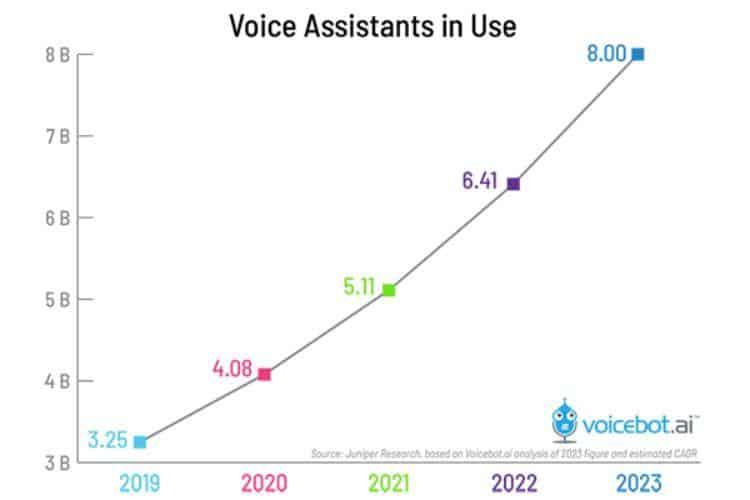
Voice assistance and voice search are booming thanks to advances in Artificial Intelligence. Users of smartphones, connected devices, and work tools are increasingly using voice to interact with digital systems.
AI is a topic that is increasingly present in our daily lives, whether at home, at work or in living environments. In this article, we will explore different aspects of the impact of AI on business productivity.
This text discusses the impact of artificial intelligence (AI) on corporate EBIT, sales, and customer service.

Artificial intelligence (AI) has become an essential technology for businesses looking to improve productivity and provide a quality customer experience.
Marketing is one of the areas that can benefit from AI, along with increased performance and the ability to reach new customers.
Automation plays an important role in our daily lives and AI technologies are increasingly being used to provide solutions that simplify actions without human intervention.
Over the years, deep learning capabilities have been developed to replicate the way humans think. Let's take a closer look at the important data.
AI technologies, especially deep learning, have revolutionized the way software agents perform complex tasks.
As automation continues to become an integral part of our daily lives, advances in AI will continue to transform the way we work and interact with the world.

In businesses, there are various aspects that can benefit from AI technologies. These include some of the following aspects.
Through data analysis and predictive analytics, customer data platforms can discover models that lead to better products and services by recommending appropriate customer solutions.
It is now possible to analyze customer feedback in real time and generate product improvements faster than ever.
Algorithms allow marketers to create more accurate targeting by exploiting psychographic profiles based on social media information.
They can identify trends quickly, allowing them to launch new campaigns with minimal risk.
Thanks to live chatbots and natural language processing (NLP), software and companies of call centers can improve their interactions with end users through automated processes.
An AI strategy allows businesses to analyze customer behavior to identify what could improve the customer experience.
Customer service interactions, which were previously only manual, now benefit from the power of AI integration, achieving a much higher level of customer satisfaction.
For example, chatbots can answer many frequently asked questions about a company's products and services, reducing the length of conversations needed between customers and agents.
Algorithms can collect data from different parts of a business environment, analyze it, and identify improvement opportunities to increase operational efficiency.
This is especially useful when it comes to finding hidden issues that could affect sales or other areas of the organization.
These areas can then be corrected before they become critical.
Algorithms can use data from different business departments, such as sales, marketing, finance, and human resources, to provide an integrated picture of the overall health of the business.
This allows suppliers to make decisions more quickly, which is crucial in a volatile market environment where changes can have a significant impact on critical parameters.
A well-defined AI strategy is one where the sales and marketing strategy is aligned with business goals.
Such a strategy is used to gain an advantage over competitors by increasing market share, especially in highly competitive sectors.
Lead evaluation has become a key measure of sales effectiveness.
Machine learning algorithms can assign accurate scores based on detailed analysis of behavioral factors, engagement levels, demographics, and other factors, making them more reliable than manual scores.
Algorithms can improve marketers' ability to prioritize leads, which reduces the overall cost of marketing because less effort is wasted on customers who aren't likely to buy.
While AI and machine learning help businesses immensely, it's important to remember that customer data is sacred.
Any company that uses data to make decisions must do so ethically and responsibly, ensuring the transparency of its practices.
You can't talk about the AI industry without considering the impact that AI assistants like Amazon's Alexa and Google Assistant have had on our daily lives.
These technologies allow us to control devices with our voice, creating a more natural interaction between us and the devices we use frequently.
Various platforms like Netflix, Apple's Siri, and Google Assistant all use AI to provide recommendations, while Pandora and Spotify use it to stream personalized music.
These platforms have made everyday tasks easier and more enjoyable, without people having to spend a lot of time learning to use this new technology.
The interesting statistics on AI show you how artificial intelligence gives business leaders a competitive advantage that can guide their organizations to a higher level of customer satisfaction.
It also helps them comply with various government requirements related to AI and provides customers with great comfort in carrying out their daily tasks.
Data scientists are currently witnessing a digital transformation of artificial intelligence marketing, as the number of AI use cases is on the rise.
The number of AI-related jobs is also expected to become massive in the coming years, which is constantly increasing the size and profitability of the artificial intelligence market.
What do you think of AI? Have you integrated it into your business? Let me know your thoughts in the comments below.
Further reading: Now that you know where the artificial intelligence market is heading, check out this list of best machine learning software to see if any of them are right for you and your business.
In addition, if you want to know how AI is currently affecting the writing sector, here is my post on best AI writing software to see what the future holds for writers.