.svg)
Discover how much data is produced every day with our analysis of big data statistics. An essential overview of current trends

In 2023, the number of data produced per day is enormous, every minute the internet sees 241 million emails sents, illustrating the intensity of digital communication and the search for information online.
The Video streaming, with Netflix and its 209 million subscribers, dominates online media consumption, benefiting from improved digital infrastructures.
Messaging apps like WhatsApp, Facebook Messenger, and Telegram, popular for their extensive services, including photos, videos, and free calls, are redefining global communication.
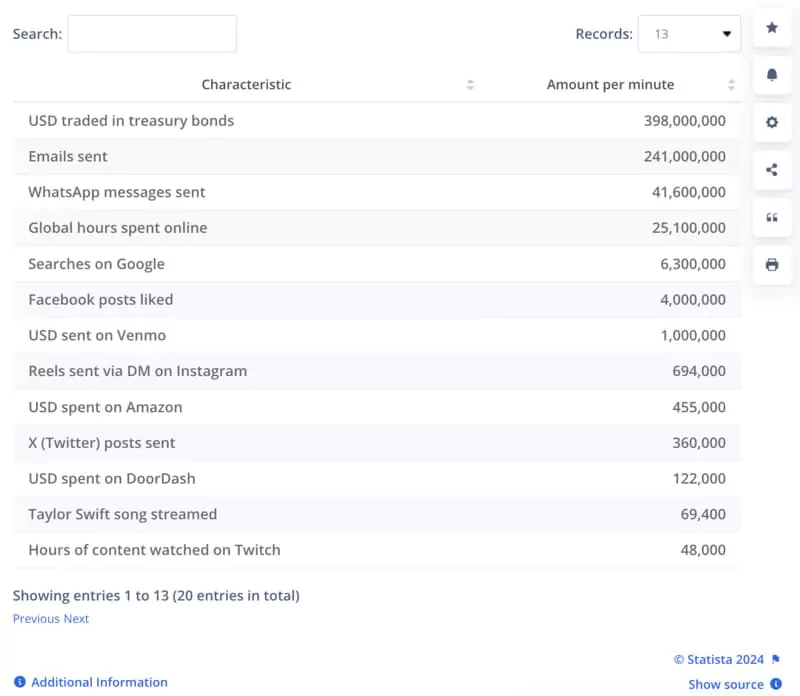
These figures are dizzying and illustrate the titanic challenge of processing such large amounts of data. But they also offer huge opportunities for businesses that can extract actionable insights from them. All of this shows the complete breadth of the data generated and the growing importance of analyzing it.
In its recent history, in 2021, the value of the global data analytics market exceeded 240 billion US dollars.
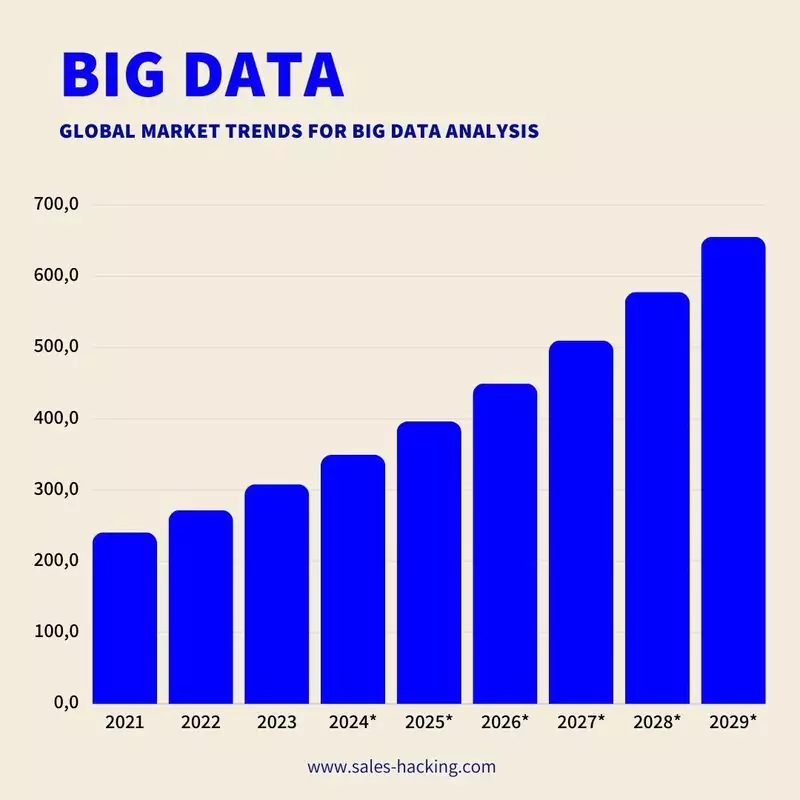
A significant increase is expected, with an expected market value of over $655 billion by 2029, stressing the rise and increasing importance of data analysis issues or problems in the global economy.

These figures show that companies have fully understood the strategic challenge of Big Data.
They are devoting colossal budgets (and are right) to develop ever more advanced analytical capabilities and gain a competitive advantage.
According to a global survey conducted in 2023, a growing number of businesses believe that they are using data effectively.
More than three-quarters of respondents said they drive innovation through data, while half saw their businesses as competitive through data and analytics.

These concrete examples show how Big Data makes it possible to better understand and serve their customers, to optimize their operations and to innovate. Marketing, finance, health, media... no sector is immune to this revolution.
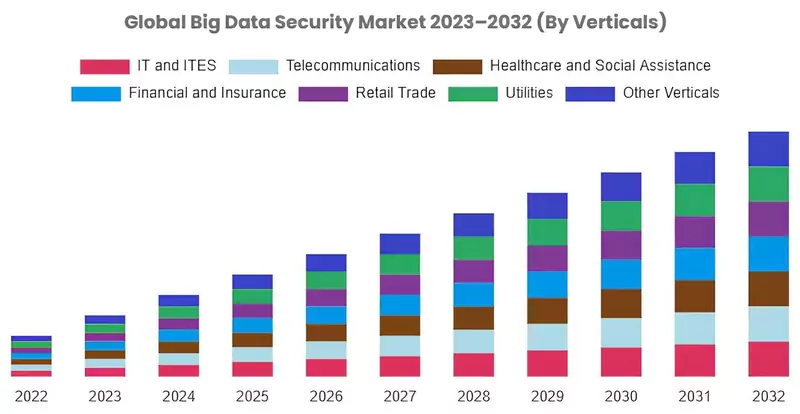
The global big data security market is expected to know an increase of 14.90% between 2023 and 2032.
Valued at $19.76 billion in 2022, the market is expected to reach $55.16 billion by 2032, reflecting the growing importance and rapid evolution of technological security.
While the potential is immense, its democratization still faces problems such as lack of skills, silos, volume, security breaches or resistance to change.
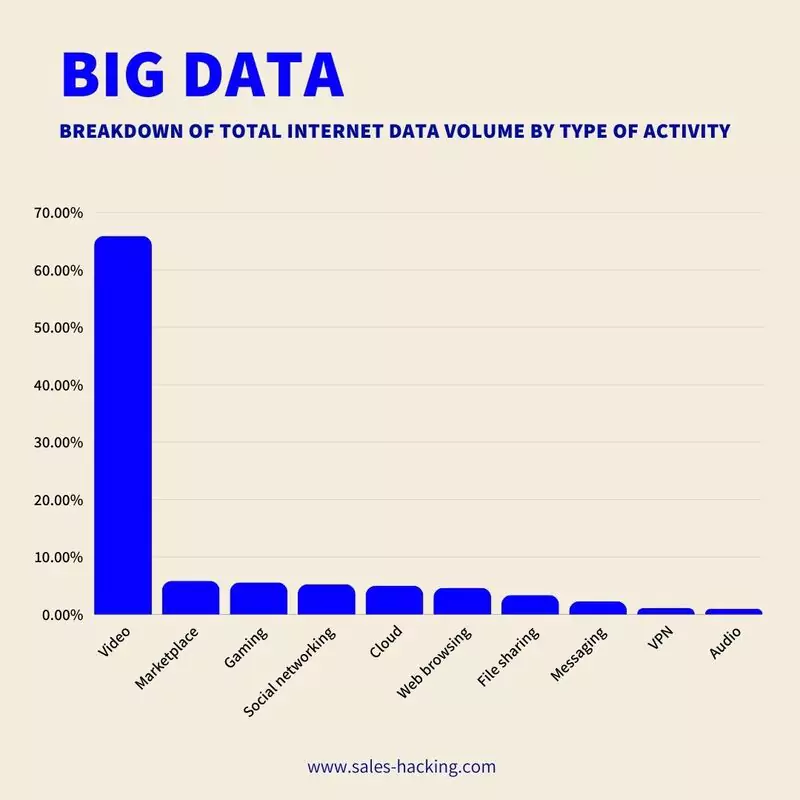
In 2023, video represented 65.93% of total data volume on the Internet, an increase of 24% compared to 2022.
This figure includes everything from TV to streaming and video downloads.
The marketplace, gaming, and social media sectors each contributed to more than 5% of traffic, confirming video as the main component of online business
One thing is certain: the flood of databases is far from receding.
To remain competitive, companies will have to rely more than ever on cutting-edge technologies such as artificial intelligence, quantum computing or edge computing.
In an ultra-connected and digital world, data and its challenges are the new cornerstone of business performance.
Big Data and Artificial Intelligence (AI) are two transformative forces of our time. But it is their convergence that promises to change our societies in the coming decades.
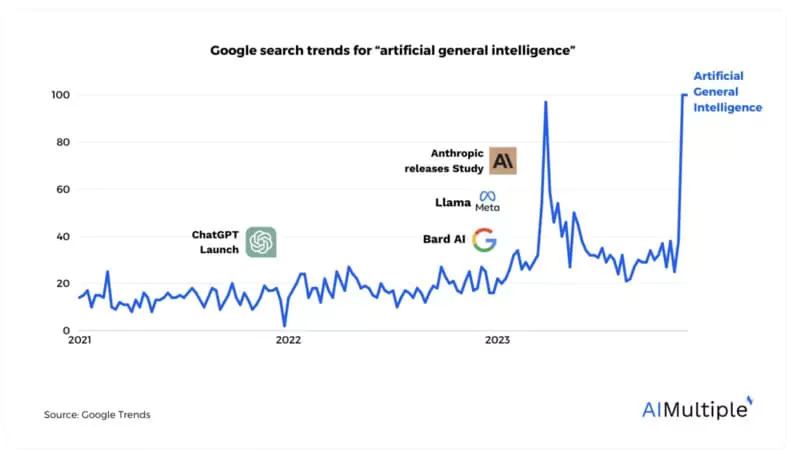
To make this leap to AGI, researchers are banking on a new generation of AI models powered by pharaonic quantities of data.

Beyond the quantitative aspect, the road to AGI will also involve algorithmic innovations:
Challenges and opportunities The prospect of an AI with superhuman abilities, nourished by the flow of Big Data, is both fascinating and worrying.
One thing is certain: the convergence of Big Data and The AI promises us unprecedented upheavals.
It is up to us to guide and manage this technological revolution now so that it benefits the greatest number of people.
The advent of AGI is no longer science fiction, it is a horizon that is fast approaching. Let's make sure that this new chapter in the human adventure brings hope and progress!
In the world of Big Data, some companies stand out for the massive amount they generate and collect.
Here is a ranking of the companies that produce the most data in the world every day
| Ranking | Company | Daily Data Volume Produced (in Petabytes) |
|---|---|---|
| 1 | 10,000 | |
| 2 | IBM | 1,000 |
| 3 | Netflix | 500 |
| 4 | 4 | |
| 5 | Dropbox | 3.6 |
| 6 | Amazon | 2 |
| 7 | Spotify | 1.8 |
| 8 | Airbnb | 1 |
| 9 | Uber | 0.1 |
| 10 | Apple | 0.05 |
| 11 | Microsoft | 0.001 |
| 12 | 0.005 | |
| 13 | Alibaba | 0.0002 |
| 14 | Baidu | 0.0001 |
| 15 | eBay | 0.00005 |
Thanks to their global reach and large user base, all of them have become major players in this ecosystem.
Here is an overview of the main hardware solutions used for storage, along with some key figures and statistics:
Distributed file systems, such as Hadoop Distributed File System (HDFS) and Google File System (GFS), are designed to store and manage massive data across server clusters.

They distribute information across multiple node forms, ensuring high availability and fault tolerance.
According to a study by MarketsandMarkets, the global distributed file system market is expected to reach $24.45 billion by 2026, with an increase of 14.2% between 2020 and 2026.

Object storage is a storage approach that manages data as objects, rather than as files or blocks.
Each object is associated with metadata and a unique identifier, allowing fast and scalable access to data.
According to an IDC study, the global object storage market is expected to reach $129.19 billion by 2026.
By definition, NoSQL databases, such as MongoDB, Cassandra, and HBase, are designed to store and manage unstructured and semi-structured data at scale:
The global NoSQL database market is expected to reach $10.16 billion by 2026.
Memory storage uses random access memory (RAM) to store and process data, offering significantly better performance than hard drive storage systems.
The global market is expected to reach $12.12 billion by 2026.
Hyperconverged infrastructures combine compute, storage, and virtualization in a single system, simplifying the management and deployment of big data resources.
The global hyperconverged infrastructure market is expected to reach $27.1 billion by 2026.
These numbers and statistics highlight the increasing importance of hardware solutions in the big data ecosystem. Companies are investing heavily in these technologies to effectively manage ever-increasing volumes of content and take full advantage of the potential of information.
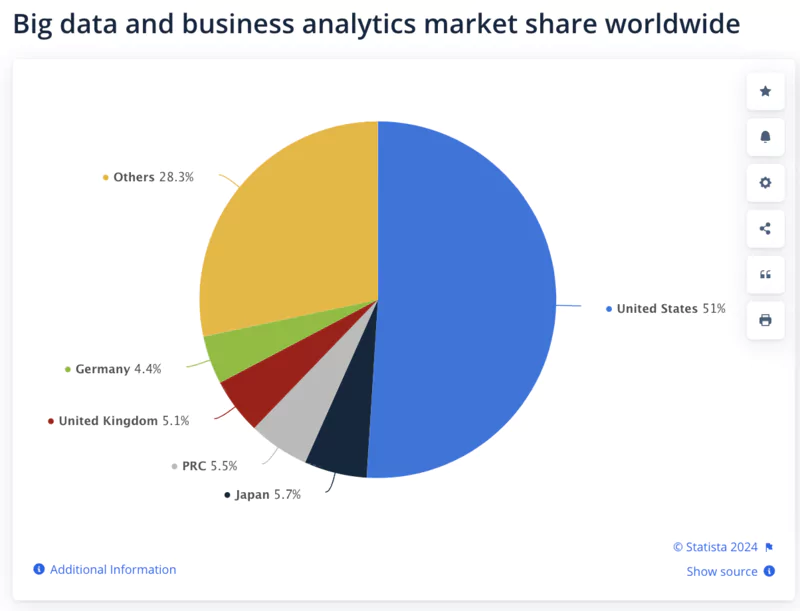
The production of Big Data is dominated by several countries, thanks to their technological infrastructures and their connected populations. Here is a ranking based on the numbers:
In the age of big data, mobile applications play a crucial role in the production and collection of data.
With billions of active users around the world, mobile applications generate colossal amounts of information every day.
Here is a ranking of the mobile applications that produce the most data:
| Ranking | Application | Daily Data Volume Created |
|---|---|---|
| 1 |
- 4 petabytes (4 million gigabytes) of data - 12.8 billion visits generating data |
|
| 2 | YouTube |
- 500 hours of video (approx. 1.5 terabytes) uploaded every minute - 1 billion hours of video (approx. 3,000 petabytes) watched daily |
| 3 |
- 100 billion messages (approx. 100 terabytes) exchanged - 2 billion minutes of voice and video calls (approx. 600 petabytes) processed |
|
| 4 |
- 95 million photos and videos (approx. 28.5 petabytes) shared - 4.2 billion likes (approx. 210 terabytes) generated |
|
| 5 | TikTok |
- 167 million videos (approx. 500 terabytes) watched every minute - 1 billion videos (approx. 3 exabytes) produced daily |
| 6 | Facebook Messenger | - 60 billion messages (approx. 60 terabytes) exchanged daily |
| 7 | - 500 million tweets (approx. 5 terabytes) posted daily | |
| 8 | Snapchat | - 4 billion snaps (approx. 1.2 petabytes) sent daily |
| 9 | Netflix | - 140 million hours of video (approx. 420 petabytes) watched daily |
| 10 | Spotify | - 600 million songs (approx. 1.8 petabytes) streamed daily |
| 11 | Google Maps | - 1 billion users generating location data monthly |
| 12 | Uber | - 18 million rides (approx. 180 terabytes) processed daily |
| 13 | Waze | - 130 million users generating real-time traffic data |
| 14 | - 200 million users generating image search and share data | |
| 15 | - 310 million users generating professional data | |
| 16 | Airbnb | - 6 million listings (approx. 6 terabytes) viewed daily |
| 17 | Dropbox | - 1.2 billion files (approx. 3.6 petabytes) uploaded daily |
| 18 | Tinder | - 1.6 billion swipes (approx. 160 gigabytes) daily |
| 19 | Zoom | - 300 million participants (approx. 900 terabytes) in meetings daily |
| 20 | Amazon | - 35 orders (approx. 350 megabytes) placed every second |
Social networks have become an essential source of data for businesses.
Every day, billions of users share information, interact with content, and communicate with each other, generating a colossal amount of usable data:
| Ranking | Social Network | Daily Data Volume Created |
|---|---|---|
| 1 |
- 4 petabytes (4 million gigabytes) of data - 12.8 billion visits generating data |
|
| 2 | YouTube |
- 500 hours of video (approx. 1.5 terabytes) uploaded every minute - 1 billion hours of video (approx. 3,000 petabytes) watched daily |
| 3 |
- 100 billion messages (approx. 100 terabytes) exchanged - 2 billion minutes of voice and video calls (approx. 600 petabytes) processed |
|
| 4 |
- 95 million photos and videos (approx. 28.5 petabytes) shared - 4.2 billion likes (approx. 210 terabytes) generated |
|
| 5 | TikTok |
- 167 million videos (approx. 500 terabytes) watched every minute - 1 billion videos (approx. 3 exabytes) produced daily |
| 6 | Facebook Messenger | - 60 billion messages (approx. 60 terabytes) exchanged daily |
| 7 | - 500 million tweets (approx. 5 terabytes) posted daily | |
| 8 | Snapchat | - 4 billion snaps (approx. 1.2 petabytes) sent daily |
| 9 | - 200 million users generating search and image sharing data | |
| 10 | - 310 million users generating professional data |
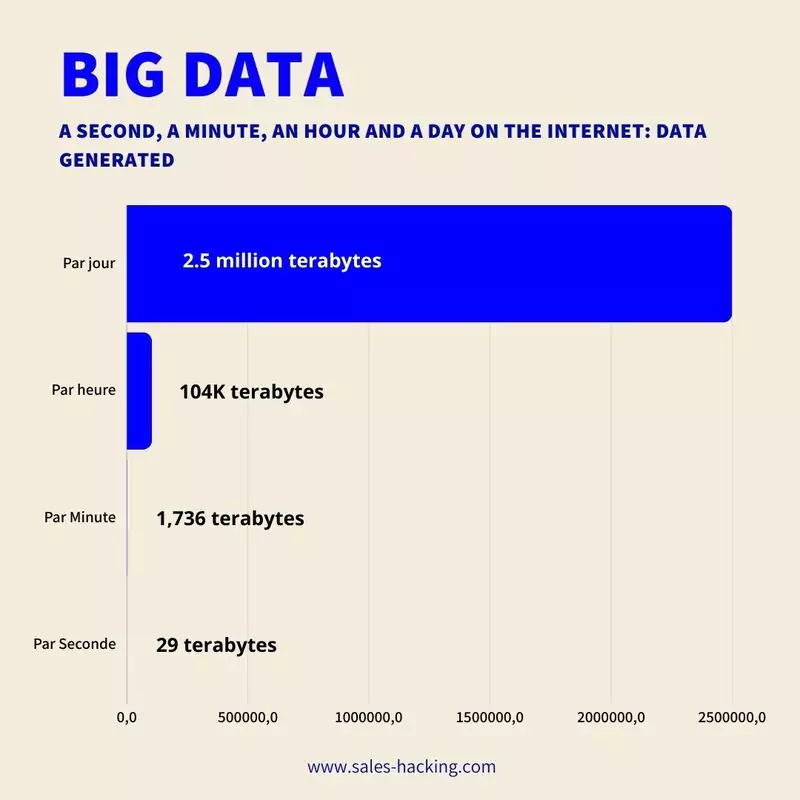
By 2024, it is estimated that the volume of data generated every day in the world will reach a volume of 463 exabytes (463 billion gigabytes).
The main big data trends in 2024 include real-time analytics, artificial intelligence and machine learning, edge computing, and the democratization of access to data analysis tools.
These are the initials for Volume (quantity of data), Velocity (speed of data processing), and Variety (diversity of data types).
In the end, big data statistics illustrate its growing importance and its many challenges.
This new era brings exciting opportunities, but also raises crucial questions about confidentiality and ethics, especially with social networks.
Those who do not adapt by not giving themselves the means and by forgetting all the recommendations risk being left behind by competitors who are more responsive and better aligned with the expectations of their customers.
Transition is not an option, but a necessity to remain competitive in a dynamic environment.
For every business, adoption is essential to innovate, meet customer needs and ensure sustainable growth.







.avif)