.svg)
Learn about the 15 best software to enlarge images without losing quality. Find tools that enhance image size while maintaining clarity and sharpness.


StockPhotos Upscaler is the best overall solution for improving and scaling images.
This web-based application charges you $0.1 per upgrade. Of course, you can try the tool for free if you want to be sure of the quality of the work before.
For example, I tried it with blurry images and thought it wasn't doing a very good job. But once I tried the tool with low resolution images, it worked perfectly.
StockPhoto Upscaler is easy to use. You can use numerous functions in addition to image scaling. For example, you can choose a scale of 2x, 4x, and 8x.
You can also define smoothing elements to optimize the magnified output. The AI that powers the magnification tool detects low resolution, noise, and image blur. That means you might need to change the settings to get the right type of improvement.
You can choose between these three image enhancement options:
It's just a matter of avoiding removing artifacts on images that don't have them, for example.
For now, the tools offered by StockPhotos Upscaler are impressive, but not magical (yet). But these tools can only be expected to improve over time.
You can try the tool with 3 free upgrades!
%25252525252520(1).jpeg)
In addition, you can choose between two paid packages:
Both plans are chargeable and price increases expire after 12 months.

Topaz Gigapixel AI is a complete set for improving AI images.
This software doesn't just improve images for you, it also reduces noise and vibration. You can also use it to resolve blurry images.
The tool is powered by the latest advances in AI image processing and the results are accurate.
Gigapixel's image-processing AI has trained with a set of millions of images. She thus learned concepts such as noise and blur. More importantly, thanks to this extensive training experience, this tool knows how to deal with these artifacts.
With Gigapixel, you can literally make photos taken by hand look like professional images taken on a tripod.
The main reason Gigapixel is on this list is its ability to improve images. Details that you lost during the image capture process can be intelligently added to the image using Gigapixel AI.
Note that pixel information that is lost cannot be restored by itself, but the AI can predict what it would look like.
In any event, here is an example of improving image detail:

As you can see, the difference is quite impressive.
Note that while Gigapixel is a great tool, it doesn't always succeed. If an image is too small, too blurry, or too loud, there's not much you can do about it.
The pricing model for this tool is simple:

Vance AI is a one-of-a-kind image enlargement tool that allows you to increase the size of your image by 800%. The images with low resolution thus regain their superb appearance.
Vance is not only a great magnification tool, but it also comes with animation magnification capabilities. This tool is one of the best tools for scaling small anime images. It can convert anime images up to 16 times. With this feature, you can easily convert small anime images into wallpapers.
Overall, you can use Vance AI to upgrade:
And even more.
You can choose the scale factors between 2x, 4x, 6x, and even 8x (with anime 16x).
Vance can also get rid of random noise and unwanted blur.
To use Vance, all you need to do is:
There are three plans available for Vance AI:
The free plan gives you a good idea of the product. If you're looking for a high-level upgrade or if you're a more rigorous user, you might want to upgrade to a paid plan.

UpScale Media is an excellent image scaling tool offered by PixlBin. This tool allows you to scale and improve images for free on a web application.
Needless to say, this tool is easy to use and easy to use. You don't need to register to use the tool and its great features.
The maximum image size for scaling is 1500×1500!
AI models are still not smart enough to fully understand what happens in less detailed images, even if the human eye can. But that's only going to get better over time.
In 10 years, it could be that image converters could perform a magic upconversion compared to state-of-the-art upscaling.

UpScale plans are:
The free plan includes scaling up to 50 images, which is more than most tools offer!

Let's Enhance is an image enhancement and scaling tool that improves the resolution of your images without losing their quality.
You can use this tool for free. All you need to do is go to their website and drop an image onto the page. The expansion process is then started. Note that you need to create an account to start the expansion. But don't worry, registration is free and you can try the software without paying!
Let's Enhance uses AI to improve the appearance of images. Thanks to the neural networks that power this solution, you can get 4k quality images.
AI processes images by:
A combination of these techniques can increase image quality by up to 1600%.

There are four plans in Let's Enhance.
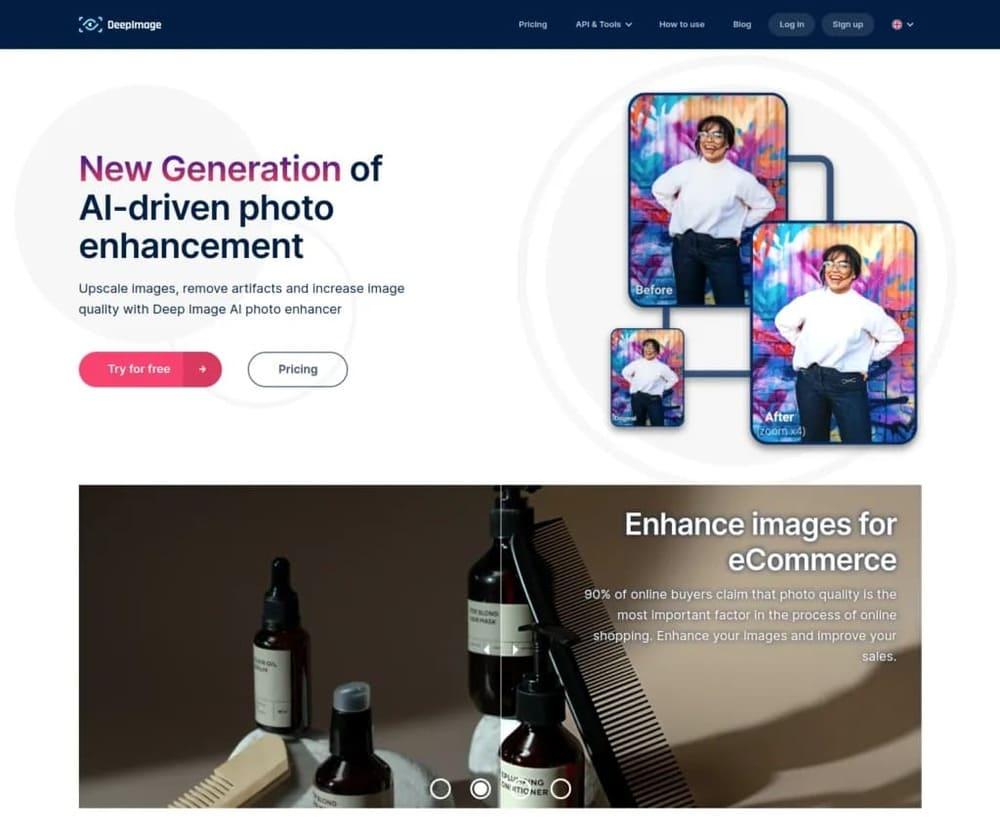
Deep Image is a great scaling tool, ideal for anyone looking to scale images en masse.
Thanks to the AI algorithms used behind the scenes, image scaling seems natural.
The size limit for a scaled image is 5000 x 5000 pixels (or 25 megapixels). This applies to registered and unregistered users.

There are four individual paid plans for Deep Image AI:
Additionally, there are business plans as well as a “pay-to-go” pricing model. Finally, there is also a personalized plan!

Icons8 is an AI image enlargement tool driven by intelligent artificial intelligence algorithms.
To enlarge an image with icons8, follow these three steps:

There are three plans for icons8:

Waifu2x is an image converter focused on cartoons. Despite its vintage look, the tool uses neural networks to scale images. The results are surprisingly good considering the old look and clunky user interface of the tool.
Even though the tool is meant for anime consumers, it can also improve any type of photo.
WAIFU2x also removes noise from the images it scales. Also, you can simply enter the URL of the image you want to compress. That means you don't need to download and drag and drop the file to the tool. Instead, the tool will look for the image behind the URL and scale it for you.
Let's take a look at the main features of Waifu2x.
Waifu2x is free to use!

Do you have low-resolution images, illustrations, or cartoons that you want to improve or scale?
BigJpg is a great solution for these types of images.
This tool is one of the most popular moving image scaling devices, known for producing excellent results when scaling moving images and low-resolution illustrations.
Even though this tool is meant for anime, you can use it on any other photo or illustration.
BigJpg is also a great option for developers because an API is available.
BigJpg is very effective during the upconversion process. It fills in colors, details, and edges in a professional manner, leaving you with quality images without data loss.
Note that the tool limits scaling to 3000×3000 images, which is more than most of the tools on this list do.
Here are some of the most remarkable features of the solution to enlarge images without losing BigJPG quality:
The tool is free to use!

Upscalepics offers several free image enlargement elements, as well as affordable pricing plans. The online resizer does not require a software download, but it has proven to be one of the most effective tools for increasing the size of an image.
Upscalepics offers two formulas:
Once you've exceeded the number of free resizes, the following prices apply:
The actual image file size has increased significantly compared to other tools. Our first (larger) image shows great detail when magnified into a larger file.
The second photo (smaller original file) looks fine when scaled down for this blog post, but the actual size has noticeable distortion (click on the image to open in a new tab).

On1 Resize is a high-end desktop software with a myriad of functions for increasing the size of an image, creating printable graphics, and simulating how a photo actually looks when printed.
On1 offers a free trial to test the software. After that, the prices are as follows:

ImageEnlarger.com boasts of the simplest of interfaces. This may appeal to some, but others will note that it looks like something from another era.
That said, the simplicity of the process is undeniable. You upload an image, choose a format, and then select the dimensions you want.
The ImageEnlarger.com tool is completely free, with a donate button to support developers.
All tests performed for ImageEnlarger.com kept the final file size well below that of the competition.
The two tests in image 1 gave much better results than I expected. I would say that the resolution of each enlarged photo is of higher quality than that of all the other tools on this list, at least without having to touch the editing functions.
Image 2 testing was a different story. They all show noticeable blur and slight color changes as images get bigger and bigger. It seems that ImageEnlarger.com quickly provides a quality magnified photo as long as the original file is not too small.
There is also a limitation on the maximum width, which is a disadvantage when trying to enlarge images without losing quality.

Befunky is an online image editor that offers powerful options for scaling, editing, and adding effects. But it also offers unique functions for incorporating creative textures and turning ordinary images into works of art, as if you wanted to make one of your images look like a painting or a A drawing.
For image enlargement, Bufunky offers a fast and free resize tool to increase the width, height, and overall size of your images by a percentage. You'll find hundreds of image editing functions, but you need to go to Edit → Resize if you want to enlarge an image.
The Befunky resize tool is free and has no limits.
The Befunky Plus plan starts at $4.99 per month for an annual plan and $9.99 per month when billed monthly. It provides access to features like the one-click AI image enhancement tool, smarter editing tools, a background removal function, the batch image editor, and many more filters, effects, and productivity options.
Increasing the size of the image 1 by 2 gave solid results, with a slight blur at the edges that is only noticeable when viewed by zooming in. Befunky achieved a maximum increase of 682% by locking frame 1. It seems that batch editing allows for larger increases, and you can go further than that if you don't lock the aspect ratio or use smaller images. In any event, the 6.8x maximum increase for image 1 produced results similar to the previous test: we are losing marginal quality compared to the original, but the 6.8x increase seems rather similar to editing at 2x.
Picture 2 was a different story, as the 2x increase shows a decent amount of blur, and the 8x increase seems stupid. I'll note that the small images allow you to increase the percentages in Befunky (I was able to reach 8x with image 2). Not to mention that the size of the files remains manageable.
The test showed obvious strengths and weaknesses. You can't start from a tiny photo and expect quality results when magnifying with Befunky. Nor should you expect a print-worthy resolution. However, we believe that it is one of the best options for quickly downloading a reasonably sized image and getting an enlarged version that is displayed perfectly on digital devices. You would have no problem using the results from image 1 on a website or blog. The fact that Befunky is free and so easy to use is also a huge advantage. The sharpening tool can also help you after scaling.

Reshade is a free desktop program designed primarily to increase the size of images and improve them in the process. I like the fact that it's lightweight software without a high price tag. Not to mention that you can upload images in bulk.
Reshade is free for Windows PCs.
Reshade has done an incredible job of keeping file sizes low while maintaining the quality you would expect from a digital photo.
Reshade seems to incorporate a vector scaling strategy, which allows you to add animation-like elements to large images to fill in the data. As long as you don't overdo it, your images stay crisp and colorful. They even look like paintings if done right.
The Image 1 tests are both magnificent.
Image 2's tests are more fuzzy, but they're still superior to the other tools we've tested. I am sure that I could have improved the results with the simple post-processing tools available.
Overall, I would say that Reshade scored the best among all the tools on this list.

GIMP is an open-source alternative to Photoshop. It is a popular image manipulation software that you download to your desktop. The advantage of GIMP is that it has a large number of followers to allow you to search for features, and there is no limit to what you can do with the software. It's much more than just an image magnifier.
GIMP is free.
I found that selecting “None” for quality interpolation gave the best results. However, this depended on the size of the image, so feel free to adjust these settings when you resize.
The size of the files obtained did not match the dimensions, which I don't understand. That makes me think there's an inconsistency with the resizer. For example, the 2400 x 1600 px file is 167 KB, while the 600 x 400 px file is 249 KB. I would have thought that they would be reversed.
A low resolution image has fewer pixels than a high resolution image. This is why low-resolution images appear to be blurry or of poor quality.
To improve image quality, scaling is required.
To scale an image accurately, you would need to add information to the image in the form of pixels. Naturally, this is impossible without taking a new photo.
The second best solution is to use image enlargement techniques.
Regular enlargement consists of increasing the resolution of a low-resolution image to improve its visual quality.
But AI-based enlargement takes a completely different approach. Instead of trying to improve the quality of an image by increasing its resolution, AI uses deep learning models to make a prediction about missing pixels.
More specifically, an AI image enlargement tool takes a low resolution image as input. It then uses a neural network to generate an image that will be scaled down to look like the original input image.
To achieve this, the AI magnification tool must have been trained with millions of images to accurately predict the high-resolution aspect of the image.
The rise of AI is making headway. You can expect the solutions to only get better over time. This is thanks to rapid developments in AI and image creation.
Image scaling by AI works based on a prediction made by the AI model. The more the AI is able to recognize what is happening in the images, the more it can predict what that would look like in higher resolution.
Today, you've discovered the best image enlargement tools without losing quality to improve the appearance of your low-resolution images.
Today, AI makes it possible to scale images to improve quality during their expansion. In short, AI predicts how the image will look in a more detailed version. This method is different from traditional magnification, which simply changes the contrast or sharpness.
To make an image enlargement tool work, companies have developed AI algorithms that are trained with millions of images. The idea of the magnification tool is to recognize what is happening in the image and to predict what it would look like in greater detail.
To choose the best AI magnification tool, make sure the solution has:
The best solutions that meet these requirements are StockPhoto Upscaler, Gigapixel AI, and Vance AI.
Thanks for reading. Hopefully you have found a suitable magnification tool to improve the appearance of the images.