The principle of affiliate marketing is based on connecting a business with partners who are paid only when they generate a measurable result.
It's all about performance-based commission: sales, sign-ups, demo requests, or lead-based compensation depending on your case.
To maximize results, it's essential to structure your affiliate program clearly and attractively, precisely defining the rules, tools, and resources available to affiliates. When well-structured, an affiliate program becomes a strong channel among your acquisition channels (SEO, email, online advertising, partnerships). If poorly structured, you may face attribution conflicts, cannibalization, and noise on the lead side.
Finally, the overall process of setting up an effective affiliate program involves planning each step, integrating the right technological tools, and continuously optimizing partner relationship management.
What is affiliation for businesses?
Affiliation is a partnership with affiliate partners (publishers, creators, comparison sites, agencies, customers...) who promote your offer. To succeed in affiliate marketing, choosing a relevant niche is important to target a qualified audience and maximize results. In return, they earn a commission-based compensation when a validated action occurs.
The key is measurement: conversion tracking, performance tracking, and clear attribution rules. To attract and engage the audience, creating valuable content is essential and should be at the heart of your affiliate strategy.
Transparency about affiliate links is also crucial to build trust with your audience and ensure a lasting relationship.
Finally, the traffic source used and the chosen compensation model (CPC, CPA, CPL, etc.) directly influence the performance of your affiliate program.
How does an affiliate program work in B2B or B2C?
The mechanism is simple: an affiliate sends traffic → attribution → validation → payment. Each step of the affiliate process, from traffic generation to sales validation, must be perfectly tracked to ensure the program's effectiveness.
The difference between B2C and B2B affiliation is mainly the cycle (longer) and quality (qualified lead or not). It's essential to analyze the market to identify demand and competition and choose affiliate programs suited to your niche to maximize conversion chances.
🛒🤝 B2B vs B2C: Useful Differences (2026)
Dimension 🔎
B2C 🛒
B2B 🤝
Paid Action 🎯
Purchase / subscription
lead compensation / demo / opportunity
Cycle ⏳
Short
Longer (CRM validation)
Tracking 🧠
Checkout + tracking cookie
Form + CRM + offline
Risks ⚠️
“Opportunistic” coupons
Off-target leads / duplicates
Management 📊
CPA + cart
CPL + pipeline quality
Advantages and Disadvantages of Affiliation for a Business
Affiliation allows you to turn part of your marketing investment into a variable cost. You pay when it performs, and you can scale without betting everything on ads.
But it comes with pitfalls: reduced margin, fraud, channel confusion, or “affiliates” who never publish. The solution is a managed affiliate strategy, not just a simple “launch.”
Pros / Cons
⚖️ Pros / Cons (Realistic View): What Affiliation Gives... and What It Demands (2026)
Axis ⚖️
Advantages ✅
Disadvantages ⚠️
Cost 💰
performance-based commission
Possible cannibalization
Growth 📈
increased sales without upfront payment
Recruitment to activate
Brand 🧠
brand awareness via publishers
Brand safety to manage
Data 📊
detailed performance tracking
Sometimes disputed attribution
Scalability 🚀
Network effect via affiliate networks
Operations + support
Key Steps to Create an Effective Affiliate Program
Here, we aim for a program that's easy to launch and then easy to improve.
The structuring process of an affiliate program includes defining goals, selecting partners, integrating technology, and implementing effective management methods.
It's exactly the “business” logic: control, process, and continuous optimization.
Performance tracking is essential to optimize affiliate campaigns, and affiliates must regularly create quality content to maintain their credibility and audience.
Process (A → Z): Goal → Compensation Type → Rules → Tracking → Kit → Recruitment → Animation → Optimization
After defining these steps, it's essential to specify that sales and commission tracking is done through affiliate links and cookies, allowing for action traceability and transaction validation to ensure affiliate compensation.
Setup Checklist
✅ Define 1 goal: generate leads or increase sales
✅ Set the compensation type (sale, lead, revshare, hybrid)
Remember that most affiliate platforms offer tools to track clicks and centralize statistics, making it easier to manage your program.
Which Compensation Type to Choose?
The right model depends on your margin, cycle, and ease of validating the action.
Comparison of Compensation Models
💸 Comparison of Compensation Models: Which Fits Your Business? (2026)
Model 💸
Ideal for 🎯
Strengths ✅
Cautions ⚠️
CPA (sale) 🛒
e-commerce, online stores, simple SaaS
clear, manageable
margin to protect
CPL (lead) 🧲
B2B affiliation
good for generating leads
fraud / quality
Revshare 🔁
subscriptions
aligns with value
churn + tracking
Hybrid ⚙️
mix B2B/B2C
balance volume/quality
rules + validation
💡 Note: Affiliate commissions can vary significantly depending on the products and programs chosen.
Tools: Affiliate Platforms or Affiliate Networks?
You have two main categories:
The affiliate platforms: you manage your program (rules, tracking, payments, reporting)
The affiliate networks: you access a pool of affiliates (often with a ready-made framework)
Among the most well-known affiliate platforms are Shopify, which allows easy management of an integrated affiliate program with an online store, and Amazon, the global e-commerce leader, whose affiliate program is renowned for its ease of access, product diversity, and strategic impact for content creators looking to monetize their audience. These platforms facilitate management, performance tracking, and affiliate compensation.
Choosing a good affiliate platform can directly influence the revenue generated by affiliates.
Help Table
🧰 Help Table: Platform, Network, or Mix (2026)
Option 🧰
For Whom 👤
What It Brings ✅
To Watch Out For ⚠️
Affiliate Platforms 🧩
you want to control the data
rules, tracking, reporting
recruitment to do
Affiliate Networks 🌐
you want to recruit quickly
pool + structure
fees + variable control
Mix 🔁
you want to scale properly
volume + control
strict governance
Note: Some affiliate platforms are giants in the sector, like Amazon or Shopify. These giants offer a large audience, strong reputation, and advanced tools to optimize your campaigns.
How to Recruit and Motivate High-Performing Affiliates?
The real issue isn't “having affiliates.” It's having active affiliates.
For this, practical advice is essential to recruit and motivate high-performing affiliates, particularly by optimizing management, platform choice, and performance tracking.
A common scenario: an SME launches its program, signs 40 partners, and 6 publish. The day it provides a ready-to-use kit + a monthly animation plan, activation takes off.
Remember that authenticity and engagement with your audience are key elements for success in affiliate marketing.
Where to Recruit (4 Effective Paths)
Media, blogs, specialized sites (product comparison sites, affiliate offer promotion platforms): strong intent, especially for e-commerce businesses, these sites are effective channels for recruiting affiliates by redirecting visitors to merchant or partner sites.
Creators and newsletters (trust + audience development)
Business partners (agencies, integrators, consultants, on the B2B side)
Satisfied customers (ambassadors, useful for customer loyalty)
Regular updates: sending newsletters or emails to inform and motivate affiliates about new features, offers, or content to promote
For affiliates, the goal is simple: make money with affiliation. For the business, your goal is to align this gain with your margin and image.
Using Social Media to Promote Your Affiliate Program
Social media has become an essential tool to boost the visibility of your affiliate program and generate sales.
When used effectively, they turn every post into a conversion opportunity while strengthening your brand's image with a targeted audience.
Here's how to maximize the impact of your social media efforts:
Select the right social networks: Adapt your strategy to your audience. Instagram, TikTok, or YouTube are perfect for reaching a connected and visual generation, while LinkedIn or Facebook are better suited for a professional or broader target. Analyze where your potential customers spend the most timeand focus your efforts on these platforms.
Focus on engaging content: Content is key to capturing attention. Vary the formats: video tutorials, stories, educational posts, customer testimonials, or product demonstrations. The more authentic and useful your content, the more it encourages action through your affiliate links.
Leverage the power of hashtags: Well-chosen hashtags increase the reach of your posts and connect you to communities interested in your products or services. Also, create brand hashtags to unite your community around your affiliate program.
Create real interaction: Respond to comments, launch polls, organize live sessions or Q&A. The more you engage in conversation, the more you build trust and the desire to discover your offers through your affiliates.
Highlight your products and your programe: Regularly present your new products, special offers, or the benefits of joining your affiliate program. Use native advertising formats to precisely target your prospects and boost the visibility of your affiliate links.
In summary, a well-thought-out social media strategy turns every interaction into a sales opportunity, attracts new affiliates, and strengthens your brand's reputation. By combining quality content, engagement, and smart promotion, you make your social media a growth engine for your affiliate program.
Best Practices, Mistakes to Avoid, and Pitfalls
One of the common mistakes in affiliation is wanting to promote too many different products, without coherence with your theme or audience.
Affiliation has the major advantage of allowing you to sell products without having to manage stock, which greatly simplifies logistics for the entrepreneur.
It's essential to stay relevant and select truly useful offers for your readers. Finally, it's crucial to ensure complete transparency about financial relationships between affiliates and companies to strengthen your audience's trust.
Best Practices in Affiliation
Define clear attribution (who earns what, when, on which channel)
Legal Aspects and Managing the Affiliate-Business Relationship (France)
In France, two areas often come up: commercial transparency and tracker management. Affiliation has revolutionized online commerce, offering an accessible and effective solution to develop a business without stock or logistics.
The goal is to be clear and consistent, without becoming overly complex. It's also essential to choose products you know and trust to maintain your credibility with your audience.
Points to Frame
Transparency in affiliation: the affiliate must clearly indicate the commercial nature of content (especially on social networks for affiliation). It's also essential that affiliates are transparent about their relationship with the brands they promote to maintain trust with their audience.
Cookies & tracking: a tracking cookie and trackers must be properly managed (banner, purposes, consent as needed). Sales traceability is done through affiliate links, which allow operations to be recorded and sales to be correctly attributed to affiliates.
Contracts and GDPR: clarify roles and responsibilities if a platform or network handles data.
Good business practice: have a program charter + a mini-contract (or conditions) that frame authorized channels, returns, payments, and compliance.
Which Indicators to Track for Performance Evaluation?
The classic trap is to only look at attributed revenue. Good management measures volume + quality + margin + risks.
origin of visitors or revenue (platform, channel, source)
identify and strengthen the best sources
You can then push SEO optimization, content marketing, and affiliated marketing strategies (guides, comparisons, templates) to increase content lifespan and improve affiliate yield.
Remember: performance tracking is essential to optimize affiliate marketing efforts.
Examples of Success in Affiliation (B2B/B2C)
For example, a B2C company specializing in home accessories can generate additional revenue by joining the Amazon affiliate program, the global e-commerce leader.
This program is particularly appreciated for its ease of access, product diversity, and strategic impact for content creators aiming to monetize their audience.
It's also advisable to diversify affiliate programs to adapt to different audience segments and maximize revenue opportunities.
B2C (e-commerce)
A store launches a simple program: CPA by category + “ready to publish” kit. It uses Shopify to manage its affiliate program and facilitate online sales.
It recruits 10 targeted publishers (comparators + creators), then optimizes: product pages, messages, and coupon rules.
👉 Result: more volume, without relying solely on online advertising.
B2B (lead generation)
A SaaS company sets up a lead-based compensation with validation (sector, size, need).
It recruits business partners and B2B media, then animates with webinars and content. To track performance and effectively manage its partners, it uses a dedicated affiliate platform.
👉 Result: fewer leads, but more usable leads, thus better profitability.
Conclusion
A solid affiliate program rests on 4 pillars:
clear objective
simple rules
reliable tracking
regular animation
Regular creation of quality content and the way you manage the program are essential to ensure its sustainability. Then, you manage with performance tracking, reinforce what works, and cut what penalizes your ROI.
🎁 TRY AI REVOLUTION FOR FREE
Notion AI: read less and decide faster
Ask one question across your pages, meeting notes, and databases. Notion AI surfaces the decisions, blockers, and next steps worth your attention.
Everyone gets complimentary AI responses. Upgrade to Business only after you use them up.
Open the meeting notes you have been avoiding and ask Notion AI for a one-minute decision brief.
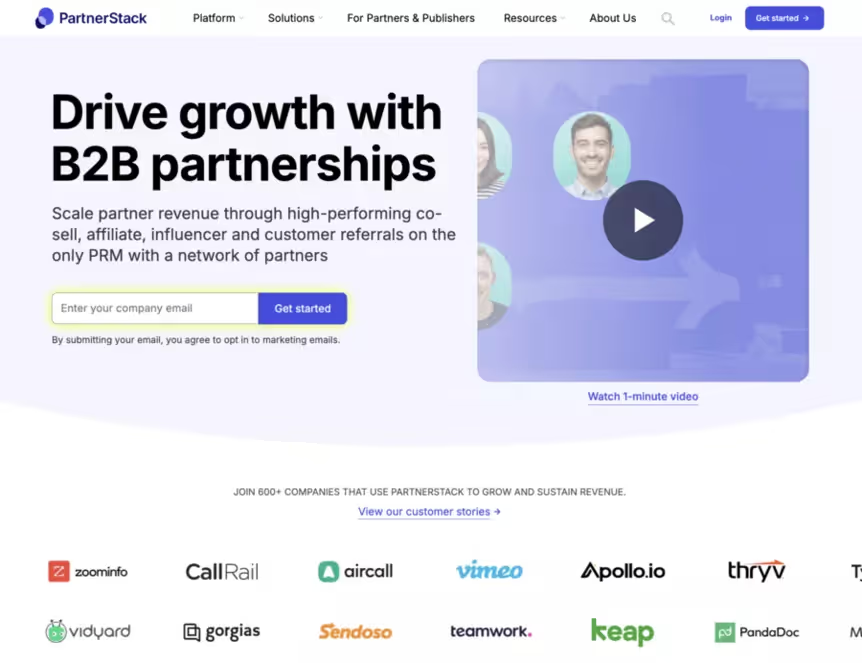
Affiliate Platforms: Compare Awin (formerly ShareASale), impact.com, and PartnerStack to Choose the Right Niche
Before comparing, keep this in mind: some solutions are more like affiliate networks (large pool of partners), while others are all-in-one management platforms for handling various types of partnerships (affiliates, creators, referrals, etc.).
This choice affects your possible niches, your level of control, and the ease of recruitment.
Understanding "Niches" Through Partner Types (and the Right Commission Model)
🧠 Understanding "Niches" Through Partner Types (and the Right Commission Model) — (2026)
Partner Type 🧠
What They Bring ✅
Typical Niches 🎯
Compensation Model 💰
Main Risk ⚠️
Content (blogs, media, comparison sites)
Hot intentions + long-term SEO
SaaS, e-commerce, finance, travel
commission-based (CPA) / revshare
Multi-touch attribution to be framed
Coupons / deals
Quick volume
E-commerce
CPA, sometimes reduced
Cannibalization + margin
Cashback / loyalty
Conversion + repeat purchases
Recurring e-commerce
CPA / tiers
Dependency + costs
Creators / influencers
Trust + brand awareness
Lifestyle, apps, courses, D2C
CPA, hybrid, codes
Transparency & brand consistency
Referral / advocate
"Hot" leads/sales (clients)
SaaS, services, B2B
CPL / CPA + quality bonus
Fraud if validation is weak
Reseller / co-sell (B2B)
Pipeline + closing
B2B affiliation, SaaS
Qualified CPL / commissions
Long cycle + CRM rules
On Awin, you'll clearly find coupon/cashback/influencer/tech partner profiles.
On impact.com, the advantage is managing affiliation + creator + referral on a single platform (with tracking/protection modules).
On PartnerStack, the focus is more on the "B2B ecosystem" (affiliate/referral/reseller).
How to Choose Quickly (3 Simple Questions)
Are you mainly selling in B2C e-commerce and want a large pool (coupons/cashback/content)? 👉 Awin is often the most direct starting point.
Do you want to manage multiple motions (affiliates + creators + referral) with contracts, tracking, and control? 👉 impact.com is more oriented towards "multi-partnership management".
Are you in B2B affiliation (SaaS) and want referral/reseller/co-sell programs? 👉 PartnerStack is often more suitable.
Understanding the Affiliate Ecosystem
Affiliation isn't just about links or commissions: it's a whole ecosystem where each player plays a key role in the success of your marketing strategy.
At the heart of this system, there are three pillars: the business (or advertiser), the affiliates, and the customers.
The business showcases its products or services and seeks to boost online sales through the recommendation power of external partners.
The affiliates are content creators, bloggers, comparison sites, or even social media influencers. Their mission? Promote these products or services through various channels – website, blog, newsletter, social media – using affiliate links or banner ads. For every sale or action generated through their promotion, they earn a commission.
The customer, on their side, discovers the offer through these channels, clicks on an affiliate link, and makes a purchase or registration.
This system relies on trust: the business must be transparent about its terms, commissions, and product quality; the affiliate must remain honest in their promotion, clearly informing their audience of the commercial nature of their content; the customer, finally, should easily identify that it's a paid recommendation.
This network of actors, interconnected by tracking tools and affiliate platforms, allows for multiplying the reach of an offer, optimizing the sales strategy, and adapting to all online business models.
To succeed, think "ecosystem": choose the right partners, diversify promotion channels, and build a lasting relationship based on transparency and performance.
Frequently Asked Questions
How to Choose an Affiliate Program When You're Starting Out?
Select one goal, a simple payment type, short rules, and clear reporting. Then, optimize once the initial results are validated.
What Are the Promising Affiliate Sectors?
SaaS, training, B2B tools, and e-commerce businesses: anywhere comparison and trust matter. Promising affiliate sectors are often those where content helps in decision-making. It's crucial to analyze the market and trends to identify sectors with high demand and suitable competition.
Can Affiliates Use Paid Advertising?
Yes, if you allow it. Paid advertising for affiliates should be regulated (keywords, brand, pages, tracking), otherwise, you might pay for sales that were already secured. It's essential to manage the budget allocated to these campaigns to avoid unnecessary expenses and optimize the profitability of your affiliate program.
How to Prevent Abuses (Coupons, Fraud, Self-Referencing)?
Written rules, validation before payment, regular checks, and exclusion of sources that bypass the guidelines. Implementing rigorous control processes is essential to prevent abuses and ensure the integrity of your affiliate program.
How to Recruit Affiliate Partners When You Don't Have a Community?
Start with affiliate networks, niche media, and business partners (agencies, consultants). With a clear kit (arguments + visuals), you can activate your affiliate partners more quickly.
What Tracking Cookie Duration Should You Choose for an Affiliate Program?
In B2C, 7 to 30 days cover a lot of journeys. In B2B, a longer window might help, but the most important thing is good conversion tracking (CRM + attribution) to avoid conflicts.
How to Improve Affiliate Performance Without Increasing Commissions?
First, work on the offer and content: more convincing pages, proofs, comparisons, and SEO optimization. Then, optimize affiliate campaigns with tiers and quality bonuses rather than a higher rate for everyone.
Can You Launch an Affiliate Program If You're Already Doing Online Advertising?
Yes, but you need attribution rules and exclusions (e.g., brand SEA, retargeting) to avoid paying twice. The goal is to keep the commission truly profitable.
What Content Works Best to Help Affiliates Make Money with Affiliate Marketing?
"How-to" guides, comparisons, use cases, templates, and short videos. By providing ready-to-publish angles (SEO + social media for affiliates), you help your affiliates perform faster, and you boost your performance tracking.


.svg)