.svg)
What is Sales Enablement? Definition, Tools, Implementation: Everything You Need to Align Your Teams and Enhance Your Sales Performance.

Sales Enablement—a term now commonly used among sales executives, yet its meaning often remains unclear. Also referred to as sales activation or sales facilitation in French, this strategic concept is transforming how companies equip and support their sales teams.
Whether you are a sales manager, sales director, or a commercial transformation consultant, understanding Sales Enablement has become essential. This comprehensive guide explains everything: definition, benefits, implementation, and essential tools to optimize your sales performance.

Sales Enablement is a strategic and cross-functional process that provides sales teams with all the necessary resources to sell more effectively. In practical terms, it involves aligning sales content, technological tools, and training around a common goal: enhancing every interaction with buyers.
According to Gartner, Sales Enablement is defined as a system of activities and processes that provide salespeople with the information, content, and tools to conduct high-value conversations. Forrester complements this view by emphasizing the ability to equip all client-facing employees for relevant exchanges at every stage of the buying journey.
This approach goes far beyond merely providing tools. It creates synergy among three fundamental pillars:
The commercial landscape has radically evolved. Today's B2B buyers are better informed, more demanding, and conduct much of their purchasing journey independently. In light of this reality, traditional sales methods are showing their limitations.
The numbers speak for themselves: the global market for Sales Enablement platforms is expected to grow from $6.13 billion in 2025 to nearly $20 billion by 2032. This 18.3% annual growth reflects the widespread adoption of this approach by companies of all sizes.
| Indicator 📊 | Impact of Sales Enablement 📈 | Quick Read 🧠 |
|---|---|---|
| Increase in Sales |
– Between 6% and 20% for 76% of equipped companies – More pronounced effect when the program is consistently followed |
– ✅ Measurable on pipeline & revenue – ⚠️ Depends on field adoption |
| Skills Enhancement | – 34% faster with a dedicated platform |
– ✅ Shorter onboarding – 💡 Useful when turnover is significant |
| Content Engagement | – +350% interaction on content |
– ✅ Assets are better utilized – ⚠️ Requires editorial governance |
| Closing Rate | – +15% for companies with a structured program |
– ✅ Better execution in meetings – 💡 Strong effect with coaching + playbooks |
| Adoption Since 2018 | – +340% of companies using it 📈 +340% |
– ✅ Rapidly growing market – ⚠️ Many tools: compare with actual needs |
Here are the most common observations when done correctly:
| Topic 🎯 | Sales Enablement 🧩 | Sales Ops ⚙️ | Marketing 🧲 |
|---|---|---|---|
| Goal | Boost sales performance 📈 | Optimize execution and data 📊 | Generate demand + messaging 🎙️ |
| Focus |
– Sales content (usable in meetings) – Coaching + adoption ✅ |
– CRM, processes, territories 🗺️ – Reporting + data quality |
– Positioning, campaigns, leads 🚀 – Nurturing + acquisition |
| Deliverables | Battlecards 🛡️, scripts 📝, playbooks 📘 | Dashboards 📊, CRM rules 🧾, routing 🔁 | Pages, ads, nurturing ✉️ |
| Measures | Adoption + impact on conversion 🎯 | Productivity + data quality ✅ | Pipeline + brand awareness 📣 |
👉 Sales Enablement "connects the dots": content + training + process + tools.
Implementing a Sales Enablement strategy is not improvised. It requires a structured approach involving multiple stakeholders. Here are the key steps to successfully deploy your strategy.

Start by analyzing your current practices. Identify the obstacles your salespeople face: lengthy sales cycles, lack of suitable content, difficulties in personalizing pitches. Then set precise and measurable sales objectives: improve the conversion rate, reduce opportunity processing time, or increase follow-up frequency.
Create a common language between your teams. Define together the content needed at each stage of the customer journey: product sheets, sales pitches, case studies, videos, infographics. Each resource must be structured, accessible, and regularly updated.
Choose solutions that meet your needs: content management platform, integrated CRM, online training tools, analytics. The key is to prioritize tools that easily integrate with each other and genuinely simplify the daily lives of salespeople.
Support your teams in adopting new tools and content. Plan coaching sessions, practical workshops, and regular follow-ups. Team adoption is the sine qua non for success.
Monitor your performance indicators (KPIs): conversion rate, sales cycle duration, prospect engagement. Adjust your strategy based on results. Sales Enablement is an iterative process that continually improves.

A successful Sales Enablement strategy relies on a complementary ecosystem of tools. Each solution addresses specific needs and contributes to overall sales productivity.
The Customer Relationship Management system centralizes all information about your prospects and clients. It allows tracking of every interaction, managing opportunities, and analyzing buying behaviors. Coupled with other Sales Enablement tools, the CRM becomes a true co-pilot in client relations.
These solutions enable salespeople to quickly access necessary resources: case studies, presentations, videos, product sheets. Information is organized, up-to-date, and easily customizable according to targets.
These platforms analyze sales calls using AI to identify best practices, understand recurring objections, and improve sales techniques. They enable coaching based on concrete data rather than mere impressions.
E-learning modules, interactive micro-courses, sales simulations: these tools enable continuous skills development for teams. Salespeople learn at their own pace and immediately apply their knowledge in the field.
| Tool Category 🔧 | Examples 📋 | Main Function 🎯 | Quick Read 🧠 |
|---|---|---|---|
| CRM | Salesforce, HubSpot, Pipedrive | Centralize client data |
– ✅ Single base to manage the pipeline – ⚠️ Does not train "on its own" without content |
| Sales Enablement Platforms | Seismic, Highspot, Showpad | Manage content and training |
– ✅ Good for distributing the right assets at the right time – ⚠️ Requires true content governance |
| Conversational Intelligence | Gong, Chorus, Ringover Empower | Analyze and optimize calls |
– ✅ Coaching based on reality (calls, objections) – ⚠️ Quality depends on volume and tagging |
| Training / LMS | 360Learning, Docebo, Didask | Train and coach teams |
– ✅ Micro-courses + progress tracking – ⚠️ Adoption is key (otherwise the platform "sleeps") |
| Analytics / Reporting | Power BI, Tableau, Looker Studio | Measure performance |
– ✅ Highlights what works (or not) – ⚠️ Requires clean data input |
The Sales Enablement Manager is not "a trainer" nor "a CRM admin." It is an orchestration role, serving commercial execution.
Sales Enablement is not reserved for large enterprises. Any organization with a sales force can benefit, with approaches tailored to its size and resources.
For these structures, Sales Enablement allows for the professionalization of sales practices and competing with larger competitors. The initial investment can be moderate with accessible SaaS solutions, and the return on investment is often swift.
In these organizations, Sales Enablement addresses issues of coherence and harmonization of practices on a large scale. It ensures a uniform message and capitalizes on best practices identified in different teams or subsidiaries.
Certain sectors particularly benefit from Sales Enablement due to the complexity of their sales cycles or products:
Sales Enablement is much more than a passing trend. It is a profound transformation in how companies equip and support their sales forces. In an environment where buyers are increasingly informed and demanding, this approach becomes a decisive competitive advantage.
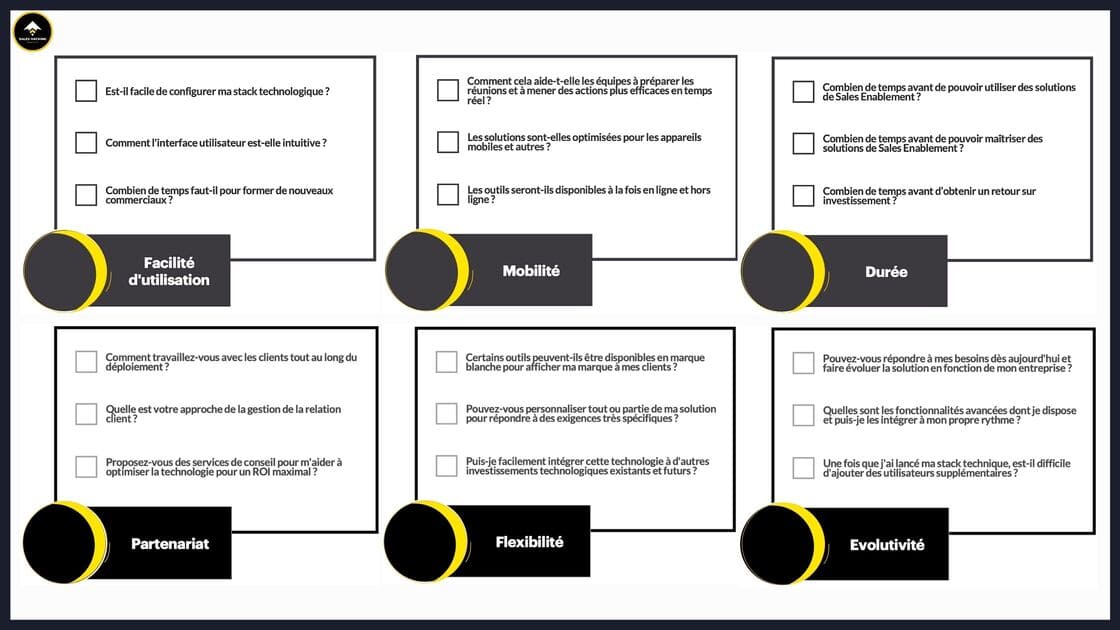
Companies investing in Sales Enablement observe significant improvements: shortened sales cycles, increased conversion rates, more effective and better-trained salespeople. The resulting marketing-sales alignment enhances message consistency and the quality of the customer experience.
To succeed in your approach, start with an honest assessment of your current practices. Identify the obstacles your salespeople face daily, then gradually build your strategy by involving all stakeholders. The tools will then support and accelerate this transformation.




Sales Operations focuses on logistical and systemic aspects: CRM management, sales forecasting, lead distribution, and territory organization. Sales Enablement, on the other hand, directly aims to enhance sales performance through content, training, and coaching. These two functions are complementary and often work closely together.
The budget varies significantly depending on the company's size and the project's ambition. An SME can start with a few hundred euros per month for basic SaaS solutions. Large companies typically invest between €50,000 and several hundred thousand euros annually for comprehensive platforms. The key is to measure ROI to justify the investment.
The first tangible results generally appear after 3 to 6 months of deployment. The adoption of tools by teams and process alignment takes time. Benefits gradually amplify as practices improve and data accumulates to refine the strategy.
No, Sales Enablement complements the CRM without replacing it. The CRM remains the central database for customer relationships. Sales Enablement platforms integrate with it to enhance the sales experience with content, training, and advanced analytics. Both work in synergy to maximize sales productivity.
Several performance indicators can evaluate the success of your approach: conversion rates at each stage of the funnel, average sales cycle duration, content usage rates by salespeople, speed of new recruits' skill development, and sales revenue growth per salesperson. Define your priority KPIs at the project's outset.
This depends on the size of your organization and the scope of your initiative. In SMEs, this role can be assumed by an existing employee (sales or marketing manager) in addition to their duties. Mid-sized and large companies generally benefit from creating a dedicated position to lead the strategy cross-functionally and ensure its success.
Sales Enablement has primarily developed in the B2B context, where sales cycles are long and complex. However, its principles can apply to B2C, especially for high-value sales (automotive, real estate, financial services) where the quality of commercial interaction makes a difference.
Adoption is the main challenge of Sales Enablement. To encourage it, involve salespeople from the project's design phase. Choose intuitive tools that genuinely simplify their daily tasks. Provide appropriate training and ongoing support. Identify internal ambassadors who will champion the project to their colleagues.