Sales Funnel (or sales funnel): it's the simplest way to turn a "curious" visitor into a customer, then into a returning customer.
In this guide, you'll understand the sales process, the customer journey, the funnel stages, and how to build a funnel that runs with marketing automation (without getting lost in 100 options).
What is a sales funnel?
A sales funnel (or marketing funnel, conversion funnel) is a series of steps that guide a person:
they discover your offer,
they give you a contact,
they receive value,
they buy,
they stay (and buy again).
💡 Key point: you don't sell "all at once." You help the person move forward, step by step, with the right messages, at the right time (this is when lead conversion skyrockets... when done right).
Initially, many sell with "a link and good luck." Then they add a capture page, 3 emails, a simple offer. And then, without changing the product, they finally see a steady flow... because they stopped relying on chance.
What is a sales funnel for: benefits
A good sales funnel helps to:
✅ Clarify your customer journey (less friction in your business)
✅ Better measure your marketing ROI (you know what works)
✅ Make your sales cycle more predictable
✅ Improve your revenue and operations
And on the marketing side: you can connect your funnel to your CRM and sales funnel, use prospect segmentation, lead scoring, and trigger the right actions at the right time.
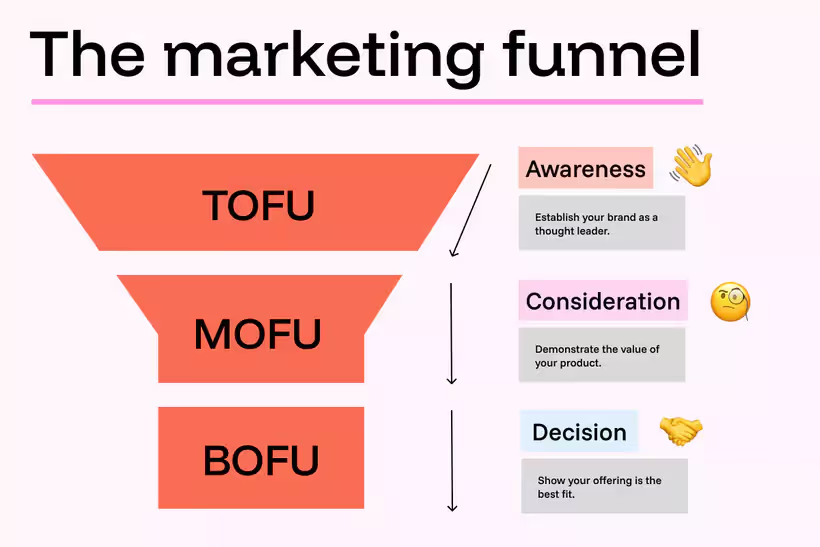
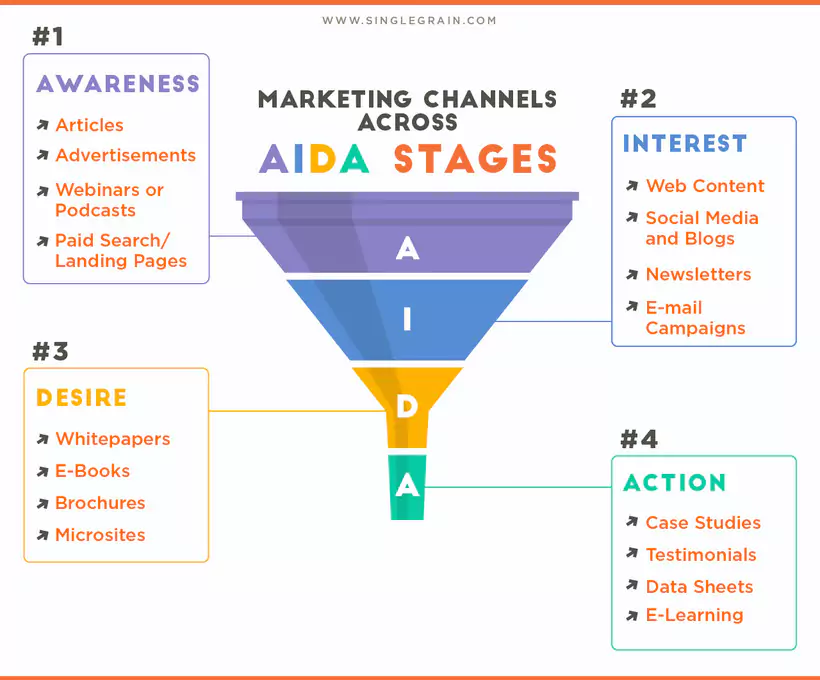
The stages of a classic funnel (TOFU / MOFU / BOFU)
A funnel is often summarized in 3 levels:
TOFU: awareness (traffic)
MOFU: consideration (trust)
BOFU: decision (purchase)
Summary Table (stages, pages, objectives, KPIs)
Sales Funnel Strategy: Stages, Content, and Key KPIs in 2026
Stage 🔻
Level 🎯
Main Objective 🔧
Pages and Content 📄
Performance KPI 📊
1. Attract
TOFU (Top of Funnel)
Generate a qualified audience via SEO and social media
– Optimized blog articles – Short videos (Reels/TikTok) – Google and Meta Ads – Digital press releases
– Monthly organic traffic – Average click-through rate (CTR) – Cost per visit 💶
2. Convert
Transition TOFU / MOFU
Capture visitor details to create a lead base
– Landing pages with forms – Lead magnets (Ebooks, templates) – Webinars and interactive quizzes – Exit-intent pop-ups
– Conversion rate (CR) – Cost per Lead (CPL) 💰 – Lead quality (MQL)
3. Nurture
MOFU (Middle of Funnel)
Educate the prospect and build a trust relationship
– Automated email sequences – Case studies and testimonials – Weekly newsletters – Personalized product demos
– Email open rate – Click-through rate – Average nurturing time
4. Sell
BOFU (Bottom of Funnel)
Trigger the purchase act and maximize immediate value
– Persuasive sales page – Smooth checkout without friction – Upsell and Cross-sell offers – Satisfaction guarantees
– Customer conversion rate – Average order value (AOV) 📈 – Return on investment (ROI)
5. Retain
Post-purchase / Retention
Turn the buyer into a repeat customer and ambassador
– Client area and onboarding – Referral program 🔗 – Satisfaction surveys – Exclusive privilege offers
– Customer lifetime value (LTV) – Annual repurchase rate – Net Promoter Score (NPS) ⭐
How to create an effective sales funnel (step-by-step methodology)
Now, let's move on to the concrete creation of a high-performing funnel. Here's the process used by top brands:
Step 1: Define your audience (Persona Building)
Before creating a page, you need to intimately know your audience.
– Immediate visual confirmation – Invitation to join a private group – Link to complementary content
Upsell / Cross-sell
Increase cart value after the first purchase
10% – 30% 🚀
– One-click exclusive offer – Sense of urgency or scarcity – Complementarity with the initial product
Non-negotiable elements for each page:
✅ Compelling headline: Clear promise, curiosity, urgency ✅ Subtitle: Clarifies the main promise ✅ Image/Video: Boosts conversion by 80% ✅ Short and scannable copy: Bullet points, bold text, short paragraphs ✅ Social proof: Number of clients, testimonials, reviews ✅ Clear CTA: A dominant button, action-oriented text ✅ Form optimization: Minimum fields (email often enough) ✅ Mobile responsive: 60%+ of traffic comes from mobile
Step 4: Set up email automation
This is where the magic of the funnel happens. You set up pre-written email sequences that trigger automatically.
Example of a nurturing sequence (for downloaded lead magnet):
Typical Email Nurturing Sequence: Schedule and Conversion Goals 2026
Email 📧
Send Delay ⏳
Objective 🎯
Strategic Content 📝
Key Indicator 📈
Email 1
Immediate (0h)
Deliver the promise
– Direct link to the lead magnet – Personalized welcome message – Reminder of immediate benefits
Open rate (>60%)
Email 2
24 hours
Provide value
– Complementary bonus resource – Exclusive practical tip – Expertise without sales intent
Click-through rate (CTR)
Email 3
48 hours
Educate the prospect
– Mini-guide or video tutorial – Solving a pain point – Deepening the initial topic
Reading time
Email 4
72 hours
Build authority
– Case study or client success – Social proof and quantified results – Creating a sense of urgency
Social engagement
Email 5
5 days
Sales transition
– Soft introduction of the flagship product – Link to the solution page – Specific client testimonial
Clicks to sales page
Email 6
8 days
Address doubts
– FAQ addressing objections – Details on satisfaction guarantee – Reassurance on customer support
Direct response rate
Email 7
10 days
Direct conversion
– Limited offer with countdown – Exclusive speed bonus – Ultra-clear call to action (CTA)
Conversion rate 💶
Email 8
14 days and more
Active segmentation
– Follow-up for non-openers – Question about current needs – List cleaning
Unsubscribe rate
Success rate: Email campaigns generate $40 for every dollar spent (ROI 40:1).
Step 5: Lead Scoring & Segmentation
Not all leads are equal. You have 1000 leads? Some are hot (ready to buy), others cold (far from a decision).
Lead scoring = assign a score to each prospect based on:
🏢 Demographic data: Company size, industry, location 📊 Behavior: Pages visited, emails opened, content downloaded, time on site 💬 Engagement: Link clicks, survey responses, shares 🎯 Intent signals: Searches, comparisons, cart abandonment
Example: A prospect who visited your pricing page 3 times AND opened 5 successive emails = high score = move to sale.
Segmentation: You divide your list into groups. Each group receives tailored messages.
📧 Lead generation: Number of leads, cost per lead (CPL), best quality source
💬 Engagement: Email open rate, click rate, page time
💰 Revenue: Lead→client conversion rate, average cart value, LTV
The 4 Main Types of Sales Funnels
Comparison of the 4 main types of sales funnels: advantages and disadvantages
Not all funnels are the same. Here are proven models based on your offer:
1️⃣ Direct Funnel (Immediate Sales Page)
You create a powerful sales page and drive qualified traffic directly to it.
Structure: Traffic → Sales Page → Purchase
✅ Best for: Info products, courses, one-time services, e-books ✅ Advantages: Quick, few steps, immediate conversion ❌ Challenge: Requires very qualified traffic (otherwise low conversion rate)
Example: A copywriter creates a sales page for their "Copywriting for Sales Funnels" course and promotes it via Google Ads to an audience searching for this course.
2️⃣ Webinar Funnel (High-Ticket)
You invite to a free educational webinar, then sell post-webinar.
✅ Best for: Services, consulting, premium courses, high-ticket (5000$+) ✅ Advantages: Very high qualification, established relationship, excellent conversion rate (30-50%) ❌ Challenge: Requires time and infrastructure (live or evergreen)
Example: A marketing agency hosts a webinar "How to Launch a Profitable Agency in 2026" and sells a $3000 coaching program afterward.
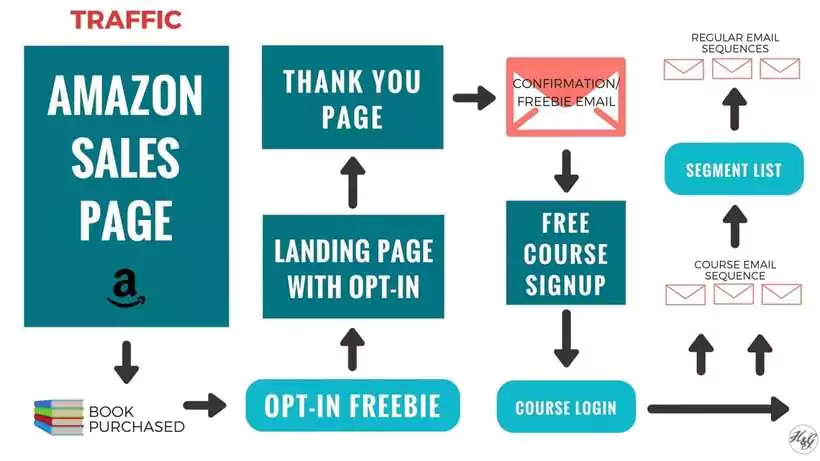
3️⃣ Lead Magnet + Email Funnel (Most Popular)
You attract with a free bonus, capture email, nurture by email, then sell.
✅ Best for: Info products, SaaS, affiliate marketing, e-commerce ✅ Advantages: Efficient scaling, complete automation, very low CPL ❌ Challenge: Heavily relies on the quality of email copywriting
Example: An entrepreneur creates a guide "How to Launch a Dropshipping Store," promotes it, captures 1000 emails in 2 weeks, sends a 7-email sequence, and sells a $297 program.
4️⃣ E-commerce Funnel (Physical Products)
You showcase products → cart → checkout → post-purchase upsells.
Here's a detailed analysis of the most effective sales funnels on the market, and the lessons you can apply to your business.
Amazon: Quick Conversion
The e-commerce giant excels in large-scale personalization. Their strength lies in the simplicity of purchase and the relevance of recommendations.
1-click purchase removes friction
Product suggestions are highly targeted
The Prime program naturally builds loyalty
Cart reminders are automated
This approach focused on ease of purchase turns visitors into regular customers.
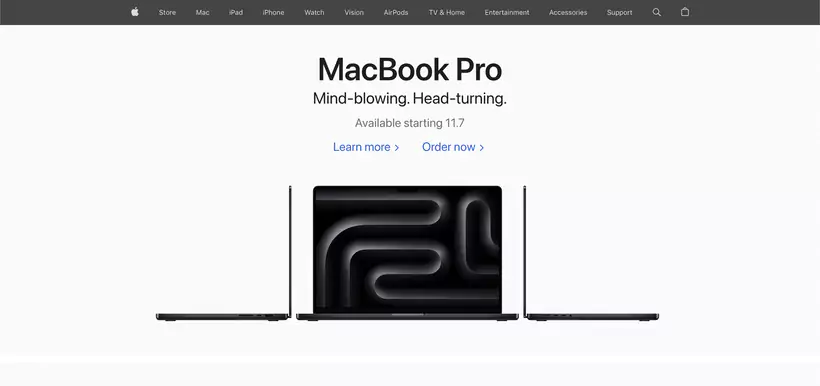
Apple: The Premium Experience
Apple creates an immersive shopping journey that justifies its premium prices. Their funnel stands out for:
A narrative that highlights benefits rather than technical features.
Minimalist product pages naturally guide towards purchase, while premium customer service reassures the investment.
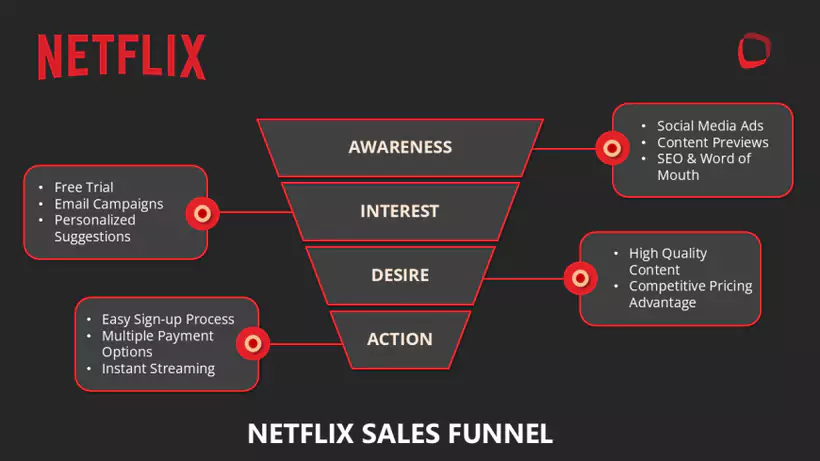
Netflix: Gradual Engagement
Netflix's marketing strategy relies on risk-free trials and advanced personalization.
The service offers a simplified onboarding that guides users to content they'll love, quickly creating a habit of use.
Smart recommendations and automatic billing simplify the experience while maximizing retention.
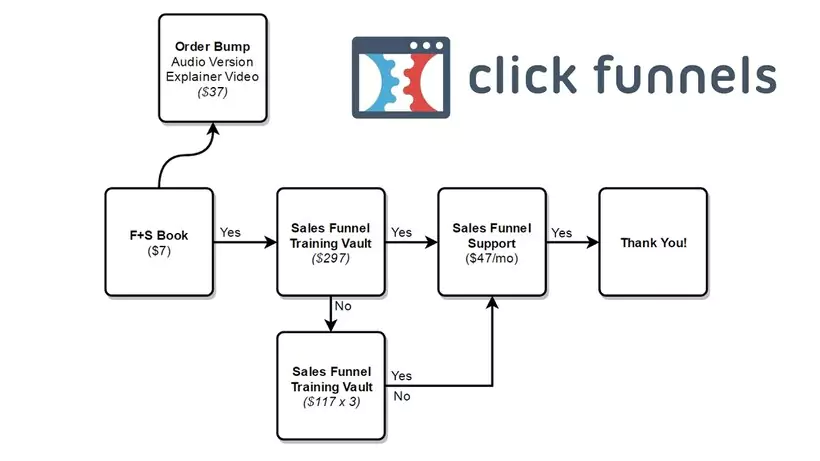
ClickFunnels: Selling Training
ClickFunnels sets the example for selling digital products. Their funnel combines:
Attractive free offers
Educational email sequences
Compelling automated webinars
Strategically placed testimonials
This logical progression turns interest into purchase.
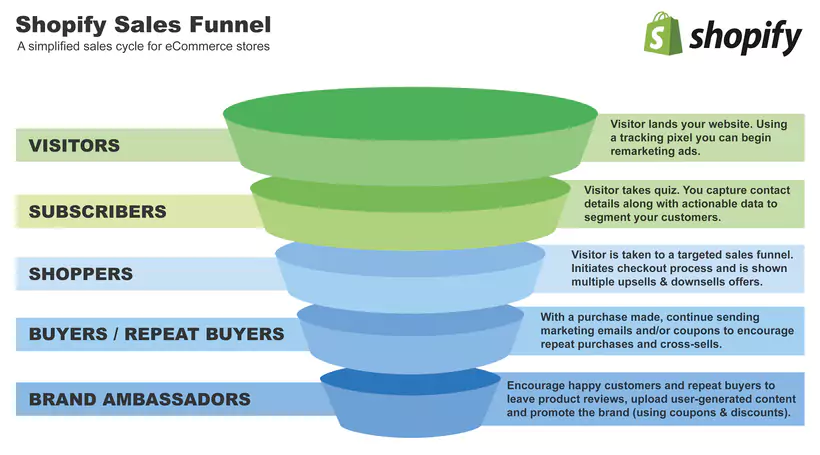
Shopify: E-commerce Optimization
Shopify's strength lies in its smooth purchasing process. The funnel integrates multiple payments, smart retargeting, and automated notifications to maximize conversions.
Personalized recommendations and post-purchase follow-up create a complete customer experience that naturally builds loyalty.
These examples show that an effective funnel always combines ease of use, advanced personalization, and smart automation. The goal is to create a natural path that guides the customer to purchase without friction.
Common Mistakes to Avoid
Here are the pitfalls that sabotage 80% of sales funnels. Avoid them:
❌ Mistake 1: Weak Targeting - Trying to Reach Everyone
The problem: You create a generic message "My product for everyone".
Why it fails: A message for everyone speaks to no one. A qualified lead doesn't identify with it.
The solution: Create a funnel for each segment. One for beginners, one for experts. One for e-commerce, one for agencies.
✅ Result: Conversion x3 minimum.
❌ Mistake 2: Vague or Poorly Positioned Offer
The problem: Your value proposition isn't clear. Prospects don't understand what they're buying.
Symptom: You have to explain for 10 minutes what your product does.
The solution:
Your headline must clearly answer: "For whom?" and "What benefit?"
❌ Bad: "Advanced marketing software"
✅ Good: "Increase your sales by 40% in 30 days with our marketing funnel - or 100% money back"
❌ Mistake 3: Asking Too Much Upfront
The problem: Your sign-up form asks for: first name + last name + email + phone + company + budget.
Result: 90% abandon before clicking.
The solution: Start small, ask big later.
Step 1: Email only
Step 2 (email 2): Add name and company (optional)
Step 3 (calendar call): Discuss budget
❌ Mistake 4: Not Sharing Enough Value
The problem: You sell, sell, sell without educating.
The reality: Leads need trust before buying. Trust is built through free value provided.
The solution:
MOFU should be 80% education, 20% selling
Give frameworks, secrets, data that others sell
The more you give, the more they buy (paradox of generosity)
❌ Mistake 5: Neglecting the Email Experience
The problem: Your emails sound salesy, generic, cold.
Result: Low open and click rates (< 15% open = problem).
The solution:
Subject lines: Personalize (include first name)
Tone: Conversational, honest, like a friend helping
Structure: Short, airy, one idea = one email
Clear CTA: One call-to-action per email
✅ Result: Open rates 30-40%, click rates 8-15%.
❌ Mistake 6: No Post-Purchase Follow-Up
The problem: Customer buys → radio silence. Never contacted for upsell, feedback, or repeat purchase.
Result: CLV (Customer Lifetime Value) of only 1x (instead of 3-5x).
The solution:
Immediate welcome email (onboarding)
Usage guide (increases satisfaction)
Relevant upsell offer (10-14 days post-purchase)
Request for review and testimonial
Re-engagement 2-3 months later (come see what's new)
❌ Mistake 7: Not Testing or Optimizing
The problem: You create a funnel, launch it... and forget to improve it. You wait for "magic" results.
The truth: No funnel converts perfectly from the start.
The solution: Systematic A/B testing.
Test ONE element at a time (otherwise results are inconclusive)
Each test: minimum 100 conversions per variant (for statistical validity)
Weeks 1-4: Test headline
Weeks 5-8: Test CTA color
Weeks 9-12: Test form fields
Result: +30-50% conversion in 3-6 months of continuous testing
❌ Mistake 8: Overly Complex Tech Stack
The problem: 12 different tools (email, CRM, landing page, analytics, SMS...) that don't communicate with each other.
Result: Fragmented data, lack of automation, nightmarish customer support.
The solution: Choose an all-in-one platform to start (ClickFunnels, Systeme.io, Kartra). Add specialized tools once mature.
Conclusion
A well-structured sales funnel is a powerful tool to boost conversions and improve customer satisfaction. By following these steps, using the right tools, and keeping your KPIs updated, you can create an automated, profitable, and scalable sales process.
FAQ
What Do BOFU, TOFU, and MOFU Mean in a Sales Funnel?
These terms refer to the key stages of the sales funnel (the customer journey):
TOFU (Top of the Funnel) – Awareness phase where you attract traffic through educational content (blogs, social media, SEO on search engines).
MOFU (Middle of the Funnel) – Consideration phase where you nurture leads with emails, case studies, demonstrations.
BOFU (Bottom of the Funnel) – Decision phase where you encourage purchases with specific offers, testimonials, and guarantees.
How to Optimize Each Stage to Improve Conversion?
To optimize a sales funnel, attract qualified traffic with SEO and targeted advertising, engage with personalized content, and simplify the purchasing process by integrating social proof and various payment options. Retention relies on regular follow-ups and exclusive offers.
What Tools Can Help Create and Manage Sales Funnels?
Systeme.io, ClickFunnels, and the HubSpot platform allow you to create complete sales funnels. Google Analytics helps analyze performance, while Mailchimp manages automated email marketing.
How to Measure the Effectiveness of a Sales Funnel?
Effectiveness is measured through the conversion rate, customer acquisition cost (CAC), customer lifetime value (LTV), cart abandonment rate, and return on investment (ROI). These indicators help optimize each stage of the funnel.


.svg)