.svg)
In this SEO showdown, I categorize and review Moz, SEMrush, and Ahrefs based on keyword search functions, technical SEO, site audits, and more.

Moz is one of the leading SEO tools that covers end-to-end SEO solutions, including keyword management, web page exploration, and optimization. It helps you increase traffic, rankings, and visibility in search engines.

Founded in 2004, its versatile features and SEO tools make it a good option for small businesses.
Some of Moz's key features include:
SEMrush also provides a comprehensive workflow for SEO professionals.

Some of the key features of SEMrush include:
Additionally, it offers an all-in-one digital marketing solution, including SEO, content marketing, competitive research, advertising, and campaign management.
It also has a healthy user base of over 4 million users, including some of the biggest advertisers and the top 500 companies. She is best known for her technical site audits, which help websites identify issues that need to be addressed.
Ahrefs is a newer SEO tool that is best known for its keyword research and ranking tracking tools. It can also boast of having the second fastest crawler compared to Google.

This all-in-one SEO toolset fulfills key functions, including:
Its customer list includes some of the biggest brands on the planet, like Facebook, LinkedIn, Uber, Netflix, and Adobe.
With Ahrefs, you can also optimize your website, analyze your competitors, learn from the best performing content in your niche, and track your rankings. It also offers free learning materials and encourages you to learn the basics of SEO before you even start its trial offer.
Next, let's move on to a point-by-point comparison between Moz, SEMrush, and Ahrefs based on the following:
Targeting the right keywords is critical if you want to attract traffic to your website. Each web page on your site should target a primary keyword and include it in the page title, URL, titles, and content.
Identifying the right keywords is like finding the key to your success.
Each of these SEO tools (Moz, SEMrush, and Ahrefs) is quite good at keyword research, with Ahrefs being the big winner.
Moz allows you to easily add, create, and manage keyword lists in one place. Additionally, you can rank, compare, and prioritize phrases or keywords to develop an effective content strategy.

Moz's reliable database, which contains high-quality keywords, provides multiple keyword suggestions and the latest SERP data. Thanks to this feature, it is easier to stand out from the competition.

You can see metrics like the difficulty level that tell you how challenging it is to rank for that particular search term. From there, choose keywords based on their competitiveness and the estimated CTR on the SERPs.
Additionally, you can estimate keyword performance with search volume estimates that are 95% accurate. You can also assign your own custom score to increase keyword importance.
The SEMrush Keyword Magic Tool provides millions of keyword results based on your business needs. You can instantly build a master list of keywords by entering the main keyword you need to be ranked for, choose geography, and press the Search button to get a complete list of keywords in seconds.
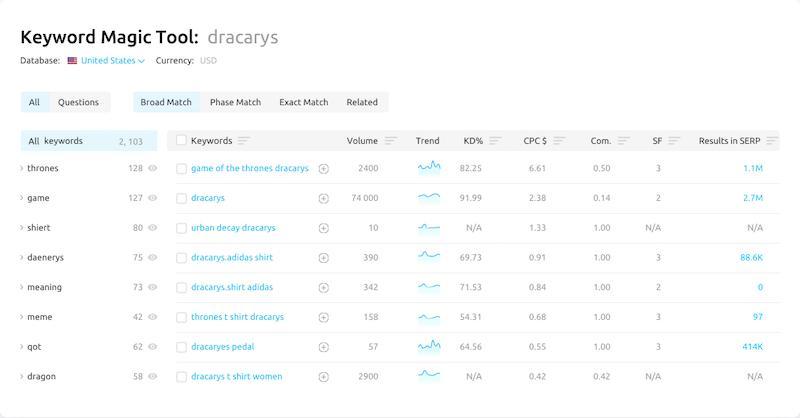
Keywords are grouped by types, questions, and groups, allowing you to immediately identify keywords that are lagging behind. You can also analyze competitive density, search volume, and CPC estimates for these keywords. This helps you determine how competitive these keywords are in free and paid search results.
The free version of this tool provides access to 10 requests per day.
You can sort search queries by date, volume, or difficulty with a single click. You can also analyze search trends and volume over the past 12 months. By clicking on the “Questions” tab, you get the questions that users are looking for related to your keywords. And the “Related” tab allows you to find semantically related terms that you can also rank for.
In addition, the keyword manager stores all your keywords in one place for great ease of use.
Overall, SEMrush gives you access to simple keywords and columns to understand and find new ideas.
It helps you:
Ahrefs Keyword Explorer is an amazing keyword research tool. It helps you visualize competitive metrics, find new keyword ideas, calculate their traffic potential, and analyze their ranking potential.

Ahrefs operates on a massive database of over 7 billion keywords that is updated every month. The data is also divided according to 171 countries. Besides Google, it can also estimate keyword volume for Amazon, Baidu, Bing, and YouTube.
As soon as you enter your keyword, you get four sections:

The click flow data function provides refined search volume each month. You can also target keywords that are easy to find by evaluating their difficulty score and the estimated number of clicks on a keyword. To help secure your searches, you can easily segment and save your keyword list.
Ahrefs is distinguished by the additional data it provides for keyword research. You can look at the history of SERP positions to see how the top five sites ranked for a target keyword over the past six months.
You can also look at all of the top 100 rankings for a given keyword to get competitive metrics for each domain: how many links point to their article, their domain evaluation (DR), their Ahrefs ranking, etc.
This SEO software is ideal for bloggers because it provides both keyword and competitor data in one place. Check out my huge guide to learning How to create a blog for beginners for more information on how to do keyword research when choosing your niche.
Here are some of the main features of the Keyword Explorer tool:
With a database of over 7 billion keywords that are separated according to 171 countries, Ahrefs is a clear winner. It provides everything you need for your keyword and competition analysis. On top of that, the dashboard is easy to navigate and use.
Keeping your technical SEO error-free is a necessity. A fast-loading, well-structured, and properly implemented site is a necessity.
I consider technical SEO to be a negative ranking factor. Having a solid base of reference won't immediately boost your rankings, but poor technical SEO will certainly lower it.
This is why it is important to conduct regular site audits in order to discover problem areas and correct them quickly.
These three tools all offer different ways of visualizing and resolving these problems. Typically, you enter your domain into their site audit tools and then find common issues such as duplicate meta descriptions, missing image alt text, slow pages, 404s, and more.
Moz offers step-by-step tips for optimizing the content of your pages. Simply enter the keyword and page combination to get priority SEO recommendations that could improve your rankings.

You can also prioritize your pages based on the page optimization score. It also performs instant audits to optimize your page with relevant keywords and audits.
Moz helps you optimize your site's SEO in the following ways:
SEMrush SEO Checker helps you get the best results from your web pages. It evaluates the factors that affect your ranking in Google, compares your website with the top performers, and produces an actionable report based on data.
SEMrush also checks all of your pages to see if they comply with on-page/off-page SEO elements.
It identifies the effectiveness of the relevance and quality of your content, the authenticity and reputation of backlinks, the body of the text, the page titles, the H1 tag, the meta description, etc. In addition, it offers a structured list of improvements to help you implement technical SEO in a planned manner.
SEMrush Compares your web page with the best websites to provide you with actionable data.
Here are the suggestions he provides:

SEMrush stands out for its technical SEO ideas.
Based on the exploration of your site, the tool provides all the technical elements that need to be corrected and gives the site a score.
Ahrefs allows you to see under the hood and identify exactly what's stopping your website from ranking better.
It goes through all the pages on your website to provide details such as:
Even if you have a huge website, you don't need to worry. Simply check your domain and explore all pages for a quick SEO check. You can also skip crawling irrelevant pages.

Additionally, it provides solutions to over 100 predefined SEO problems.
Here are some of the most important ones:
In addition, SEO professionals have total control over a hundred data points on all pages thanks to the Ahrefs Data Explorer tool. In other words, you get all the relevant SEO metrics in one place.
The choice is very tight between SEMrush and Ahrefs. But SEMrush is slightly winning because of its ability to give suggestions for improving on-page SEO in a structured manner. Digital marketers can also prioritize SEO optimization on web pages with greater organic ranking potential.
It is technically impossible to compete with your rival without knowing them. You can't compete with a top website in your niche without knowing its keywords, backlinks, PPC strategy, domain authority, and more.
That's why you need to take a closer look at your competitor's website.
Moz's link explorer (formerly Open Site Explorer) extracts all the essential data about a target website, including its domain authority, page authority, and more.
All you need to do is enter the URL and click on the “get free link data” option.

It will bring out all the necessary data such as link domains, incoming links, ranking keywords, external and internal links.
This is what the results page would look like:

The two key parameters here are:
Additionally, you get 10 free requests for an entire month, which is handy if you want to check out the product before buying the paid plan.
Overall, the Moz link explorer allows you to:
SEMrush also offers a simple user interface for collecting essential data on any site.
Just enter the URL and click on the “Verify” option here:

Then, it extracts all the essential data, including domain authority, backlinks, lost backlinks, the link building process of your competitors, and more.

On the first page, you have details about settings such as:
Scroll down to find detailed reports on:

You can also analyze the keyword list based on specific countries. It also indicates the categories and authority of the reference domains. Click on the referring domains to find out the number of backlinks, root domains and countries.
The report also contains data on referring IPs, indexed pages, competitors, anchors, and referring domains. You'll see a “View Full Report” option under all metrics to give you a more in-depth look at all of these numbers.
Overall, SEMrush backlink analysis allows you to:
Ahrefs started as a link analysis tool. Their “Site Explorer” is one of the best SEO tools (and one that I use almost daily).
This Site Explorer allows you to enter any domain and provides in-depth analyses of the website's profile, backlinks, and organic search traffic.
It also combines three powerful SEO features in a single interface:
A thorough analysis of competitor backlinks helps you identify backlink gaps and sites to target. You can also visualize broken backlinks, dofollow and nofollow links, and much more.
Ahrefs also prides itself on having over 150 million keywords in its database. With all of this keyword data and backlinks, you can:
Ahrefs Site Explorer is the gold standard for competitor research.
Finding the right keywords for advertising campaigns is critical to reaching potential customers. Advertising in the wrong region or with incorrect phrases will only burn your hard-earned cash with no results.
It is therefore essential to review your competitors' marketing plan and your own to make sales and get a better return on investment.
Moz's unique search capabilities allow you to run highly optimized PPC campaigns. For example, you can create, add, and manage a list of keywords in one place to launch PPC ads.
It offers thousands of intuitive suggestions to help you choose better keywords and rank among the best competitors. Metrics like search volume estimates to choose high-quality keywords for your campaigns.
Then there is Moz Local - an excellent tool for small businesses that want to advertise their presence in the local market.
If you want to plan your PPC campaign properly, knowing your competitors is essential. Learn about their research strategy and ads - half the battle will be won.
The advertising search tool of SEMrush allows you to:

It evaluates things like PPC spending and competitors' marketing strategy from serious angles.
You can analyze how much money your competitors spent on advertising and how much traffic they received through PPC. This gives you a clear picture before you spend money advertising your website. If you want to go further, you can read the pattern of your competitors' advertising spending over the year to optimize your budget more effectively.
Then there's the market exploration function from SEMrush that provides details on specific topics to attract targeted audiences, market demographics, and more.

Additionally, SEMrush evaluates competitors' PPC strategy from a variety of perspectives, including:
Ahrefs generates thousands of keyword ideas in six different ways to help you run engaging PPC campaigns:
And if you don't want to run your PPC campaign on Google, Ahrefs is the marketing tool you should consider. It uses click flow data to assess the popularity of search queries in other search engines. Ahrefs can make your paid marketing a breeze on platforms like YouTube, Baidu, Amazon, Bing, among others.
It also allows you to identify and prioritize a variety of keywords by applying a variety of filters, including:

Additionally, it also offers advanced metrics, including the percentage of clicks, the percentage of organic clicks compared to paid clicks, and the return rate for better understanding.
Ahrefs' ability to generate keyword ideas in multiple formats makes it a great option. However, SEMrush's market explorer and advertising research tool give it a slight edge over Ahrefs and Moz. Ahrefs comes right after, as it provides search query rankings on various search engine platforms other than Google, making it a versatile option.
There is no point in putting in the effort if you don't know the result. That's why you need powerful analytics and reports to assess the results of your SEO efforts and calculate the return on investment.
With Moz, you can get up to:
Moz's ranking tracking feature analyzes your website's SERP positions. This allows you to track web pages and keywords.
It also provides a detailed list of the keywords with their SERP rankings that you've followed during the month. You don't have to manually check SERP rankings, saving you a lot of time.

Historical Moz data (on all search engines like Yahoo! , Google, Google Mobile, and Bing) allow you to analyze the results of your SEO efforts. And not only globally, you can also track local rankings based on region, city, or sector.
SEMrush analyzes website performance quite easily. You can easily compare traffic with that of your competitors or partners. Additionally, you can track trends and define leaders based on competitive traffic analysis.
SEMrush also provides reports on numerous marketing metrics, such as keyword rankings, backlinks, paid search positions, and more.

It also allows you to streamline your reports in three easy steps:

You can also assess user engagement across multiple devices and compare them on desktop or mobile. SEMrush also allows you to compare your audience with that of your competitors, analyze potential growth, and identify user preferences.

You can also analyze the “input sources” of your competitors. This function allows you to know the direction of their digital marketing campaigns.
Additionally, SEMrush also tracks top products, popular topics, and blogs to optimize your content strategy. It also determines the best performing channels, evaluation expenses, affiliate performance, and your performance based on geographic areas.
Ahrefs also offers a powerful ranking tracker to monitor the performance of your keywords and website. You can track Google SERP rankings on mobile and desktop across 170 countries and receive all corresponding reports directly in your inbox.
All you need to do is import or enter the keyword list, add countries, and enter competitor URLs. That's it, it will start to track your SEO data and send you regular updated reports.

In addition, it allows you to analyze the percentage of traffic coming from organic search and to check your progress over a given period of time. You can also track your rankings segmented into different groups.
You can segment your data to see only what you want to see if you have a long list of keywords.
Ahrefs also offers a batch analysis tool which allows you to obtain SEO measurements for a maximum of 200 URLs at a time.

All of these SEO tools provide unique tools for analysis and reporting. However, SEMrush is the winner for its ability to deliver these reports for yourself or for your customers.
Price is a key consideration when choosing an SEO tool. You don't want to overstate your budget.
Here's a breakdown of the pricing plans from Moz, SEMrush, and Ahrefs:
Moz offers 4 pricing plans:

The Standard plan is suitable for small businesses and beginners. The Medium plan is its most attractive plan as it also offers a 30-day free trial and full access to the keyword planning tool.
On the other hand, its Large plan offers more advanced features such as 1900 keyword rankings, 60 on-demand crawls per month, and unlimited reports. Finally, the Premium plan is for large businesses and agencies that focus on SEO. It generates data from 4,500 keyword rankings, provides access to 5 user seats, and provides unlimited reports.
All Moz plans come with these standard features:
You also save 20% if you pay annually.
SEMrush offers three pricing plans:

You get a 16% discount on the annual subscription for these plans. The Pro and Guru plans also come with a free subscription.
Here is a comparative report of the characteristics of all the plans:
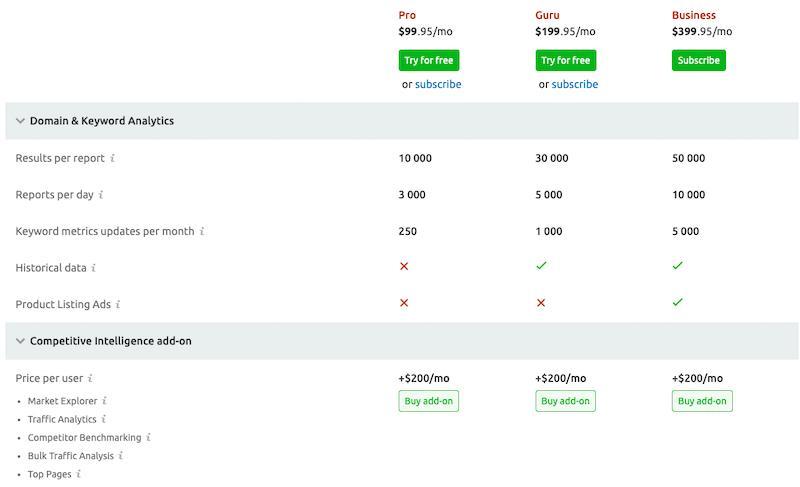
The product list feature is only available with the business plan. And the historical data feature isn't available with the Pro plan. Additionally, you can get up to 50,000 results for each report in the business plan. The Pro and AGuru plans offer 10,000 and 30,000 results per report respectively.
Ahrefs offers four plans, including the following:

The Lite and Standard plans also offer a 7-day trial for $7. The Lite and Standard plans only allow for one user. The Advanced and Agency plans allow access to 3 and 5 users, respectively.
All plans offer some standard features, such as:
With annual billing, you can get two months of free subscription.
With the best overall features and a 7-day trial for $7, Ahrefs is the winner in my book. You can still try it out for seven days, do all of your organic searches, and then cancel before the first payment.
These three tools all have strengths and weaknesses.
To make things easier for you, here are the pros and cons of each tool to better understand their unique selling points and issues.
Moz identifies your website's ranking in search engines by giving it a score ofdomain authority (DA). The DA can fluctuate between 1 and 100. The higher the score, the more likely your site is to rank in search engine results pages (SERPs).
Moz calculates the DA by taking into account several key parameters, including the total number of links and the root domains of the links. The single DA can be useful for comparing the ranking strength of different websites.
Here are some of the ways you can improve your site's domain authority:
Ahrefs calculates the Domain Rating (DR) to know the strength of the website. It takes into account both the quality and the number of its backlinks. Like Moz, it also calculates the DR score on a logarithmic scale of 0 to 100. Ahrefs' Domain Rating is similar to Moz's Domain Authority (DA).
Here's how they calculate the Domain Rating at Ahrefs :

Page authority determines the ability of a web page to rank in a SERP. Its score can be between 1 and 100. Naturally, web pages with a higher score have a better chance of ranking on the search engine page.
Page authority is calculated using parameters such as index data and domain authority. Moz also uses the machine learning algorithm to determine the page authority of a specific web page. If you want to improve the authority of your page, try improving your backlink profile.

The URL Rating (UR) defines the link profile of a web page on a logarithmic scale of 0 to 100. It calculates the UR taking into account external and internal links. Also, the higher the logarithmic value, the better the evaluation of the URL of a web page.
Ahrefs uses the same principles Only the Google page rank to calculate the ranking of URLs.

Referral domains refer to the number of websites that link to you. For example, a site that links to you three times is considered three backlinks, but only one referring domain.
For example, if your home page has a link back to Buzzfeed, you have a referring domain. And if you have backlinks on both Buzzfeed and the Washington Post, that means you have two referring domains. However, even if you have two backlinks on Buzzfeed, this is considered to be a single referring domain.
As with reference domains, link root domains are the number of third-party websites that are linked to your website through backlinks. Only the number of unique domains is counted in the link root domains. This means that two links from a website are counted as one. The concept of link root domains is similar in principle to that of reference domains.
The spam score defines the percentage or number of websites with similar characteristics that are also banned or warned by Google. Moz's machine learning algorithm calculates 27 standard characteristics from millions of penalized or banned sites.
However, don't worry if your website gets a spam score. Just make sure you're getting high-quality links from low-polluting websites.
That's it — my review of Moz, SEMrush, and Ahrefs. Each SEO tool has its own strengths and weaknesses.
For example, if you want a reliable SEO tool that has excellent technical SEO and analytics features, I recommend SEMrush.
And for powerful tracking of backlinks, site crawler tools, and keyword research, Ahrefs is the best option.
Finally, Moz is a decent SEO tool for local SEO, custom reporting, and campaign analysis.
Be sure to read these reviews carefully before making your final decision.