.svg)
AudioSonic is a tool of artificial intelligence-based audio generation developed by Writesonic, designed to convert written texts into synthesized voices that are intended to be natural and expressive.
It aims to provide quality, almost human narration for various content such as blog posts, marketing content, podcasts, or audio guides.
With a multilingual capacity, AudioSonic is positioned as a global solution for digital storytelling.
AudioSonic stands out as a AI voice generator revolutionary, transforming text into audio with striking authenticity.
Here's an exploration of key features that could revolutionize your business communication.
AudioSonic helps maintain a consistent brand voice that is essential for brand identity.
While the tool promises vocal consistency, it's crucial to ensure that AI-generated voice stays true to the brand identity and doesn't distort the message.
AudioSonic offers an economical solution for voice production, avoiding the high costs of voice actors and studios.
The quality of the voice generated can vary, and it is essential to assess whether it meets professional quality standards before fully engaging.
AudioSonic's multilingual support opens the doors to an international market, facilitating communication across linguistic borders.
However, attention should be paid to the accuracy of the translation and to the ability of the tool to manage the nuances of different dialects to ensure authentic communication.
AudioSonic adapts to the growing needs of businesses, ensuring fast and reliable voice production.
The real question remains AudioSonic's ability to maintain consistent quality during scale-up, a decisive aspect for growing businesses.
AudioSonic integrates seamlessly with Writesonic and Chatsonic, enriching the content creation process.
The integration seems promising, but users need to be ready to adapt to the Writesonic ecosystem to fully exploit the tool's potential.
AudioSonic gives you 10 minutes of free audio generation when you sign up for Writesonic. For larger needs, buy additional minutes with pay-as-you-go pricing.
AudioSonic's pricing plans offer significant flexibility for businesses of all sizes, allowing precise adaptation to specific audio generation needs. However, dependence on a pay-as-you-go model could prove costly in the long run for frequent users, underlining the importance of careful cost assessment prior to engagement.
Excellence in the AI creative studio

Murf AI uses real human voices to generate AI voices that rival the authenticity of a natural voice, making it an ideal tool for projects that require a human touch.
Rates :
Murf AI is a strong contender with its comprehensive creative studio and diverse voice library. However, for large-scale projects, costs can quickly add up, especially for businesses that require the highest plan.
For precise intonation control

Resemble.ai excels at creating personalized human voices, offering rich intonation for audio content that resonates with emotion and precision.
Rates :
Resemble.ai offers significant flexibility for developers and content creators, but its per-second pricing structure could prove expensive for long audio projects.
The complete solution for AI voice generation
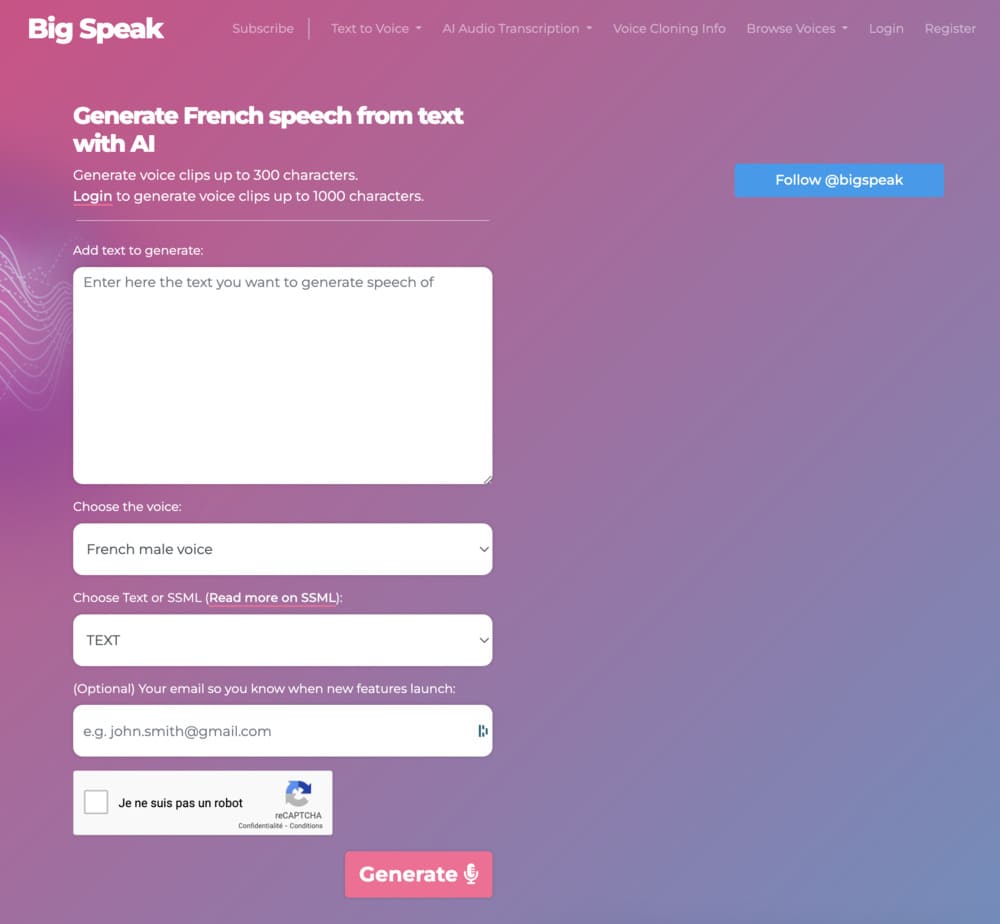
BigSpeak.ai allows you to create short voice clips with a simple interface and advanced customization options, ideal for a variety of projects.
Rates :
BigSpeak.ai is attractive for small projects with its free offer, but the character limitation may restrict its use for more elaborate content.
Comparative Conclusion :These AudioSonic alternatives each offer unique features that may be suitable for different types of audio projects. Resemble.ai is ideal for those looking for extensive customization, BigSpeak.ai for short, free projects, and Murf AI for those looking for a full-featured creative studio with collaboration options. The choice will depend on specific customization needs, content length, and budget. AudioSonic, with its Writesonic integration, is still a solid option, but these alternatives are worth exploring for their distinct offerings and unique capabilities.
This guide is designed to help you use Audiosonic step-by-step, even if you're new to artificial intelligence-based voice generation.
To get started with Audiosonic, log in to your personal space on Writesonic.

If you don't have an account yet, creating is easy and free.
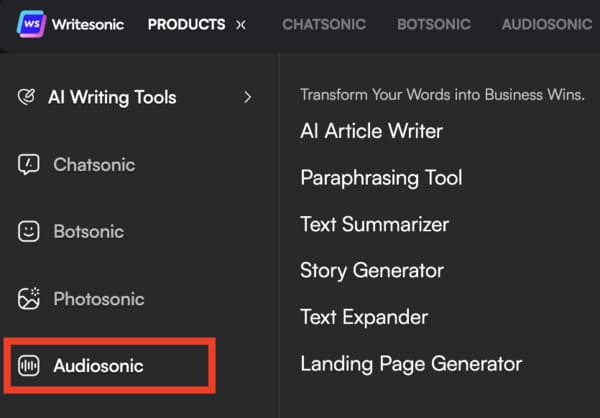
Once logged in, navigate to the dashboard sidebar and click on the “Audiosonic” option. You are now ready to start your audio project.
On the Audiosonic page, you'll find a field dedicated to inserting your text. This is where you'll enter the phrases you want to convert to audio.
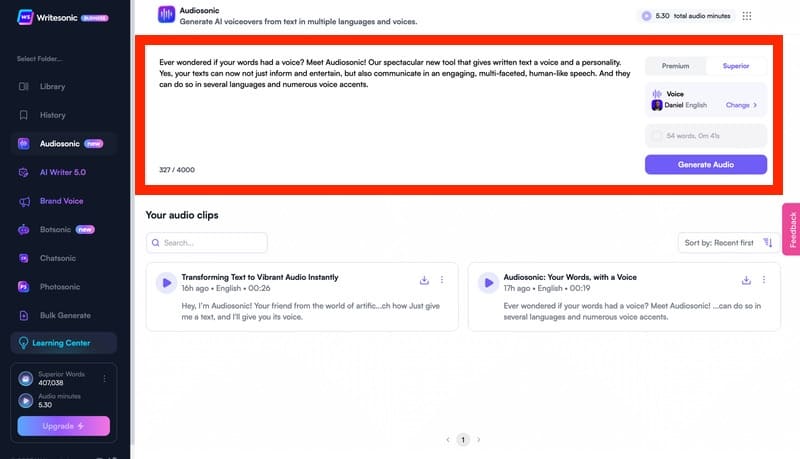
Take the time to refine your text so that it clearly reflects the message you want to convey.
Now it's time for personalization! You can choose between different audio qualities, such as Premium or Superior.
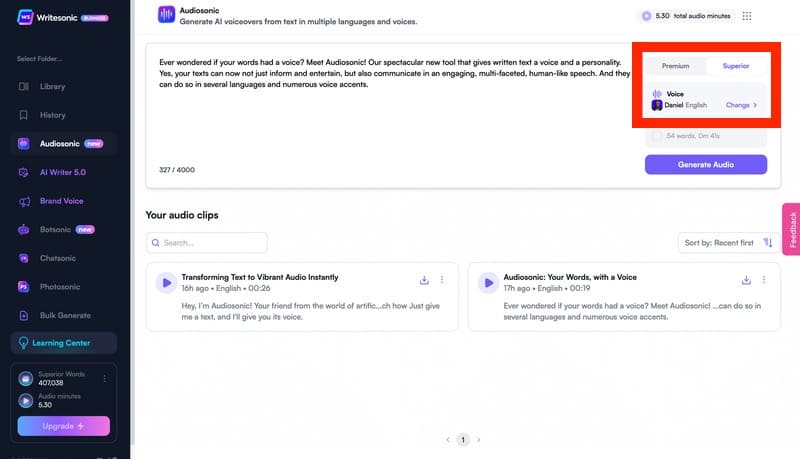
Then select the voice that best matches the identity of your content.
Audiosonic offers you a variety of voices that faithfully mimic the human tone. Listen to the samples and choose the voice that will convey your message accurately and emotionally.
Once you are happy with your choices, click on the “Generate Audio” button. In just a few moments, Audiosonic converts your text to audio.

You can listen to the result immediately and find it in the “Your audio clips” section.
Audiosonic's simplicity and effectiveness make it a valuable tool for bringing your textual content to a new dimension.
Get started and explore the potential of Audiosonic to enrich your communication strategy and give your brand an authentic voice.
The Audiosonic tool promises to revolutionize the way we interact with written content by turning it into dynamic, striking audio.
While the idea of transcending language and geographic barriers with authentic AI voices is appealing, the end user experience will depend on the tool's ability to deliver truly natural and engaging voice quality.
Initial enthusiasm should be tempered by a practical evaluation of the tool in a variety of use scenarios.
Ultimately, Audiosonic has the potential to bring words to life, but it's the listener's experience that will determine whether this tool is truly the future of audio content.







%2520(1).webp)