.svg)
Discover how to use Zoom for virtual meetings. This guide explains Zoom’s features, setup process, and tips for maximizing your video calls.

You can use your web browser and the invitation link that the host sends you to get started.
Simply click on the meeting link and follow the instructions to join a meeting.

In the desktop app (or even in the Zoom mobile app), you can join a meeting by entering the meeting ID that was sent to you by the host.
The host will find it in the upper left corner of their Zoom window when they start or schedule the meeting.

One of the key characteristics of meeting IDs is that once a host chooses the recurring meeting option, participants will still be able to join the same meeting room by entering the same personal identification number.
Some of these elements depend on whether you are an administrator or a meeting attendee.
As an administrator, you'll be able to control certain features that participants can't use, such as muting others, starting or stopping the video, and recording the meeting.
However, as standard, there are features that anyone can use while meeting in the Zoom meeting room:


Nonverbal feedback is a great way to show your reaction to something being said in the meeting without interrupting the person speaking.
Zoom offers a few different options for this, which can be found in the bottom toolbar of the Zoom window.

You can type in different emojis or “reactions” to show how you feel in the discussion.
You can also use the appropriate icon to virtually “raise your hand”, which is useful if you want to ask a question but don't want to pause the meeting before you can.
If you are organizing a meeting, you can change the settings during the session to activate/deactivate the reactions or the raised hand icon.
Speaking of chat, it's nice to know that anyone can send/receive files during the meeting (if enabled).
However, opening a file does not automatically download it. You will therefore have to click on “Save as” if you want to keep this file locally on your computer.
If you want to collaborate with other meeting participants, you may need to share your screen.
Screen sharing is useful for presentations, for showing something on your screen, or even for co-browsing a website.
On video call:

If you share your entire desktop, consider closing any programs that may generate notifications or contain confidential information, as everyone on a call will be able to see it on your screen.
On a different note, it's good to know that you can also share your Apple iOS iPhone screen if you're organizing a meeting on an iPhone.
The same is true if you're using an Android phone.
You can also share slides as a virtual background, share a portion of your screen, and share content from a second camera.
Finally, you can also share files from third-party integrations like dropbox and Google Drive.
As a host, you can control various settings about who can and cannot share screens. These settings can be restricted in account, group, or user settings.
During Zoom calls, you can keep the focus on one or more people during the meeting by “pinning” or “highlighting” them.
Click on the video camera, choose the three dots, then select “pin” to get started.
If a person is pinned, they will still be shown even if they don't speak.

The meeting host can pin up to 9 people, while attendees can pin one person by default.
On the other hand, the “Spotlight” function allows a person's video to be displayed in large numbers on the screen, even if other people are talking.

The spotlight can only be done by the host/co-host and the pin of the crushing individual.

To remove the projector function, the host can click the option that appears on the camera frame when it is no longer needed.
The different Zoom meeting layouts and views allow you to personalize how you see people on your screen.
The main views are the gallery view and the speaker view, which can be accessed by clicking on the icons on the appropriate toolbar.
The gallery view shows video feeds of all participants in small tiles, while the speaker display shows only the person who is speaking.
It's good to know that if you're recording meetings in gallery view, the recording will only show the speaker's view, not the gallery view selected during the live meeting.
It's also worth noting that the gallery view can show up to 49 participants.
Additionally, you can choose to only see video feeds from other meeting participants whose cameras are on, which means you won't see the black feed from someone whose camera is off.
To schedule meetings from the Zoom web portal or the Zoom desktop app, start by opening the Zoom app and signing in.
Once you're logged in, click “Schedule a Meeting” on the home page.
Enter all relevant information, such as the subject of the meeting, the date and time, the duration, and whether or not a password is required.
You can also download the Zoom client for easy access.
Using the Zoom app means you don't have to go through your web browser every time you want to start or join a meeting.
Here is more information on how to schedule Zoom meetings for your specific needs.
During a session, you can invite participants from the web portal, the desktop application, or the meeting toolbar.
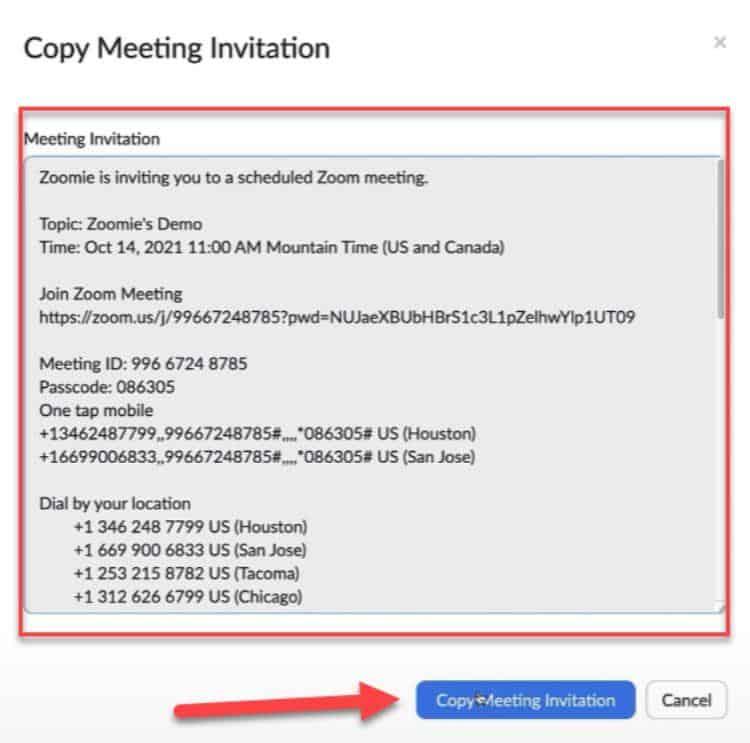
When using the web portal, click copy the invitation to share the URL with participants.
The password may also be included in the information. So make sure it is and check it when inviting people to your meetings.
You can also add the meeting invitation to your calendar Microsoft Outlook, Google Calendar or yahoo.
You can then invite others from the specific calendar, just as you would normally do for any other event.
If you're inviting someone from the desktop client, click Meetings, choose the Upcoming Meetings tab, copy the invitation, and paste the information into an email, or send it directly to the person you want to invite.
While a meeting is in progress, you can use the context information menu to invite people to use the join link in the Zoom meeting.
You can also open the participant window, and you'll see various options for inviting people to join the meeting.
ZoomBombing is a word that was created to describe the malicious act of a person who interrupts or disrupts a live Zoom meeting—typically a meeting to which the host did not invite the person.
While it's possible to cause a meeting to fail or share offensive and inappropriate images or words, Zoom focuses on three steps to keep its meetings safe.
When you start a new meeting, using a waiting room means everyone will see a message until you are ready to start.
You can also use an access code that people will need to enter or have them sign in to a specific account before joining you.
This can help you avoid people joining your meeting uninvited - you can also refuse entry to anyone you don't recognize.
Hosts can use the shield icon during the Zoom meeting to lock the session so that no one else can join.
You can also use this icon to remove a participant or even pause all of a participant's activities in case things get out of hand.

By clicking on the shield icon, you'll also find the report button, which you can use to report a user (or multiple Zoom users) for inappropriate behavior.
You'll need to choose which attendee to report, enter meeting details about what happened, and then submit the report.
You can also report attendees after the Zoom meeting is over.
Major Zoom room options can be used to create small group sessions during a meeting.
This can be done by clicking on the appropriate icon and selecting the meeting rooms.

You'll be able to choose how many Zoom rooms you want, and then you can either manually move people into the room or assign them automatically.
The host will be able to move between the different rooms and also broadcast a message to all the rooms at the same time.

Once the session is over, everyone will be taken back to the main meeting.
Setting up a meeting or webinar via Zoom is a relatively easy process, but there are a few things to consider.
Be sure to test your audio and video before you start the meeting to make sure everything is working properly.
If you're inviting people to join your meeting, be sure to send them the information in advance so they can get ready.
And finally, be aware of the security risks that could occur and take steps to prevent them.
Finally, if you want more features than what a free account offers, consider the Zoom Enterprise (Pro) version for the best possible experience with one of the most powerful video conferencing tools available.
Further reading: Did you know that it exists Several alternatives to Zoom that could be a better solution for your specific needs?