.svg)
Learn about growth mindset, its benefits, and how to develop it. A comprehensive guide to fostering a positive, success-driven mentality.

The mindset of a Growth Hacker is 200% focused on growth.
This is important in 2 ways:
Let's look at that in more detail now.
READ MORE: What are the skills of Growth Hackers?
Think of mindset as the lens through which you see the world and respond to its evolution:
Your state of mind determines how you develop, how you manage change, and how you experience emotions.
Above all, it is a personal work that is important for you every day and not only in your life as a Growth Hacker.
The Growth Mindset is very important from a professional point of view.
As a business, you will constantly be faced with new challenges and obstacles for which you need to find solutions quickly.
And if your actions don't work, you'll need to quickly find new ways to overcome these problems.
In this context, being agile is essential in order to learn new methods, tools or skills to get ahead of your market.
That is why it is so important to adopt a Growth Mindset :
Moreover, many entrepreneurs define Growth Hacking primarily as a state of mind rather than a set of methods and processes.
This advice is probably the most difficult to apply. The fear of failure is deeply rooted and linked to the fear of the unknown.
The Growth Mindset teaches you to see challenges as opportunities:
Experiment, analyze your mistakes, and learn to be patient. Each time you do it again, you are one step closer to the success of your business.
In Growth Hacking, speed of execution is more important than perfection.
No one can say for sure in advance What will or will not have an impact on growth. This is why Growth Hackers prefer experimentation through short iterations (period of 2 to 4 weeks) to search for new growth drivers.
On average for beginner Growth Hackers, only 10% of experiments are successful. We go up to a level of 30/ 35% for more experienced profiles.
So the more you experiment, the more likely you are to succeed.
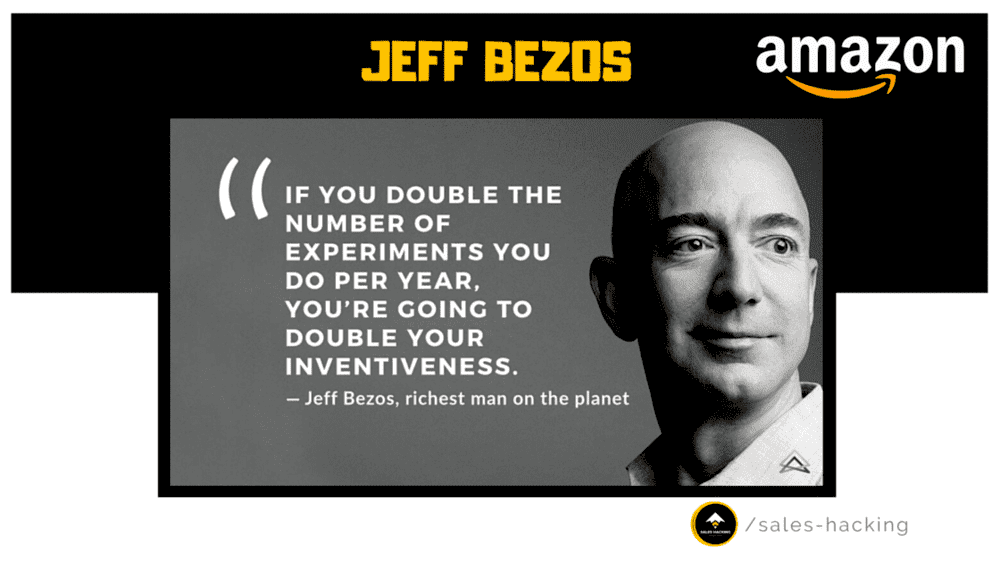
Amazon itself mentioned a real correlation between the number of monthly experiments and the impact on its growth.
So let's consider that as many experiments as possible should be carried out, it is important not to get carried away by perfectionism. It will therefore be more beneficial to focus on the”good“only on the”pristine“.
For example, when we look at fast-growing businesses like Booking or Amazon: they don't necessarily have the most beautiful websites in the world, but are known for their ability to experiment with new ideas more than others.
If you reduce your initial requirements - without going overboard, of course - you will logically have more time to carry out more experiments and get more chances of success.
Digital intelligence is one of the most important qualities of a Growth Hacker : it is the ease with which you can adapt to the latest technology.
Some questions to ask yourself to assess your level of digital intelligence:
Technological developments on the web are going very fast nowadays. New software, tools and applications are added every day on the Internet.
Thus, Growth Hackers must constantly monitor new developments so that technology is not a hindrance but rather a way to go faster in the context of their experiments.
“Learning to learn” is one of the most important skills in Growth Hacking. A Growth Hacker will never be an expert but an eternal student.
If the organic structure of your brain is capable of change, why wouldn't you?
Adopt the Growth Mindset! Brain plasticity means that our brains are able to change and adapt through experience.
For example, the brain can change its physical structure as a result of learning processes, or move functions from one area to another in the event of damage. The word plasticity does not refer to plastic, but to the malleability of the brain.
Now that you know what your brain is capable of, don't you think it's time to let your mind become “plastic” too?
As we mentioned, the Growth Mindset is about having an open mind and that also applies here to looking for your growth problems.
All sorts of problems can limit the growth of your business, such as:
The majority of businesses that don't attract enough customers often forget to look beyond their daily marketing actions.
However, it's a huge waste of time and budget if you're working on the wrong issues.
Many Growth Hackers use the Pirate Funnel (AAARRR, AARRR) to optimize efforts and focus on the obstacles that limit business growth.

This funnel model makes it possible to segment and target the bottlenecks that hinder growth at each stage of the customer journey:
Growth Hacking rhymes with efficiency: the Pirate Funnel is one of its tools for tackling real problems and working more effectively.
READ MORE: What is the Pirate Funnel? AAARRR? ARRR?
When trying to find solutions to the obstacles to your growth, it is generally not the most common or used solution that will be the most effective.
Les Growth Hacks that work for other startups, like Uber, Airbnb, and Spotify, probably won't work for your business.
Why? Because:
The average mindset always uses the same tried and tested tactics to solve problems or learn. All of this has to do with the fear of failure.
What if this new method doesn't work? Just because others around you are studying or working using a method doesn't mean that method will necessarily work for you.
It's not a competition between you and the rest of the world: Growth Mindset is a competition between who you are today and who you were yesterday.
The greater the variety of tactics you are able to apply, the wider the spectrum of problems you will be able to solve!
This is another critical change you need to make if you want to get out of the normal mindset and understand the Growth Mindset.
The Lamba mindset is, in general, always focused on the end result:
As we said before, don't put yourself in competition with others.
READ MORE: GROWS, a method used by Growth Hackers
Choices based on data rather than intuition
20 years ago, marketing budgets were divided between the various channels by the marketing manager. He/she made this decision about how to divide the marketing budget based on their intuition:
And today, I still see it regularly: some companies do not advertise on Facebook, for example (and have never tried), because their management does not believe in this medium.
19 or even 20 acquisition channels are available but how many have already been really tested?
Growth hackers work differently: they work based on numbers and data.
Today it is easy to calculate exactly which channel provides the most customers at a significantly lower cost.





.avif)