.svg)
Explore the key skills of Growth Hackers, including mindset, technical, analytical, and creative abilities. Master the growth hacking field with this guide.

Les Growth Hackers systematically explore new growth opportunities at each stage of the customer journey (modelled by the Pirate Funnel)
In terms of technology, Growth Hacking began in 2010 when Sean Ellis said it was suitable for startups in due to their limited budgets and resources.
Since then, it has shown a steady rise in popularity among traditional and large-scale businesses.
The Growth Hacking is based on a experimental approach and focused on data at the border of marketing, product and engineering.
READ MORE: What is GROWTH HACKING?
Growth Hacking is one of the super skills of the future and is vital in today's self-defining world every day with new innovationsS.
You may already know that the Growth Hackers are hybrid profiles that have many different skills.
Some are obvious, others are controversial... and some are only mastered by real experts in Growth Hacking ! Nevertheless, I have drawn up here a complete list of the entire perimeter of Growth Hacker Skills.
The hidden weapons of Growth Hacking are very simple: innovate and hijack systems.
The job requires you to think outside the box and let your creativity run wild, to have a mindset that is always focused on growth and the ability to learn every day.
Be creative: “Growth Hacks” don't follow any rules.
La transgression of the rules is at the heart of growth thinking and the functioning of the process of Growth Hacking.
The Growth Hacking mindset or Growth Mindset is a very different way of working than other professions.
The main metric that they optimize every day is the North Star Metric : it represents the benefits provided to customers or users and therefore long-term growth.
READ MORE: What is the Growth Hacking Mindset?
For most beginners, I recommend that you take training courses, read specialized blog articles like this one, or take the time to read books (see our reading tips).
Data monitoring and analysis are among the #1 Growth Hacker Skills.
These are the data that will guide experiments to eliminate bottlenecks and find new growth drivers.

Channel Marketing/Acquisition is a very broad skill, but I still mentioned it here as an item on this list.
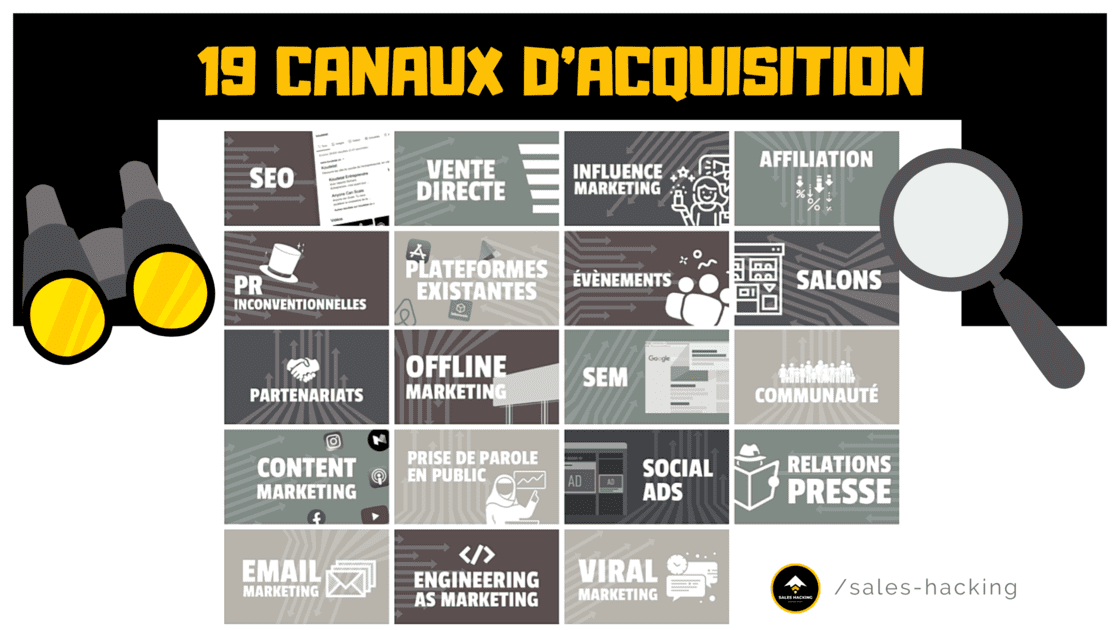
These skills are a “common core” but will not always be necessary on a daily basis due to the type of industry or business.
The above marketing channels are developing so rapidly that you cannot expect a young Growth Hacker's knowledge to always be 100% up to date, unless they have worked intensively on a single specific channel at their last employer.
An experienced Growth Hacker should have an idea of how the algorithms work for each channel and should have sufficient basic knowledge/experience with them.
However, you should not expect an experienced Growth Hacker to be an expert in all areas. It's just impossible.
One of the biggest differences between a Growth Hacker and other profiles is the knowledge of numerous skills such as:
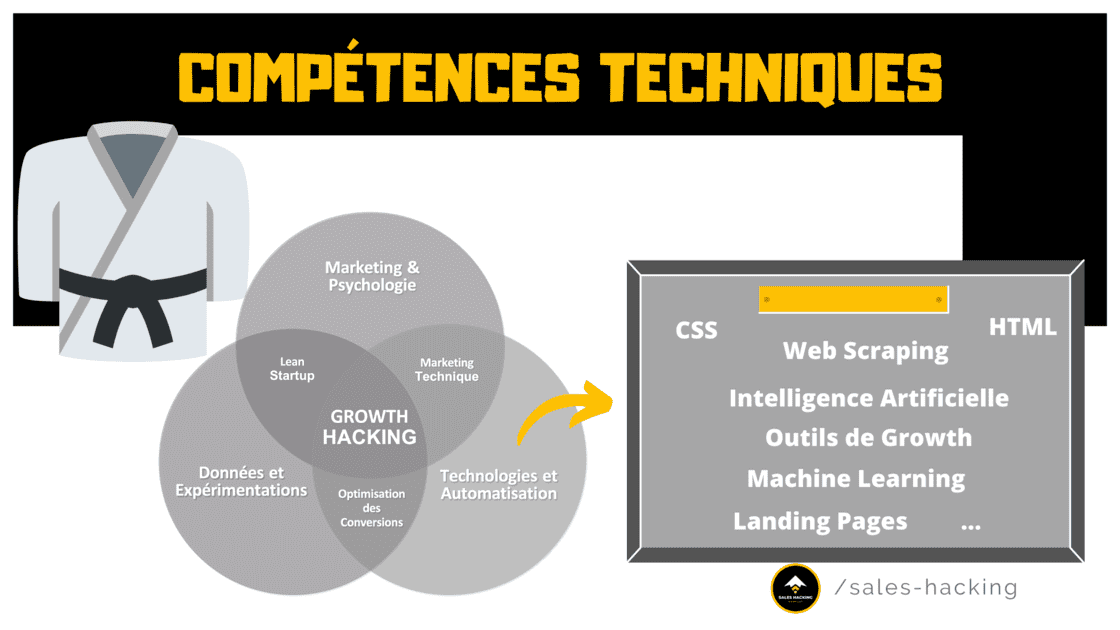
As a Growth Hacker you need to test and experiment quickly, for this it is important that you can also technically implement the solutions yourself.
Most of Beginner Growth Hackers start with a background or simply a passion for marketing and therefore have little technical knowledge.
From my point of view, having good technical skills is a big “plus” to save time and ever more relevant data on the web.
The Web Scraping for example, is extremely useful but sometimes technical. Let's see together why knowledge of the code is still mandatory through 3 techniques:
It is possible to do this on LinkedIn, with very simple tools - such as Dux-Soup and PhantomBuster, ProspectIn, We-Connect.
READ MORE: List of the best tools for collecting data on LinkedIn
“Simple” sites are those that do not require a lot of interactions (clicks on buttons, forms to fill out, etc.) and that have a structure that remains similar between each of the pages (example: Amazon product pages).
(Knowledge of HTML and CSS code is often mandatory)
READ MORE: List of the best tools for collecting data on the web
“More advanced” sites are those where you will have to do numerous actions on websites (example: requiring a connection to access elements of the site, writing data in fields, etc.) or having dynamic URLs or data for example. For this type of processing, the Python language will generally be mandatory, but also HTML, CSS or sometimes Javascript).
READ MORE: How to collect data on the web using Python
A world will open up for you if you get at least basic skills in HTML, CSS, Javascript or Python (at least read them).
As a Growth Hacker, you should try to stay up to date with the latest tools that are coming out on the web.
For example, check out ProductHunt, Crunchbase, or BetaList. Reading articles and books or listening to podcasts will also be very educational.
Personally, I use blog posts in a very personal way at the core. Writing allows you to put your knowledge on paper and to music. Having to talk about it means knowing how to ask yourself questions about the things you think you know and the things you really know.
Google is also a very important skill! Over 95% of people don't really know how to use Google and its advanced searches.
To learn and use this type of research, I invite you to read the following article:
READ MORE: How do you collect leads using Google? (+ examples)
Retention is an important step that is the growth model, repeat customers are essential for a business and you cannot grow if you lose all of your active customers.
Let's analyze the figures of a cloud computing startup, with a 50% retention rate and around 1,000 new users per month.
After 24 months, our company has only 3,000 active customers instead of 90,000, a difference of x30! ...
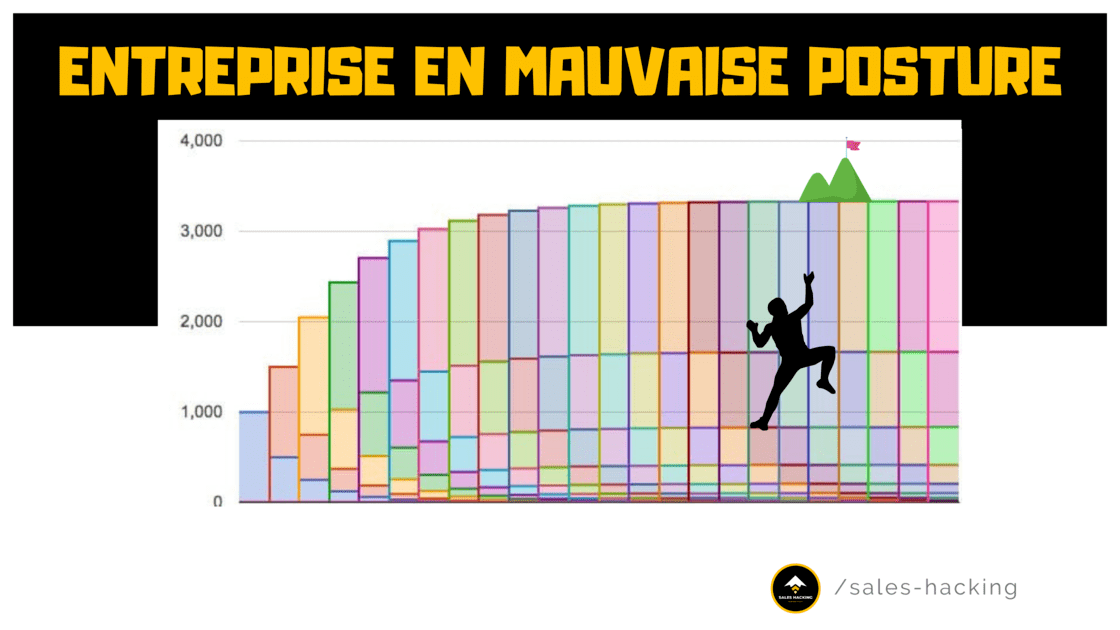
Retention is a key skill that Growth Hackers need to develop. However, retention is not always easy as the quality of your product plays a major role.
By retention skills, we mean different things:
READ MORE: Best GROWTH HACKS for Retention
Since many businesses are barely aware of the importance of good retention, the Beginner Growth Hackers don't usually work hard enough On this metric and on their skills.
However, for a Experienced growth hacker, the Retention should be one of the first variables that should be focused on.
Unless you are a Startup with few or no customers, then in this case acquisition and activation will surely be the first development steps.
Retention can only be developed by practicing intensively because it is strongly linked to the behavior of your customers. Hence the importance of having a deep understanding of your customers to control retention.
To find out more, here are some readings on this subject:
Among all the Growth Hacks, the most well known are above all referral programs:
dropbox was one of the first to use its referral program: They offered users additional free storage space if they agreed to share dropbox with their friends.
Dropbox went from 100,000 users at the end of 2008 to 4 million at the beginning of 2010! At the peak of this growth, 2.8 million invitations were sent out per month. Most channels can't compete with such a viral marketing strategy.
That's why Growth Hackers often try to apply referral marketing to businesses, but it's not easy.
Referral marketing is not an easy subject and you can't expect a young Growth Hacker to master it perfectly.
If he wants to set up a referral program and considers it to be the holy grail, he is very likely to overlook the other parameters of the Pirate Funnel.
While there might be greater potential elsewhere in the funnel.
Here is an interesting article on these topics if you want more details.
READ MORE: What are viral loops and k-factors?
Thanks to this article, you will understand that the most important thing is not always the value (k) of the viral factor but that of the speed of propagation of viral loops (t). It may seem a bit complex as it is, but in this article I used the example of Youtube, which exploded thanks to this understanding.
In addition to attracting customers through creative and viral Marketing Campaigns, conversion optimization is one of the most sought-after skills in Growth Hacking.
The return on investment from such a skill can be huge.
Since most A/B testing software is expensive, you'll find that not many first-time Growth Hackers have the opportunity to practice it.
An experienced Growth Hacker should have done a lot of experimentation before promoting himself as a “Senior.”
There are plenty of conversion optimization blogs that discuss this topic. I recommend that you read the following:
You can also try Google Optimize for a personal website to put this Growth Hacking skill into practice. It is one of the only free optimization tools on the market. It is not very powerful but has the merit of existing.
One of the iconic figures in Growth Hacking, Neil Patel, believes that onboarding is the most important growth factor in Growth Hacking.
And to be honest, I can understand that:
Because if you offer users a good grip on your tool or service, the customer will more easily see the value of it (“WOW Moment”), have a higher retention rate and will give more recommendations.
And because it's an integral part of the Pirate Funnel, activation is an important skill for Growth Hackers.
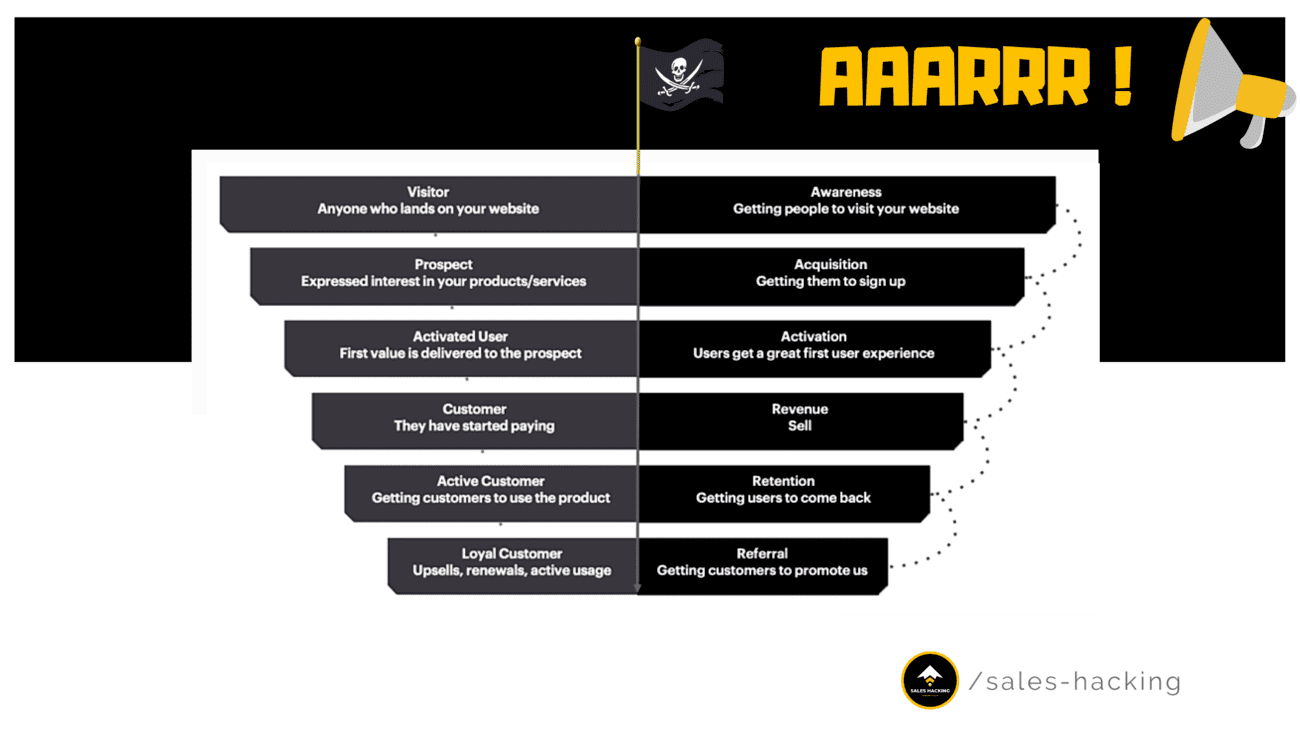
READ MORE: What is the Pirate Funnel? (AARRR or AAARRR)
Setting up onboarding adapted to a new user is a task that falls to an experienced employee.
You need to know a customer's journey by heart and be able to implement appropriate onboarding through tools, documentation, and excellent product knowledge.
READ MORE: Best GROWTH HACKS to Increase Your Activation Rates
Above all, try to deepen your marketing knowledge by mapping your customers' journeys or by regularly participating in Customer Service Management.
Customer success occurs when your customers achieve their desired outcome through interactions with your company. Lincoln Murphy
Also read these articles that discuss activation and onboarding in Growth Hacking:
Especially when working for SaaS applications, the UI/UX is a Very important skill for a Growth Hacker.
A user-friendly and easy to use interface is essential because:
A customer always chooses to click Or not on a button - this has a major impact on your conversion rates.
You don't need to be an expert but should still understand and be able to apply the principles of UI/UX.
Many first-time Growth Hackers will certainly be able to list the basics, because they know a number of “Growth Hacks” and have probably read UX/UI blogs that list best practices.
It is important to pay attention to the applicability of this knowledge. Can my Growth Hacker draw conclusions about why our interface is (or not) giving the expected results? Does he always fall back on the same principles? Is it open to other possible interpretations? The Growth Hacking Is a A question of mindset and experimentation.
Un Experienced growth hacker is able to design excellent interfaces and participate in discussions with UX/UI or IT managers.
To improve your UX/UI skills, I recommend the following resources:
Designing (designing) is one of the core skills that every Growth Hacker needs to learn. It is common to have to create visuals or other content for:
If you can't design by yourself, you'll be much slower when iterating and certainly won't be able to test every hypothesis as easily and quickly as possible.
Fortunately, the practical side of design is no longer such a difficult skill nowadays. Simple and free tools like Canva have revolutionized this market and are now essential for Growth Hackers.

Unfortunately... Good design depends heavily on everyone's appetite for design, and not all Growth Hackers always have good artistic skills. However, using good web designs as a source of inspiration can be a good starting point.
It takes training and inspiration.
For the first point, I use tools like Canva or Figma.
On a practical level, you can of course also read numerous blogs and watch YouTube videos. Here are some interesting websites on this subject:
As a Growth Hacker, you are always trying to understand and find the best ways to influence your customers.
Understanding the intrinsic behaviors and motivations of your customers is an incredible weapon in your Growth Hacker toolbox.
READ MORE: 16 cognitive biases used to convert more leads
This is a skill that is highly dependent on experience. You need to talk to a lot of customers and do website audits to recognize these psychological patterns.
It is a skill that is highly dependent on experience.
The most important thing to pay attention to when hiring a junior Growth Hacker is that he/she is open to the opinion of peers or the opinion of customers. Above all, target a “Growth Mindset” rather than a list of skills.
To develop this skill as a Growth Hacker, you can practice by conducting and deepening your qualitative research (demographic or psychographic) to understand their motivations.
So try to do more interviews with your customers to get to know them like the back of your hand. You can also read a number of blogs to improve your understanding and approach:
Everyone wants to know, “Why are my customers leaving my sales funnel at this point?”
To answer this question:
Use heatmapping tools (HotJar) or satisfaction surveys to get an initial overview.
Then find a more qualitative and thorough answer by talking to customers to understand what motivated them to make that decision. As a Growth Hacker, you need to be able to get:
Researching your customers is a Essential Skill for Growth Hackers, because it can save you a lot of failed experiments.
LEES MEER: How do you conduct customer interviews?
You should no longer guess why your customers are disappearing, but rather get the answer directly from them by asking them the right questions.
Few Growth Hackers really paid attention to it and therefore do not develop this skill enough.
Interviews take a lot of time and other Growth Hacking activities seem to have a better return on investment. For this reason, many Growth Hackers remain inexperienced in this field for a long time and continue to make rookie mistakes by asking the wrong questions, or in the wrong way.
An experienced profile understands the importance of talking to the client and must be able to carry out this work themselves.
Tips to improve yourself
On the practical plan, You should practice often and ideally under supervision with a more experienced profile or simply a sales person. Feel free to mingle with them as often as possible at customer meetings in order to understand your market and your target customers.
On the Tactical Plan, you can avoid a lot of mistakes by digging deeper into the field of “Customer Satisfaction.”
As such, there are numerous experts who share their knowledge on the Internet.
You need it everywhere: in ads, on websites, in lead magnets, in email marketing, in blogs, etc.
Copywriting is a vTrue Core Competency of the Growth Hacker More and more sought after. Not that other disciplines don't need this skill, but it's essential.
On the other hand, Copywriting is not an easy skill, because you always need to find a balance:
Additionally, you should also understand enough psychological factors to be able to reach the customer emotionally with your writings.
Anyone can write texts, but there are A Difference Between Classical Texts and Striking Writings.
Writing well is not innate and given to everyone, but with inspiration and learning, a Growth Hacker can write good texts for landing pages or advertisements.
To help you, there are many tools that allow you to assess the quality of your web pages or their content to improve their quality:
There are numerous writing methods that can help you, even without being Victor Hugo, to be more impactful in your writing, such as AIDA, PAS, or the 4C's. Find out more about this below.
LEES MEER: Copywriting methods to sell more
Growth Hackers are often big fans of automation. The reason is that it can save you more time and more results in less time.
However, it's not one of the most difficult skills today. You have numerous tools to automate tasks like Integromat, Zapier or n8n.
With these tools, you can already connect more than 3000 tools together without having deep technical skills.
LEES MEER: The list of the best alternatives to Zapier
If a Growth Hacker already has a few years (1-3) of experience, they should certainly have worked with Zapier or Integromat in the past and be aware that there are Growth Hacking tools that can automate a huge part of your work. So it's a skill that you can demand from a Growth Hacker.
A senior growth hacker should have extensive experience in this area, for example in setting up fully automated flows between different channels.
Then you have the even more technical Growth Hackers... They can write their own bots and scripts, and create unique integrations via APIs. But that's only a very small portion of all Growth Hackers.
Start training with tools like Zapier and Integromat.
For example, look at your current tasks and ask yourself what things are taking up too much time and that you could automate.
You may argue that it's not really a skill, but it's undeniable that a Growth Hacker mindset is required to be a successful expert.
When we talk about the growth hacking mindset we mean a certain way of looking at challenges and opportunities.
LEES MEER: What is the GROWTH HACKING Mindset?
Someone who has a mentality of Growth Hacker Doesn't cling to his own vision of the world and knows that he doesn't know everything. That's why experimentation is such an important part of growth hacking.
“What is the best way to solve this random problem?” There isn't a single right answer and that's why we Let's Experiment.
It's also important to test things with small touches before deploying them on a large scale. You first need to know if something works before investing more time/effort/money into it.
The Growth Hacking It is a field that is evolving very rapidly and is strongly influenced by new skills and new tools. Therefore, people need to develop a “learning ability”, that is, the desire and ability to develop rapidly and adapt their skills.
When you decide to hire or hire a freelance Growth Hacker, pay attention to the profiles who take the time to train every day.
Conducting technological or methodological monitoring is essential to succeed in this field!
Un Growth Hacker Has a very large amount of skills which is characteristic of this profession.
You never know what part of the Pirate Funnel or what marketing channel your business needs to focus on. For this reason, you need to prepare yourself by acquiring many fundamental skills.
With your “ability to learn,” you need to master the skills and tools needed to get the job done.





.avif)