.svg)




Step-by-Step Guide: Create Your First Application with Lovable
Transform your idea into a functional application without writing a single line of code. This detailed tutorial guides you from start to finish, with examples and pro tips to ensure success on your first attempt.
Before You Begin: What You Need
| 🛠️ Element | ✅ Required | 🎁 Optional | Quick Read 🧠 |
|---|---|---|---|
| ⏱️ Time | 30–60 minutes | A longer session if iterations | – Allow 1 hour for a first MVP |
| 👤 Lovable Account | Free | Pro Version (as needed) | – Start free, upgrade to Pro if Dev Mode is useful |
| 💡 App Idea | Even basic | Light wireframe, user stories | – 1 need, 1 user, 1 outcome = good start |
| 💻 Coding Skills | None | Bonus if you can read code | – Useful for speeding up debugging and cleanup |
| 🌐 Browser | Chrome / Firefox / Safari | Dev extensions (console, inspector) | – Chrome recommended for quick diagnostics |
1️⃣ Account Creation and Interface Familiarization
Registration and Initial Contact
- Go to lovable.dev
- Click on "
Start Building" or "Sign Up" - Choose your registration method:
- Google (recommended for speed)
- GitHub (if you are a developer)
- Traditional email

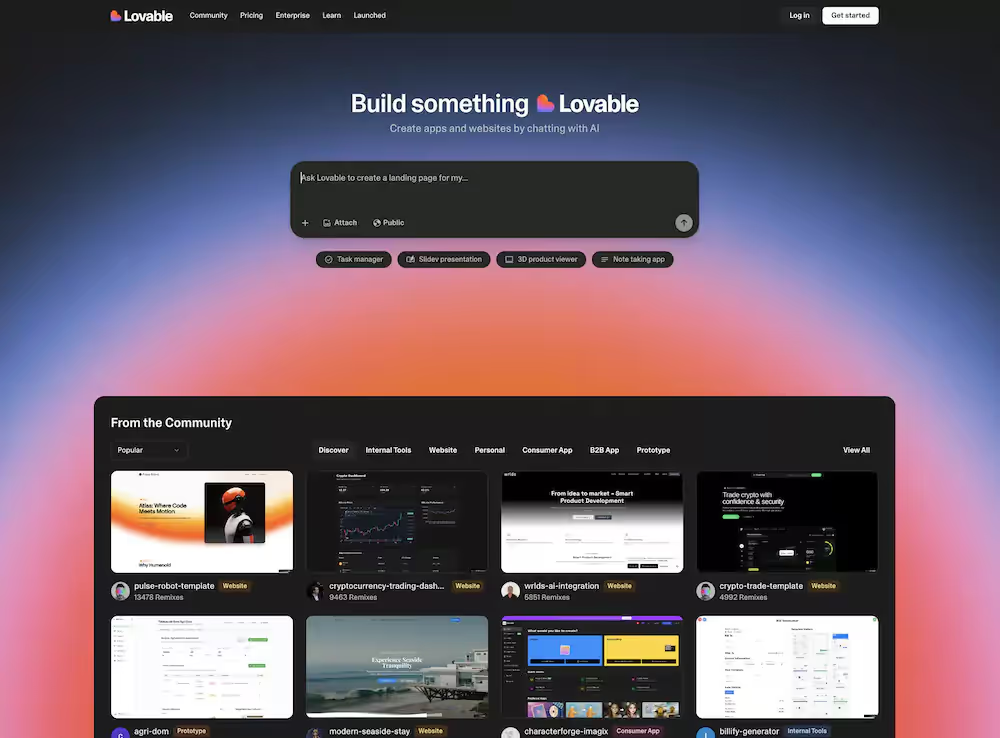
Exploring Your Workspace
Once logged in, here's what you see:
| 🖼️ Area | 🎯 Function | 🏃 Initial Reflex | Quick Tip 🧠 |
|---|---|---|---|
| 📝 Prompt Bar (bottom) | Describe what you want to create (front-end, back-end, workflow) | Start with “Create a…” then press Enter | Add a measurable goal (“collect, filter, save”) |
| 🖼️ Preview Area (center) | Visualize the app in real-time and interact with it | Click on a component to test it | First test the main path (happy path) |
| 📁 Projects Panel (left) | List and organize all your projects | Click on “New Project” to start | Name your versions (e.g., v1, v2) to avoid confusion |
| ⚙️ Editing Tools (right) | Edit properties, styles, and behaviors of elements | Select an element to display its panel | Change one thing at a time to isolate effects |
| ↩️ History (top) | Undo/Redo recent actions | Use the “Undo” button or Ctrl + Z | If a bug occurs, revert to the last stable state and restart |
💡 Beginner Tip: Explore the interface for 2 minutes before creating. Click everywhere, you won't break anything!
Optional Setup for the Tech-Savvy
If you want to view/modify the generated code:
Profile → Settings → Integrations → Connect GitHub
This allows you to:
- Save your code
- Collaborate with developers
- Customize beyond AI
2️⃣ Mastering the Art of the Prompt: The Key to Success
Anatomy of an Effective Prompt
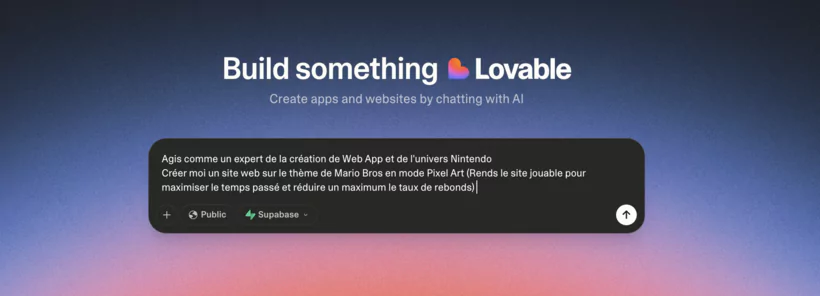
A good prompt follows this structure:
[WHAT] + [FOR WHOM] + [FEATURES] + [STYLE]
❌ Vague Prompt:
"Make me a todo app"
✅ Precise Prompt:
"Create a task management application for
students with:
- Task list by subject
- Due dates with alerts
- Progress percentage
- Dark/light mode
- Modern design like Notion"
Prompt Examples by Application Type
| 📱 App Type | 💬 Starter Prompt | 💡 Tip | Objective 🧠 |
|---|---|---|---|
| Simple Mobile App |
Create a mobile-first expense tracker with categories, monthly budget limits, and interactive charts. Use a clean, modern design and offline data storage. |
– ✅ Specify offline support to ensure accessibility – Add 2–3 rules (e.g., “budget alerts,” “CSV export”) if needed |
Validate the journey and basic data |
| E-commerce |
Build an online store for handmade jewelry featuring a product gallery, shopping cart, checkout form, and order confirmation. Include a size guide with zoomable images and care instructions. |
– 🎯 Indicate product zoom to enhance the experience – Add “transactional emails” if aiming for conversion |
Test the conversion (cart → checkout → confirmation) |
| Dashboard |
Design a sales dashboard showing revenue trends, top products, and customer metrics. Add date range filters, export to PDF, and dynamic tooltips. |
– 🖨️ Mention PDF export for reporting – Specify 3 KPIs max to avoid a “catch-all” dashboard |
Obtain a readable and shareable report |
| Form |
Create a multi-step job application form with resume upload, portfolio links, and real-time validation on each step. Send a customizable confirmation email upon successful submission. |
– ✉️ Specify confirmation email to reassure the user – Add error handling (file too large, missing field) |
Secure the collection and reduce abandonment |
Advanced Technique: The Iterative Prompt
Step 1 - General Structure: "Create a recipe sharing app with homepage showing recent recipes"
Step 2 - Add Features: "Add a search bar to filter recipes by ingredients and cooking time"
Step 3 - UX Improvement: "Make recipe cards show prep time, difficulty level, and rating stars"
Lovable understands the context. No need to repeat everything with each prompt!
3️⃣ Connect Supabase for a Powerful Backend

Why Supabase?
| ❌ Without Supabase | ✅ With Supabase | 💡 Benefits | Quick Read 🧠 | |
|---|---|---|---|---|
| Data | Temporary data (in-memory) | Persistent data on PostgreSQL | Reliability + recovery after restart | Essential if you want a durable app |
| Users | No user management | Complete auth (email, OAuth, MFA) | Secure access + multi-user | Solid base for a multi-account app |
| Collaboration | Single-user usage | Multi-user support | Shared work + data continuity | Useful as soon as you expand to a team |
| Security | No built-in security | RLS + access controls + encryption | Data protection and better governance | RLS = fine control by role and row |
| API | No instant API | Generated REST + Realtime APIs | Accelerated development + easier sync | Perfect for connecting the app to other tools |
| Files & Media | No media storage | Storage for files and media | Centralized assets (images, docs, uploads) | Useful for CVs, attachments, catalogs, etc. |
| Back-end | No server functions | Edge Functions (serverless) | Back-end logic without managing servers | Good for webhooks and on-demand processing |
Step-by-Step Connection Guide
- In Lovable, click on the
Supabasebutton (top right corner)!
[Lovable logo] -------------------- [🔌 Supabase] [👤]
- First connection? A window opens:
- Click "
Create Supabase Account" (if new) - Or "
Connect Existing Account" (if already registered)
- Click "
- Authorization required:
- Supabase asks: "Authorize Lovable to access?"
- Click "
Authorize" (secure)
- Creating the Supabase project:
Organization name: [Your name/company]
Project name: [Your app name]
Region: Europe (Paris) // Closer = faster
- Back in Lovable:
- The project appears in the dropdown menu
- Select it
- Green badge = Connected! ✅
⚠️ Important: Connect Supabase BEFORE requesting:
- Login/signup system
- Data saving
- User profiles
- File uploads
4️⃣ Testing and Deploying Your Creation
| 🛠️ Element | 🔍 Description | 💡 Required/Optional | 🚀 Priority | Quick Read 🧠 |
|---|---|---|---|---|
| 🌐 Domain Name |
– Register and point to the Lovable app – Verify DNS (A/CNAME) + propagation |
✅ Required | High | Do it first to avoid DNS delays |
| 🔒 SSL Certificate |
– Encrypt all HTTP connections – Enforce HTTPS + clean redirects |
✅ Required | High | Blocking for trust + SEO |
| ⚙️ Environment Variables |
– API keys, base URL (e.g., Supabase), secrets – Separate dev / staging / prod |
✅ Required | High | Never put secrets in the front |
| 🧪 Pre-Prod Tests |
– Smoke tests: login, creation, payment (if applicable) – Error cases: invalid form, permissions, 404 |
✅ Required | High | Test the critical path end-to-end |
| 🛠️ CI/CD Pipeline |
– Automate build, tests, and deployment – Deployment by branch/tag (depending on organization) |
✅ Required | High | Reduces human errors at launch |
| 📊 Analytics |
– Integration GA4, Matomo, or equivalent – Events: registration, activation, conversion |
✅ Required | Medium | Without events, hard to steer the product |
| 📝 SEO Meta Tags |
– title, description, og:image for social sharing – Clean tags per key page (home, pricing, signup) |
✅ Required | Medium | Direct impact on CTR (SEO + social) |
| ⚡ Performance |
– Lighthouse audit + image optimization – Lazy-load + reduction of unused JS/CSS |
✅ Required | Medium | Priority if paid acquisition (traffic quality) |
| ✅ Accessibility |
– WCAG controls, ARIA labels, keyboard navigation – Contrasts, visible focus, clear forms |
✅ Required | Medium | Avoids friction and improves UX |
| 📄 Privacy Policy & T&Cs |
– GDPR-compliant legal pages – Describe collection, purposes, retention, rights |
✅ Required | High | Mandatory as soon as email or analytics are collected |
| 🍪 Cookie Consent |
– Banner + consent management – Block non-essential tags before opt-in |
✅ Required | Medium | Align with your analytics tool |
| 📥 Backups & Rollback |
– Backup strategy (DB + assets) + restoration – Rollback plan if a release breaks the app |
✅ Required | Medium | Plan a “one-click” rollback |
| 🗂️ Sitemap & robots.txt |
– Generate sitemap.xml and configure robots.txt – Submit to Google Search Console |
✅ Required | Low | Useful if SEO, less critical if closed app |
| 🔗 Social Previews |
– Images and descriptions optimized for social networks – Test rendering on X/LinkedIn/WhatsApp |
⚪ Optional | Low | Do if you rely on social sharing |
| 🔔 Monitoring & Alerts |
– Uptime + error logs + Slack/email alerts – Thresholds on latency, 500 errors, DB saturation |
⚪ Optional | Low | Recommended as soon as you have paying users |
| 📱 PWA / Mobile |
– Manifest + service worker for offline mode – Icons, home screen, controlled cache |
⚪ Optional | Low | Useful if field use or unstable network |
🔍 Advanced Preview Tool:
- Click on "
Preview" (eye at the top right) - Select the device (mobile/tablet/desktop)
- Share the temporary link for feedback
- Valid for 24h (perfect for user tests)
Deploying to Production
Option 1: Instant Lovable Deployment
Button "Ship" → Choose URL → Confirm → Live in 30 sec!
- URL type:
yourapp.lovable.app - SSL included (https://)
- Automatic global CDN
Option 2: Custom Domain
| 🛠️ Service | ⚡ Difficulty | 💰 Price | ⏱ Setup Time | Quick Read 🧠 |
|---|---|---|---|---|
| Netlify | ⭐ Easy | Free (depending on usage) | ⏱️ 5 min | Great choice for simple deployment + domain as a quick win |
| Vercel | ⭐ Easy | Free (depending on usage) | ⏱️ 5 min | Very smooth if your project is front-oriented (React/Next) |
| Namecheap | ⭐⭐ Medium | ≈ €10/year | 15 min | Useful if you want to manage DNS yourself (and keep the domain) |
| Custom Hosting | ⭐⭐⭐ Expert | Variable | 30+ min | Reserved if you need custom (proxy, rules, infra) |
📋 Netlify Process (recommended):
- Export from Lovable (
Download code) - Create Netlify account
- Drag & drop the folder
- Custom domain in 2 clicks
Beginner Mistakes to Avoid
| ❌ Common Mistake | 🛠️ Solution | 💡 Practical Advice | Quick Read 🧠 |
|---|---|---|---|
| Prompt Too Long | Break it down into steps (screen → logic → data) |
– First write a plan in 3–6 actions – Validate each step before moving to the next |
Less back-and-forth, more control |
| Not Specific Enough | Add examples and constraints |
– Specify pages, fields, business rules – Mention your UI tone (simple, modern, etc.) |
A good prompt = fewer “surprises” |
| Forgetting to Save | Use auto-save (but check) |
– Check save status before a big change – Make a “stable version” before testing a big change |
Reduces regression risk |
| Wanting Everything Perfect | Iterate gradually (MVP → polish) |
– Deliver the main flow first (happy path) – Only then: edge cases, design, micro-interactions |
The MVP saves time and clarity |
| Ignoring Errors | Read the red messages and isolate the cause |
– Fix as you go (otherwise it piles up) – Request a targeted fix on one bug at a time |
Avoids costly debug loops |
Types of Projects Achievable with Lovable
Lovable goes beyond simple landing pages: it is a no-code AI platform that enables the creation of professional web applications from start to finish, from quick MVPs to finished products.
With a conversational interface, you describe your project in natural language, and the AI takes care of generating the architecture, interface, and features, including database integration, authentication, and payments.
Overview of Possibilities
| 📂 Category | ⭐ Complexity | ⏱️ Average Time | 🧩 Concrete Examples | Quick Read 🧠 |
|---|---|---|---|---|
| 🌐 Showcase Sites | ⭐ Easy | 30 min – 2 h |
– Portfolio – Landing page – Interactive CV |
Perfect for quickly validating a design + promise |
| 🛍️ E-commerce | ⭐⭐ Medium | 2 h – 4 h |
– Online store – Marketplace – Booking system |
Plan details on payment, stock, and emails |
| 📱 SaaS Applications | ⭐⭐⭐ Advanced | 4 h – 8 h |
– Basic CRM – Analytical dashboard – Collaborative tools |
Works well if business logic remains simple |
| 🚀 Complex Platforms | ⭐⭐⭐⭐ Expert | 1 – 3 days |
– Social network – Marketplace – Multi-service portal |
Often partial MVP: tests, security, performance to plan |
Starter Projects (Perfect for Beginners)
Lovable is ideal for quickly launching simple and beautiful projects, perfect for creatives, freelancers, or entrepreneurs.
| 🎨 Project Type | ✨ Key Features | 💬 Starter Prompt | Tip 💡 |
|---|---|---|---|
| Creative Portfolio |
– Fullscreen artwork gallery – Animated bio – Contact form – Integrated testimonials |
“Create a photographer portfolio with fullscreen gallery, about section, and booking calendar” | Add 1 mobile-first constraint + a color palette |
| Product Landing |
– Impactful hero section – Feature list – Offer comparison table – Strategic CTA buttons |
“Build a SaaS landing page with pricing tiers, feature comparison, and email signup” | Specify the goal: emails, demo, or purchase |
| Interactive CV |
– Career timeline – Dynamic skill bars – Project gallery – PDF download button |
“Design an interactive resume with work timeline, skill ratings, and project gallery” | Request a clean print mode for PDF |
🛒 Turnkey E-commerce and Business Solutions
Lovable allows the creation of robust business solutions, connected to Supabase for data management and Stripe for payments.
| 🛒 Solution | 🎯 Ideal Use Case | ✨ Essential Features | Quick Read 🧠 |
|---|---|---|---|
| 🏪 Online Store | Artisans, creators |
– Product catalog (categories, variants) – Cart + checkout – Stripe payment (or equivalent) 🔐 – Stock and order status |
Great if you already have 10–30 products ready to sell |
| 📅 Booking | Restaurants, salons, coaches |
– Interactive calendar + slot management – Email confirmation (SMS if needed) – Automatic reminders – Booking tracking dashboard |
Very profitable if availability changes often |
| 🎫 Ticketing | Conferences, shows |
– Ticket selection (categories, quotas) – QR codes + mobile check-in – Confirmation emails + resend – Analytics (sales, sources, no-show) |
Priority: secure payment + check-in |
| 💼 Job Board | Recruiters, associations |
– Advanced filters and search – CV upload + candidate profile – Matching (simple rules first) – Company space for application tracking |
Start “simple” before adding AI |
Advanced Applications: The Power of Lovable
Lovable also excels in complex projects, thanks to its native management of databases, authentication, and custom workflows.
| 🔧 Platform Type | ⭐ Technical Level | ✨ Advanced Features | ⏱️ Estimated Time | Quick Read 🧠 |
|---|---|---|---|---|
| 🤝 Mentorship Network | ⭐⭐⭐ |
– AI matching (rules + scoring) – Secure messaging – Coordinated calendar – Automated payments |
6–8 h | Good ground to test matching with minimal risk |
| 🏠 Rental Marketplace | ⭐⭐⭐⭐ |
– Geolocation + map – Advanced dynamic filters – Reviews & ratings – Secure transactions |
8–12 h | Priority: payment + clear cancellation rules |
| 💰 Crowdfunding Platform | ⭐⭐⭐⭐ |
– Multiple campaigns (goals, tiers) – Interactive progress bars – Project updates – Analytics (contributions, conversions) |
10–15 h | Works if the “tier” logic remains simple initially |
| 🔨 Online Auctions | ⭐⭐⭐⭐ |
– Real-time auctions – Instant push notifications – Bid history – Escrow payment (if needed) |
12–20 h | Most risky: real-time + fraud → frame very early |
Example: Subscription Platform
- Step 1: “Create a subscription-based learning platform with course catalog”
- Step 2: “Add user authentication with subscription tiers (free, pro, premium)”
- Step 3: “Include video player, progress tracking, and completion certificates”
- Step 4: “Add instructor dashboard with earnings and student analytics”
Result: complete platform like Udemy in 1 day ready to welcome your first subscribers even for non-programmers
How to Choose Your Project with Lovable
Key Questions to Ask:
- 🎯 Main Objective: sell, inform, connect, automate?
- 👥 Target Audience: B2C (mobile-first), B2B (dashboard/analytics), both?
- 💰 Business Model: direct payment, subscriptions, commission, free?
- ⏰ Urgency: quick MVP, finished product, market test?
Remember that many options are available to customize your project according to your needs, whether in terms of hosting, integration with services like Vercel or GitHub, or advanced features.
Lovable Strengths
- Web and SaaS application generation in natural language (conversational AI)
- Native Supabase integration (backend, database, authentication)
- Stripe payments, one-click deployment, installable PWA
- GitHub synchronization for advanced customization
- Ultra-fast and iterative prototyping, even for non-technicians
- Perfect for MVPs, side projects, internal tools, marketplaces, and complex platforms

Final Opinion
Lovable is an innovative software that represents a major advancement in the field of AI-powered no-code tools, enabling anyone – entrepreneurs, startup founders, or citizen developers – to turn ideas into functional applications without technical skills.
With its intuitive conversational interface, features like voice cloning or lip-syncing, and simple visual customization, Lovable democratizes app creation by dramatically reducing development time.
Lovable's promise is clear: to make app creation accessible to everyone, simplifying every step of the process. The revenue generated by Lovable testifies to its growing success and rapid adoption by a large community of users.