.svg)



Updated on July 7, 2026 using official Nous Research, GitHub, and Hermes Agent documentation. We do not invent private benchmark numbers: results and costs depend on your model, enabled tools, and infrastructure.
What is Hermes Agent?
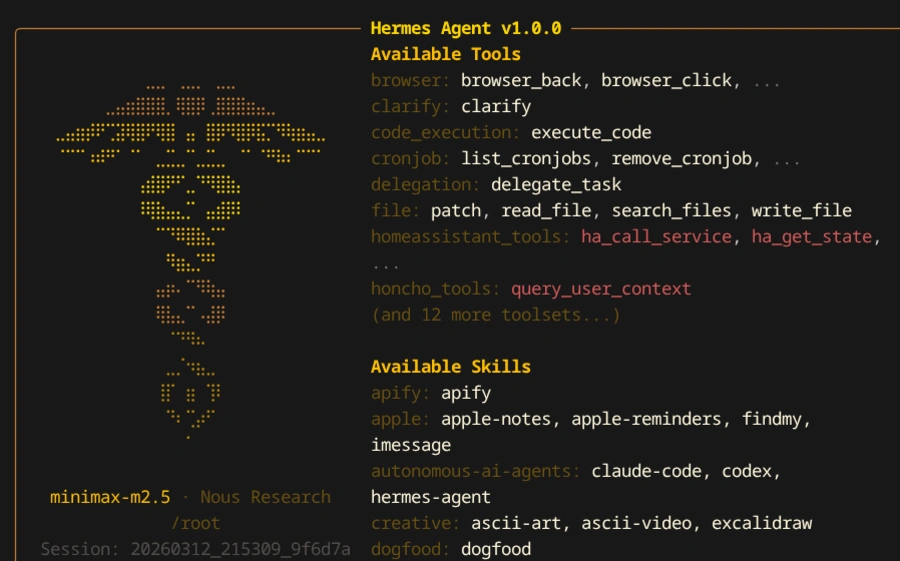
Hermes Agent is an open-source autonomous agent built by Nous Research. Its role is to execute multi-step tasks by connecting a language model, tools, reusable skills, persistent memory, and automations inside one environment.
The important distinction is that Hermes Agent is not just a chatbot. It can remember useful context, reuse skills, call tools, run scheduled tasks, and improve repeat workflows over time when you configure it properly.
In practice, Hermes Agent targets people who want an AI assistant that can operate across code, files, research, browser workflows, and recurring tasks while remaining self-hostable and inspectable.
Our verdict on Hermes Agent
Hermes Agent is one of the more interesting open-source AI agents for technical teams in 2026. The product is strongest when you treat it as an agentic workspace rather than a simple chat interface: define skills, constrain tools, connect the right model, and use memory deliberately.
We would recommend it to developers, AI builders, automation-heavy teams, and advanced operators who want more control than a closed SaaS agent usually gives. We would not recommend it as the first AI tool for a non-technical user who simply wants a polished assistant with no setup.
What changed in v0.18.0?
The latest checked release is Hermes Agent v0.18.0, published on July 1, 2026. The release is presented by Nous Research as The Judgment Release and continues the transition from the earlier OpenClaw project into Hermes Agent.
For buyers and builders, the message is simple: Hermes Agent is active, but still moving quickly. That is positive for innovation and risky for teams that need slow, stable enterprise software.
Key features
Setup and learning curve
Hermes Agent is easier to approach than many experimental agent frameworks, but it is still a technical product. You should expect to read documentation, configure providers, understand which tools are enabled, and test workflows before trusting it with important work.
The learning curve is worth it if you plan to automate repeated tasks. It is less attractive if you only need occasional writing help, a general assistant, or a browser-based AI product with enterprise support already included.
Best use cases
Hermes Agent is most compelling for workflows where memory, repetition, and tool access matter. Good examples include recurring research, codebase assistance, document triage, lightweight operations monitoring, support knowledge workflows, and internal automation prototypes.
It also fits AI engineering experiments where you want to compare model providers, use a local model through tools like Ollama, or keep more control over your agent stack than you would get with a purely hosted product.
Security and data control
Open source does not automatically mean safe. Hermes Agent gives you more visibility and control, but you still have to manage secrets, tool permissions, filesystem access, browser access, memory retention, and logs.
For professional use, start with a narrow tool set, avoid giving broad write permissions, keep secrets outside prompts, and review the memory and provider configuration before connecting sensitive data.
This is exactly where Hermes Agent can be stronger than a black-box SaaS agent: you can inspect and constrain more of the stack. But the responsibility moves closer to your team.
Real cost and value for money
Hermes Agent is open source under the MIT license, but running it is not automatically free. You still pay for the model, infrastructure, enabled tools, storage, possible cloud browser usage, and your own maintenance time. Nous Portal can simplify access to hosted models and tools, but it remains an external cost layer.
Nous Portal pricing at a glance
Credits can be spent on models, web search, browser automation, media generation, and other hosted services. The practical question is not whether Hermes is free, but which tasks should run locally and which ones deserve paid cloud models.
The value for money is excellent for technical users who can limit tool access, choose a sensible model, and automate recurring work. It drops quickly if you let an expensive model run without guardrails, if cron tasks are poorly scoped, or if you need someone else to maintain an installation you do not understand.
Hermes Agent vs Claude Code, Codex, Warp, and OpenClaw
Hermes Agent should not be judged against only one category. Compared with Claude or coding assistants, it is more configurable and more self-hostable, but less polished. Compared with Warp, it is less of a terminal experience and more of a general agent framework. Compared with OpenClaw, Hermes Agent is the project to follow now because the migration path points in its direction.
If your main need is code editing inside an IDE, a dedicated coding assistant may be faster. If your main need is repeatable agent workflows with memory and provider flexibility, Hermes Agent becomes much more interesting.
Who should use Hermes Agent?
Choose Hermes Agent if you are comfortable with technical setup, want an agent you can inspect, and have workflows worth automating. It is a strong candidate for developers, AI operators, builders, and teams exploring agentic infrastructure.
Skip it if you need a fully managed enterprise platform, strict support commitments, or a simple assistant for occasional prompts. In those cases, start with a more polished product and revisit Hermes Agent when your workflows become repeatable enough to justify the configuration work.
Final verdict
Hermes Agent is not the easiest AI agent to adopt, but it is one of the most strategically interesting ones if you care about openness, memory, reusable skills, and control over model providers. The best way to test it is to start with one narrow workflow, measure the real cost, then expand only when the agent is reliable enough.
For a broader map of the category, compare it with our guides to AI agents, AI code generators, and Claude vs GPT vs Gemini.