.svg)
Discover the top LMS (Learning Management System) software options. Compare features, pricing, and usability for educational success.

Here is a list of some of the best knowledge management platforms to use this year.

Freshdesk is a cloud-based knowledge management tool that provides solutions for implementing practical knowledge management. The support tool helps you help customers find answers to common questions.
It also helps you keep documentation up to date, manage knowledge access and permissions, organize documents, etc. The software helps you document tutorials, answers to frequently asked questions, DIY guides, and more.
Its free text editor is another asset. The text editor offers numerous formatting options for structuring your content and responses. It also makes it easier to integrate images and other graphics to illustrate the steps of the tutorial.
Freshdesk is offered in five plans (including a freemium plan):
All plans have a 21-day free trial.
Try freshDesk for free ->
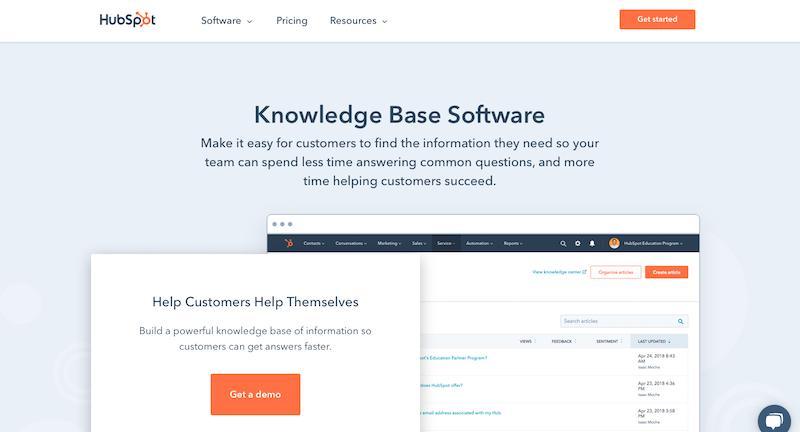
HubSpot Knowledge Base is a knowledge management software that helps you set up knowledge management to provide uninterrupted information. The tool analyzes your post, the most frequent conversations, and the most frequently asked questions from customers to create content.
It sets up answers to common customer questions and needs in order to reduce customer support requests and save time. Overall, HubSpot makes it easy for customers to navigate, discover, read, watch, or refer to your customer base.
It also helps your knowledge management articles and documents to be indexed in search engines. You can even customize the look and feel of items and preview how they'll look on different devices.
In addition, it synchronizes with chatbot software to make your knowledge management and the most relevant content easily accessible.
The HubSpot knowledge management platform is only available with the Professional and Enterprise editions of the software.
Pricing plans include:
Both plans come with advanced features such as 1:1 video creation, video hosting, a survey tool on the customer experience, etc.
Try HubSpot for free ->

LiveAgent is a help desk software that helps you add knowledge management articles, create forums, and feedback boards. It allows you to create customizable knowledge management to manage customer requests without having to contact them.
The installation process involves only four steps, namely creating, configuring, customizing, and populating the template with content.
Businesses that sell multiple products, brands, and services can create an unlimited number of knowledge bases using a single account. You can also ensure that each knowledge management has a unique design, content, and layout.
LiveAgent also integrates with multiple communication channels like Gmail, Viber, contact forms, Slack, Twitter, Facebook, etc.
LiveAgent offers 2 pricing plans for its knowledge management platform:
Both plans are suitable for small businesses, individuals, and marketing professionals. They also come with a free 14-day trial (no credit card required).
Try free LiveAgent ->

Zendesk is a knowledge management solution that allows you to organize your institutional knowledge and gather it in a searchable database. It offers customer service, ticketing systems, and even allows you to integrate knowledge management with support tickets.
You can display your knowledge management articles and content for specific audiences, including support agents, certain customers, etc. It also comes with pre-designed templates to maintain content structure and create articles that are easy to read with rich formatting.
ZenDesk also accelerates customer service through in-context self-service. The Web Widget and the Mobile SDK allow a service in context within a product or on a website.
It also allows your agents to write new articles and documents and to flag older articles that need improvement. You also have the option of embedding self-help articles in other places like blogs, product pages, etc.
Zendesk provides knowledge management tools with two of its plans, including:
The Suite Professional plan allows for more advanced collaboration, routing, and analytics.

ProProfs is a knowledge management system that helps you create online knowledge management, user manuals, documentation, FAQs, Wikis, and more. You can also create “how to” videos for a more engaging approach.
It's also a big project tool and Tasks that helps team members collaborate
ProProfs integrates with communication channels such as help desk systems, live chat software, analysis tools, etc.
Popular integrations include Google Analytics, Wufoo, Freshdesk, Salesforce, ProProfs Help Desk, ProProfs Live Chat, and more. Integrating with other tools helps you reduce customer tickets and maintain team collaboration.
It only takes five simple steps to create knowledge management with ProProfs:
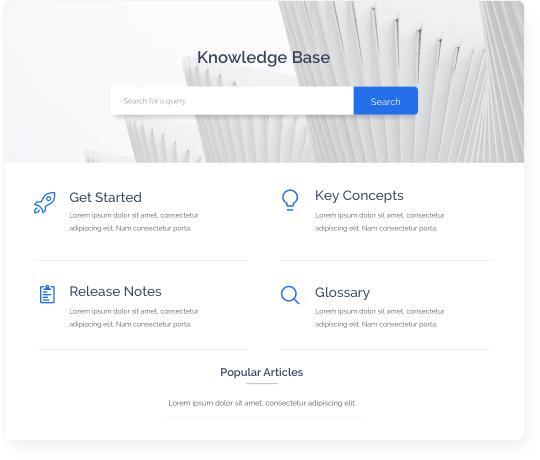
You can create either a private database for your employees or a public knowledge management that is accessible to all your customers. Standard features include information centralization, unlimited editing, content authorization, cross-device compatibility, and more.
ProProfs offers three plans:
You can also try one of the paid plans for free for 15 days. The Premium plan allows you to create an unlimited number of public or private databases and offers advanced features such as the API, white label, etc.

Helpjuice is a knowledge management builder that helps you organize your corporate wiki into a single centralized center. It allows you to collect, organize, access, and communicate information to a specific audience, including your staff and customers.
It offers dozens of custom themes and editing tools that allow you to personalize your content. Other features include unlimited content formatting, easy article creation, SEO optimization, article history restoration, and more.
Helpjuice also allows you to create separate privacy settings. You can create internal knowledge management for your team, as well as a public base for answering questions from your customers.
Helpjuice offers four pricing plans:
All plans come with a 14-day free trial, expert personalization support, and customer service.

Guru is a knowledge management platform that helps you organize your business information and access it from anywhere. It acts like a corporate wiki that stores and provides all the necessary information at the click of a button.
In addition to managing knowledge management, it also creates a business intelligence network. Guru's unique “Capture” feature allows you to capture all relevant information from Google Docs, Slack threads, your business application, and more.
It also uses AI to suggest information to avoid manually looking for information. The system based on machine learning and AI also improves its functions over time according to your daily workflow.
The tool also comes with verification flow and browser extension features to ensure team members have access to the right information at the right time.
Guru is offered with three pricing plans:
All paid plans offer a 30-day free trial. Standard features include a browser extension, Slack app integration, verification, unified search, comment function, public maps, and more.
Knowledge management software is a tool used by organizations to create knowledge management to solve customer questions. These tools also help you organize documents, frequently asked questions, tutorials, and other information in compatible formats.
A knowledge management is a form of online library where users can find all of their answers. All you need to do is provide documentation, answers to questions, guides, etc. to integrate this automated system.
Users can then do a quick search and get answers to the questions they want. You can restrict their access to company staff, a group of customers, or the general public.
Here are some of the benefits of a knowledge management tool:
Here are some standard features that you should consider when choosing a knowledge management system:
Your customers want quick information, which is why your knowledge management should have a search engine that is easy to use. The target audience should be able to find answers to their questions quickly after entering the desired keywords.
It should also be as effective in providing accurate results, even if the user enters one or two misspelled words.
You need to choose a tool that is easy to use, both for your users and for yourself. A simple dashboard will allow you to easily manage and edit hundreds of articles or guides. This, in turn, will help you create engaging content for your users.
Choose software that allows you to gather customer feedback and determine key parameters, such as which item performs best. This information will help you to constantly update your information in order to provide better customer service.
The tool should also identify things like the number of views per document or article and search results. Additionally, it should allow integration with Google Analytics and others data visualization tools for more detailed reports.
All knowledge management platforms should offer tools that allow information to be properly organized and easy to navigate. You need to be able to divide your data into categories and folders to make it easily accessible to everyone.
Organizing everything will also help you keep track of and update articles regularly.
Choose knowledge management software that has backup options to ensure that your data never gets lost. It will also help you access past articles if needed and current information for future use.
Your knowledge management platform should be able to create knowledge bases and manuals adapted to SEO. Standard SEO features include mobile-optimized pages, high search engine rankings, optimized titles and meta tags, and more.
Other critical features include automation, content management, reporting and analysis functions, social media integration, and more.
Customers typically look for self-service options and FAQs and prefer to find answers themselves rather than other means of customer support.
The self-help option is expected to grow in popularity in the coming years. According to Gartner, One billion service tickets could be created automatically by customer-owned bots by 2030.
well-structured knowledge management also reduces the number of support tickets and can help your visitors search for answers on their own.
Consider these platforms if you want to create knowledge bases and tutorials for a better user experience:
These knowledge management solutions are suitable for all types of businesses, including SaaS start-ups, large businesses, small businesses, and more.





%252520(1).avif)

.avif)